

Er. Prabhat Kishore
Examinations have long been a major source of anxiety for students and their families. Across age groups, but especially among adolescents preparing for board examinations or competitive entrance tests, academic pressure often becomes overwhelming. Expectations from parents, comparison with peers, fear of failure, and societal definitions of “success” combine to create an environment where stress, anxiety, and even depression are increasingly common. In many cases, examinations are perceived not as an assessment of learning, but as a decisive judgment on a student’s worth and future. This distorted perception has had serious consequences for mental health.
It is against this backdrop that Pariksha Pe Charcha (PPC) emerged as a transformative national initiative. Launched by the Hon’ble Prime Minister on 16 February 2018 at Talkatora Stadium in New Delhi, PPC was conceived to fundamentally change the way examinations are viewed in India. Rather than treating exams as a burden or a source of fear, the programme encourages students to see them as a natural part of life and learning—an Utsav, not a crisis.
Pariksha Pe Charcha is the Prime Minister’s annual interactive dialogue with students, teachers, and parents from across the country and even abroad. Through direct interaction, he addresses questions related to exam preparation, stress management, career choices, self-confidence, discipline, and personal growth. What makes PPC unique is its human and empathetic tone. Instead of preaching or prescribing rigid formulas, the Prime Minister speaks as a mentor, helping students reflect on their inner strengths, priorities, and aspirations.
Over the years, PPC has evolved into what can be described as a national masterclass on handling examinations and life pressures. It creates space for honest conversations on fear, failure, expectations, and purpose. The programme consistently emphasises that marks do not define a student’s intelligence or potential. Success, as repeatedly highlighted, is multidimensional and deeply personal. This message is particularly important in a society where academic performance is often linked to social status and family honour.
The phenomenal growth of Pariksha Pe Charcha since its inception reflects its deep resonance with students and educators. The first edition in February 2018 saw around 22,000 participants. The second edition in January 2019 witnessed participation from over 1.03 lakh individuals. By the third edition in January 2020, registrations had increased to 2.63 lakh. During the COVID-19 pandemic, the fourth edition in April 2021 was held virtually and recorded an unprecedented 14.02 lakh registrations, including 10.5 lakh students, 2.6 lakh teachers, and 92,000 parents.
The momentum continued in subsequent years. The fifth edition in April 2022 recorded 15.73 lakh registrations, while the sixth edition in January 2023 saw 38.79 lakh registrations, including over 31 lakh students. The seventh edition in January 2024 marked a historic milestone with 2.26 crore registrations, including more than 2.05 crore students. The eighth edition in February 2025 surpassed all previous records, registering over 3.56 crore participants.
In 2025, PPC 8.0 achieved a remarkable global distinction by entering the Guinness World Records. Students from 245 countries, teachers from 153 countries, and parents from 149 countries participated in the event. This global participation highlights that exam stress is not an Indian phenomenon alone. It is a universal challenge, and India’s approach to addressing it has begun to inspire the world.
What truly sets Pariksha Pe Charcha apart is its focus on transforming stress into positive energy. By addressing real questions from students and offering practical, relatable solutions, the programme bridges the gap between educational policy and lived experience. Its inclusivity, digital outreach, and interactive format ensure that students from diverse socio-economic backgrounds feel heard and supported. With each edition, PPC reinforces a powerful message—that examinations are not the end of life, but one of its many beginnings.
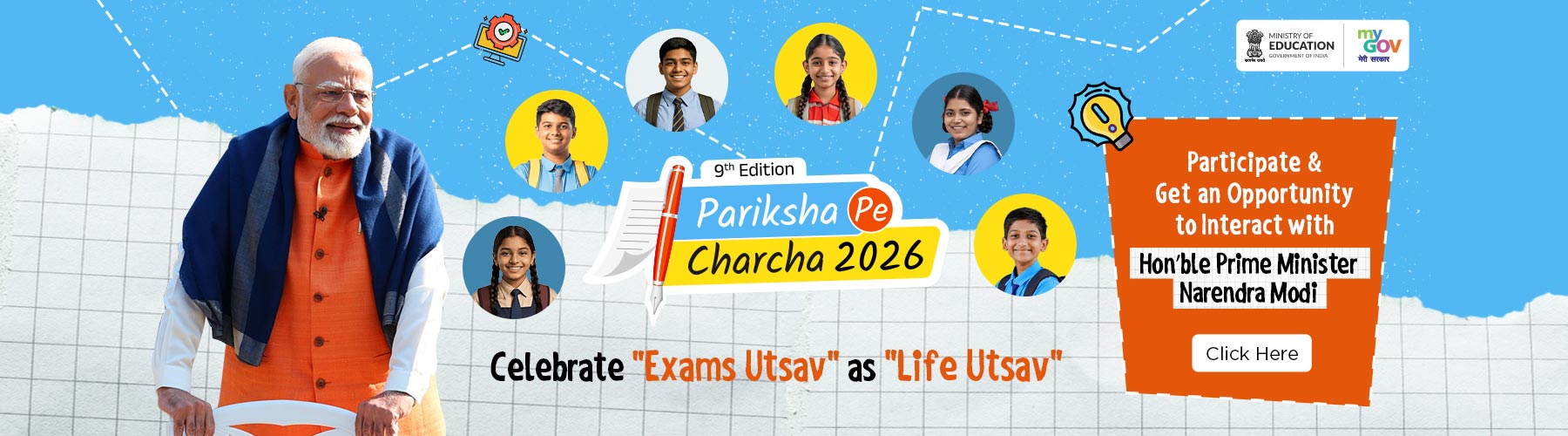
The ninth edition of Pariksha Pe Charcha is scheduled for January 2026. To select participants, an online Multiple Choice Question (MCQ) competition is being conducted on the MyGov portal from 1 December 2025 to 11 January 2026. Students from classes 6 to 12, teachers, and parents are eligible to participate. The programme includes students from all types of schools, including government schools, Kendriya Vidyalayas, Sainik Schools, Eklavya Model Residential Schools, and CBSE-affiliated institutions.
The registration process is simple and free of cost. Participants can register using a mobile number, email ID, or DigiLocker credentials through the MyGov platform. After registration, participants answer five MCQs and may also frame questions for the Prime Minister on topics such as life skills, exam preparation, stress management, and career guidance, within a prescribed character limit.
Participation in PPC is not merely symbolic. Selected questions, shortlisted by NCERT, are featured during the programme. Selected students get the rare opportunity to interact directly with the Prime Minister. All participants receive a certificate of participation. Additionally, 2,500 participants receive a PPC kit from the Ministry of Education, and ten “Exam Warriors” are given the opportunity to visit the Prime Minister’s residence.
States with high enrolment are encouraged to ensure registration of at least 50 per cent of students from classes 6 to 12, while other States, Union Territories, and Autonomous Bodies are urged to aim for 100 per cent registration. Teachers of classes 6 to 12 are also expected to actively participate, reinforcing the idea that managing exam stress is a collective responsibility.
Pariksha Pe Charcha reminds us that education is not merely about competition, ranks, or scores. It is about growth, resilience, and self-discovery. For this vision to succeed, society, families, and teachers must work together to place examinations in the right perspective. Exams should test learning, not threaten life. They should motivate effort, not induce fear.
As envisioned by the Hon’ble Prime Minister, Pariksha Pe Charcha is an invitation to celebrate the Utsav of examinations. By embracing this spirit, India can nurture confident, emotionally strong, and balanced learners—future nation builders who view challenges not as obstacles, but as opportunities.
(The author is a technocrat and educationist.)

Comments are closed.