

Irfan Ahmad Shah
The Himalaya ‘Roof of the World’ one of the most astounding physical features on the surface of the earth, is well known for its diverse landscapes and aesthetic, cultural, biological and hydrological values. It has witnessed a series of changes in its geomorphology, climate and biota since its origin during Cretaceous-Oligocene periods (Vishnu-Mittre, 1984). The great mountain chain covers about 13% of geographical area in India north-west and passes through Pakistan, Indian Kashmir, Himachal Pradesh, Garhwal, Kumaon, Sikkim and Arunachal Pradesh (Ahluwalia and Gerner, 1985).
The north-western Himalaya generally represent the Himalayan tract from Kumaon in Uttar Pradesh to Chitral in Gilgit, The state of Jammu and Kashmir (J&K) and Himachal Pradesh (H.P) .The Himalayan ranges situated in this region exhibit a diverse climate, topography, vegetation, ecology and land use pattern. The annual average rainfall varies from 80 mm in Ladakh to over 200 cm in some parts of Himachal Pradesh and Uttar Pradesh. The outer hills or ‘Siwaliks’ support scrub vegetation and the climate are subtropical with harsh summers. The middle hills are the true temperate regions and support predominantly temperate vegetation. Agricultural activity only occurs below 2,000 meters, after which land becomes agriculturally unproductive and rugged. Given these conditions livestock rearing plays a major role in the local socioeconomic. Above the middle Himalayas lie the cold, arid deserts of Lahul, Spiti, and Ladakh. In this region the cultivation of fodders is restricted to the lower hills. Beyond this zone, the cultivation of fodder is not practical because of adverse climatic and the land constraints. Almost all the available cultivable land, which is around 10% of the total geographical area, is used for the cultivation of cereals, pulses and oil seeds.
The distribution of grasses is primarily governed by climatic factors, chiefly by latitudinal influence followed by altitude and topography, particularly the soil moisture relationship. The Indian Council of Agricultural Research conducted grassland surveys and classified the grass cover of India into five major types (Dibadghao & Shankarnarayan 1973):
Sehima-Dichanthium type, Dichanthium-Cenchrus-Lasiurus type, Phragmites-Saccharum-Imperata type, Themeda-Arundinella type, and Temperate Alpine type. In the North-West Himalayan region, Themeda-Arundinella and Temperate Alpine type grasslands are found.
-
a) Themeda-Arundinella type
This grass cover occurs in the entire northern and north western mountain tract, on an area of approx. 230,000 km2 in the north-eastern states, West Bengal, Uttar Pradesh, Punjab, Haryana, Himachal Pradesh and Jammu and Kashmir. In the west, this type is found approximately between 29° and 37°N, and between 73° and 81°E, and in the east approximately between 22° and 28.5°N, and 88° and 97°E. This type is associated with undifferentiated forest and hill soils, and also with undifferentiated forest sub-mountain regional soils. The principal species of this grass cover are represented by Arundinella benghalensis, A. nepaolensis, Bothriochloa intermedia, Chrysopogon fulvus, Cymbopogon jwarancusa, Cynodon dactylon, Heteropogon contortus, Themeda anathera, Euloliopsis binata, Ischaemum barbatum. Associated perennial species are: Apluda mutica, Arundinella khaseana, Pennisetum flaccidum, Chloris, Desmostachya, etc.
-
b) Temperate Alpine type
This cover type occurs on the high hills of Uttarakhand, Jammu and Kashmir, Himachal Pradesh, West Bengal and North-eastern regions. The tract lies approximately between 29° and 37°N, and between 73° and 81°E in the western part of the country. On eastern side, it is situated approx. between 27° and 29.5°N, and 88° and 97°E. It essentially occurs at higher elevation, beyond timberline, approximately above 3,000 m in the west and above 2,000 m in the east. The principal perennial species are: Agropyron conaliculatum, Chrysopogon gryllus, Dactylis glomerata, Danthonia cachemyriana, Phleum alpinum, Carex nubigena, Poa pratensis, and Stipa concinna. Associated species are: Poa alpina, Festuca lucida, Eragrostis nigra, Bromus ramosus, etc.
Table 1 Grass species for different Agroclimatic zones North-West Himalaya
Zone |
Species |
Sub-tropical 300-1800 m |
Setaria anceps, Panicum maximum, Napier bajra hybrids, Pennisetum orientale |
Temperate 1800-3200 m |
Dactylis glomerata, Bromus spp., Phleum pratense |
Alpine zone (above 3200 m) |
Agropyron spp. Medicago spp.Poa bulbosum, Agrostis stolonifera and Onobrychis vicifolia |
Source: Katoch et al., 1992
Degradation in Carrying Capacity
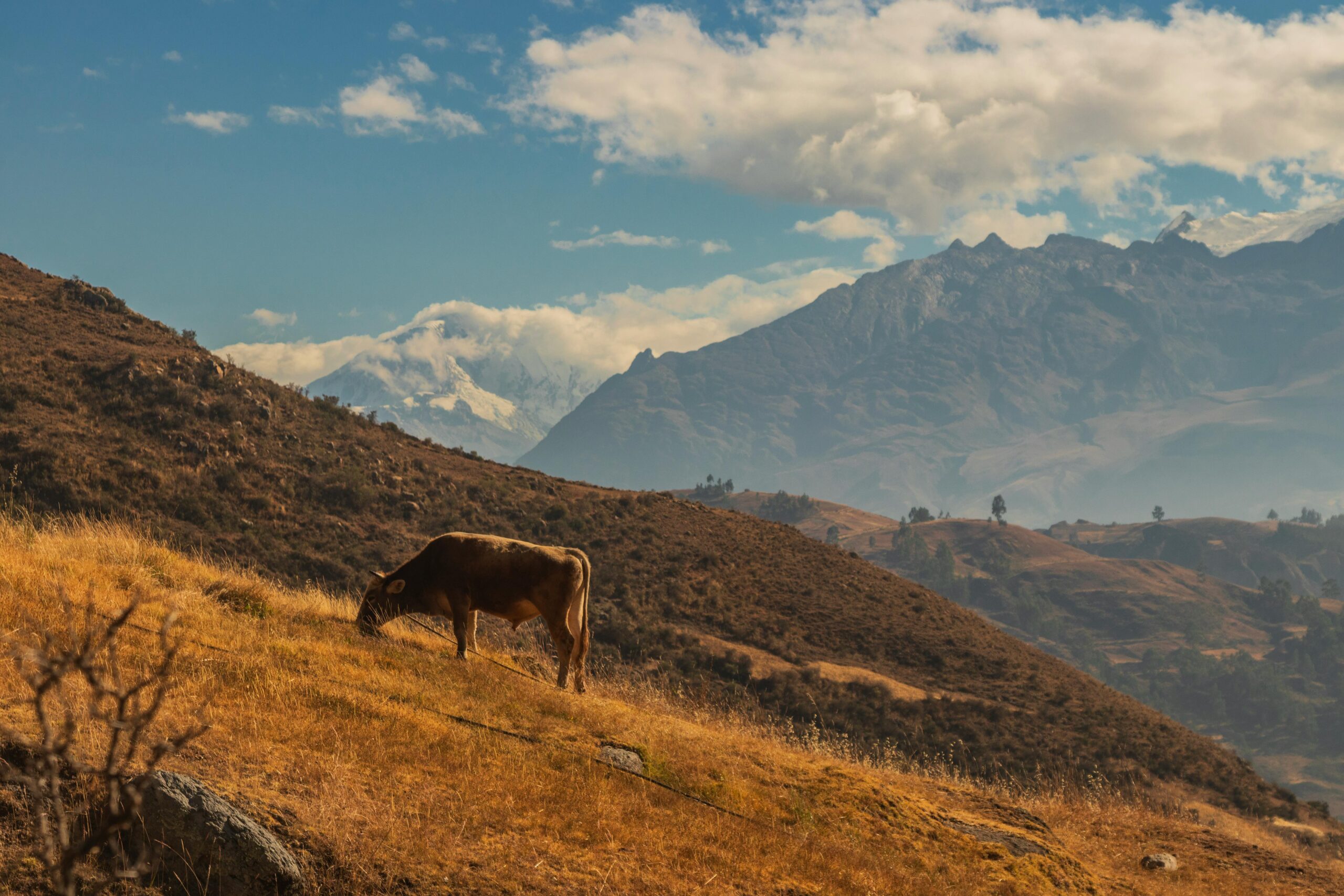
Nomadic graziers (Khadwals, Gaddis, Gujjars, khas) use sub-alpine and alpine pastures for rearing their livestock. Due to ever-increasing demand of animal products, the livestock population has increased manifold, thereby increasing the grazing pressure on these pastures. This has resulted in the deterioration of the grass cover as well as valuable forest species. As a result of this a significant area of this natural resource has been covered by noxious plant species like Aconitum, Anemone, Adonis, Aquilegia, Cincifuga, Clematis, Lepidium, Artimisia, Ranunclus, StipaSorbinia and Sambucus (Misri, 1988). All these factors have led to the decrease in carrying capacity of these pastures. In the North-Western part of India, the high altitude sub-alpine and alpine pastures are grazed during the short summer by migratory herds who depend on other grazing resources the rest of the year—a period as long as eight month. These pastures are known by a variety of names throughout the north-western Himalayas. Called Margs, Bahaks or Dhoks in the Jammu and Kashmir regions, such grasslands are known as Thach or Bhugiyals in Himachal Pradesh.
The Himalayan forage resource base has undergone a considerable neglect at the hands of researchers, planners and the development agencies. Misri (2003) studied the biomass availability of some of the representative pastures of Kashmir Himalaya and found that green herbage availability varied from 4.7 to 29.1 t/ha. In Himachal Pradesh the green herbage availability varied from 1.5 to 1.74 t/ha in temperate pastures and 0.5 to 1.0 t/ha in alpine and sub-alpine pastures (Singh, 2005). Ram and Singh (2006) observed that biomass availability varied from 1.62 to 3.96 t/ha (green herbage) in Himalayan pasture of Uttar Pradesh. Tincheng and Yuangang (2004) reported the stocking capacity of central Himalayan pastures between 0.4 and 13.3 sheep/ha/annum under natural vegetation in alpine steppe, meadows and alpine meadows. In cold and temperate grasslands of semi-natural grasslands the stocking capacity varied from 0.6 to 1.9sheep/ha/annum. Melkania and Singh (2005) have estimated that net above ground biomass varied from 279 to 1568 gm-2 for low elevation Himalaya, 219 to 285 gm-2 for mid elevation Himalaya and 233-372 gm-2 for high elevation Himalaya. Forage cultivation is restricted to only about one per cent of the cultivated area in the entire Himalayan region. This is basically because of the preponderance of marginal and small land holdings in the area. Besides grazing and fodder trees, the major local forage resource is the crop residue, which again is too inadequate to sustain the livestock. In the state like Himachal Pradesh there exists a gap of about 35.0 and 57.0% from dry and green forages, respectively. Every year on an average about 7450 t of wheat straw is imported annually from the neighbouring states. (Vashist et al., 2000).
The N-W Himalayan region is presently under heavy stress on account of a large-scale exploitation for fuel wood, timber and fodder, mismanagement of forest resources and frequent fires (Khosla and Toky, 1985). There is acute shortage of fodder especially green nutritious fodder, which is the major cause of low productivity of the livestock, especially in hilly area (Deb Roy et al., 1989). The main reasons for low productivity is insufficient and low quality fodder and feed including grazing facilities (Deb Roy, 1993). The shortage of fodder supply in the Himalayan region is attributed to some of the following reasons.
-
Uncontrolled grazing
Grazing pattern of Himalayan tract clearly indicates a heavy grazing pressure on pasture. This has led to a decline in biomass availability. All the three vertical divisions of the Himalaya are under heavy and indiscriminate grazing. The outer hills are used for the grazing of local livestock and migratory livestock graze here for about six months. The mid-hill grasslands are protected only for about two to three months during monsoon and are grazed during rest of the year. Sub-alpine and alpine pastures of higher Himalaya are grazed from April to October, which is the active period for growth of vegetation during rest of the year these are covered with snow. The edible species do not get time to grow, set seed and proliferate. Excessive and continuous grazing has severely damaged these lands. The herbage species found in these lands represent the third or fourth stage of degradation.
-
Decrease in Genetic Potential
Grasslands are extremely important environmentally as a major form of vegetation, and play a vital role for animal production, soil erosion control and carbon sequestration; they are a major reserve of biodiversity, a cheap and safe form of in situ conservation of genetic resources, and important wildlife habitat. There is continuing genetic erosion of forage species due to agricultural and urban encroachment and unsustainable grassland management, which has dramatic consequences at country and global level, given the role that these species could play for further generations. Since pasture crops are still in the process of domestication, natural grasslands are a major source of genetic material for breeding programmes. These grasslands are often maintained by pastoral societies who may have no involvement with the varieties bred from that material. Conservation programmes should be clearly focussed on preserving the many multi-functional characteristics of the different species. The chief cause of loss of genetic diversity has been poor grassland management, overgrazing, and spread of modern, commercial agriculture. The consequence of the introduction of new cultivars of crops and forages has been the replacement and loss of highly variable pastoral ecotypes and natural cultivars (FAO, 2006).
-
Weed infestation
Due to high grazing pressure and little time for regeneration many edible species of grasses have vanished. Weeds such as Stipa, Sambucus,Aconitum,Cincifuga, Adonis, Sibbaldia, Rumex have heavily infested these areas (Misri,2004).
-
Soil Erosion
Grasslands are highly susceptible to soil erosion due to steep slopes and having very few trees to act as wind breaks and binds soil firmly, therefore both wind and water act as agents of erosion leads to removal of fertile soil leads to decrease in soil fertility of the grassland.
-
Nutrient Deficiency
Not a hint of the natural grasslands in sub – temperate, temperate and sub-alpine regions of N-W Himalaya are fertilized in any form except dung and urine addition by the grazing animals. This leads to continuous depletion of plant nutrients resulting in the poor growth of plant-species and effect in carrying capacity.
Improvement strategies in N-W Himalayan Grasslands
Efforts should be made to increase overall forage availability by introducing some of the advanced technologies whose adoption could lead to a substantial increase in availability of fodder in the region. The number of areas under fodder cultivation and agro forestry system increased will greatly reduce rangeland pressure. The following are some of the improvement strategies:
Grass/legume introduction
Beginning of improved grass/legume species in the native vegetation not only helps in increasing total biomass production but also improve the quantity of the produce. However, the introduction of improved species in the existing vegetation particularly with seed is not an easy task, unless initial competition from the native vegetation is checked by some means. In view of sloppy terrain in hill soil work may lead to soil and nutrients losses. However, the sod killing herbicides like paraquat has shown good results. The Introduction of Siratro after paraquat spray in 15-cm bands @ 0.6 L/ha was found to be the best method of introduction of Siratro in the existing vegetation. It increased fresh forage yield. (Sood and Singh,1986).
Fertilization
Nitrogen @ 40 and 80 kg ha-1 was applied as basal and two splits (onset of monsoon and 45 days after first dose) in the natural grassland. Forage yield increased significantly with the increase in nitrogen to the level of 80 kg. Two splits were significantly superior to single application (Singh, 1995).
Cutting and grazing
Generally, uncontrolled and continuous grazing is prevalent in most of the grasslands throughout the north-western Himalayas. Though rotational system of grazing gives better results but it is not so easy to adopt it on large scale in hilly situations. The most desirable system of grazing would be that of periodic or deferred grazing by limiting the number of livestock on the basis of carrying capacity of grasslands. This system would give a better chance for self-seeding and stand recovery (Singh, 1995).
Forage Production on Terrace Riser/Bunds
A non-competitive land use system for the forage production in the hills is to grow improved grasses on terrace bunds and risers. There is added advantage to produce forge without any fertilizer or manure since it is available from the cropped terrace (Singh, 1995).
Hortipastoral System
There is considerable area under orchards in temperate regions. Inter spaces between fruit trees could be utilized for the production of fodder by growing perennial grasses and legumes depending upon the topography, age of the trees and spacing etc. The cultivation of legumes would be more desirable because of their nitrogen fixing ability (Misri, 1997).
Conclusion
It may be concluded that the forage production situation in the region is very alarming and corrective measures have to be taken to improve the same. Demarcation of the area for various agricultural activities should be created and adhered under legislation. A comprehensive grazing policy needs to be formulated for the entire zone. Both grazing and forage cultivation has to be considered complementary to each other and simultaneous efforts are required to improve the both. In order to improve the grasslands, the grassland management needs to be considered holistically promoting the interaction between grassland, livestock and the grazing communities, so that this vast natural resource can serve human society substantially, more particularly grazing communities of the region.
Future Thrust
Forage production must be taken up as a first management goal and 25% of the forest area should be put under trees with regulated accessibility to the farmers.
-
Growing forage grasses and fodder trees along village roads and panchayat lands
-
Growing forage grasses and fodder trees on terrace risers/bunds- a non competitive land use system
-
Conservation of native biodiversity for future improvement
-
Breeding biotic, abiotic, stress tolerant cultivars of forage species suitable for area not used under arable agriculture
-
Participatory techniques to be adopted to identify the problems and to carry out the improvement programme
-
In-depth studies on migratory graziers
-
Forage based agro forestry systems
-
Controlled grazing to maintain the productivity of pasture (grazing should be allowed as per carrying capacity).

Comments are closed.