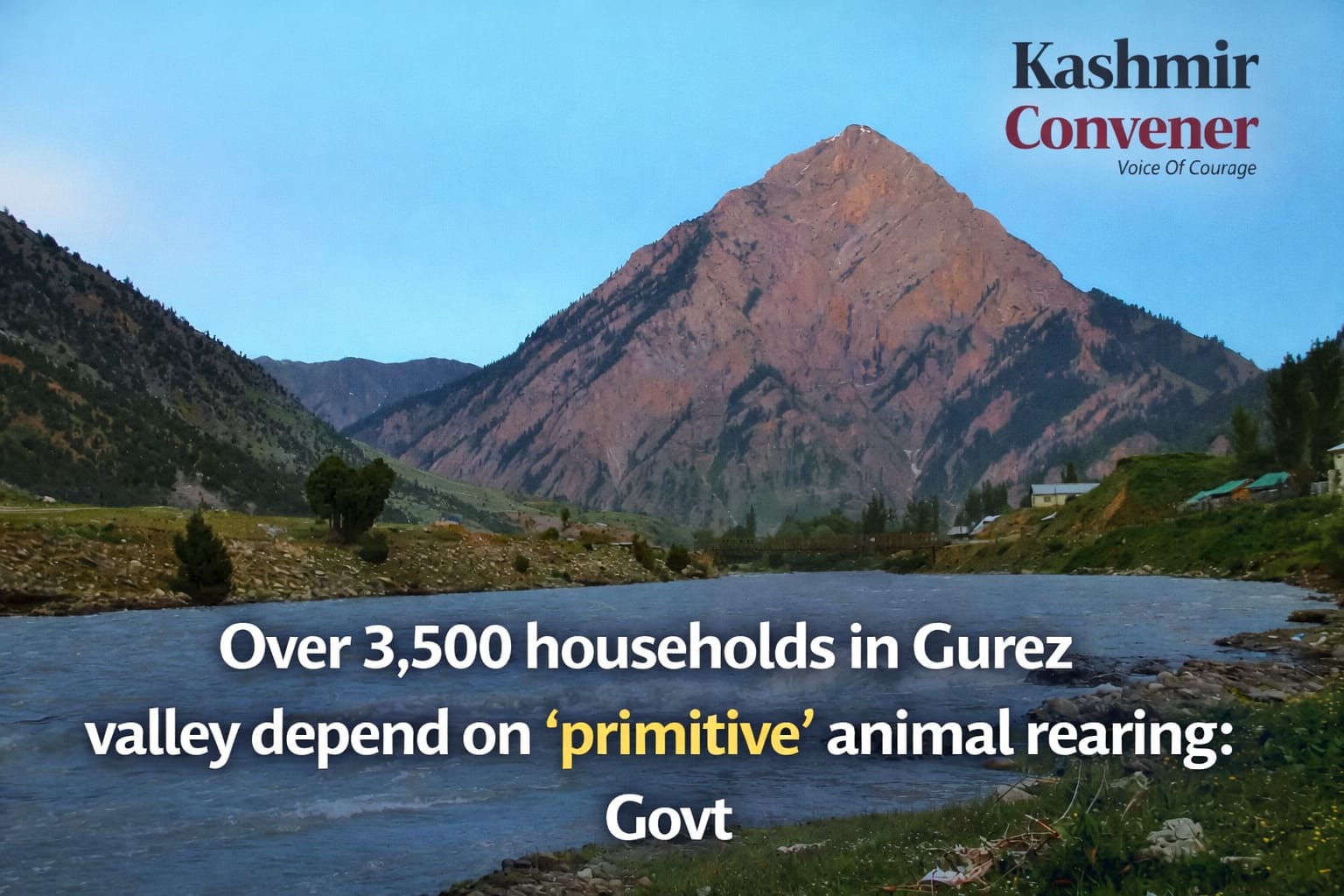
Jammu, Feb 11 : The Jammu and Kashmir government on Wednesday informed the Legislative Assembly that animal rearing in the remote Gurez Valley of north Kashmir’s Bandipora district continues to be practiced through “centuries old primitive methods,” with over 3,500 households dependent on a modest livestock population for their primary livelihood.
In a written reply to a question by legislator Nazir Ahmad Khan, the Minister Incharge of Agriculture Production, Rural Development & Panchayati Raj as per Kashmir Convener said the economy of the high-altitude Gurez subdivision remains “predominantly agrarian” due to severe geographical isolation, especially during winter.
The government’s data, citing the 20th Livestock Census, revealed a stark contrast: while 3,512 households are engaged in livestock rearing, the total animal population in the subdivision stands at only 2,598 — indicating an average holding of less than one animal per household.
Officials acknowledged that traditional practices in Gurez and Tulail are “shaped over centuries by the region’s unique geography, harsh climate, and limited accessibility.” They described the system of seasonal migration and stall-feeding as a “practical and ecological adaptation” to the challenging environment.
Detailing a push to modernise the sector, the Animal Husbandry Department as per Kahsmir Convener outlined a multi-pronged strategy including free mass vaccination, artificial insemination services, breed conservation of the indigenous Gurezi sheep, and the promotion of livelihood schemes such as subsidised livestock units and modern shearing equipment for wool.
The government stressed that all new interventions are being implemented “without disturbing the local ecological balance,” aiming to gradually shift animal rearing from subsistence to a more scientific and economically viable activity the reply further reads.



Comments are closed.