

Mir Gowhar
“The digital age has empowered ordinary citizens, but it has also blurred a critical line—owning a camera or a social media account does not make one a journalist.”
We live in an age where information moves at lightning speed. The digital revolution and the rise of social media platforms have transformed how news is consumed and shared. Today, almost anyone with a smartphone and internet access can record an event, voice an opinion, or highlight a public issue within seconds.
This democratization of information has, in many ways, empowered ordinary citizens and amplified voices that were earlier ignored. However, it has also created a growing confusion between journalism and social media activity—particularly evident in regions like Kashmir.
In recent years, a noticeable trend has emerged where many social media users begin identifying themselves as journalists simply because they upload videos, photos, or short updates from their localities. While citizen participation in public discourse is both welcome and necessary in a democracy, it is crucial to understand that journalism is not defined by owning a camera or having followers on social media.
The act of posting content does not automatically make one a journalist.
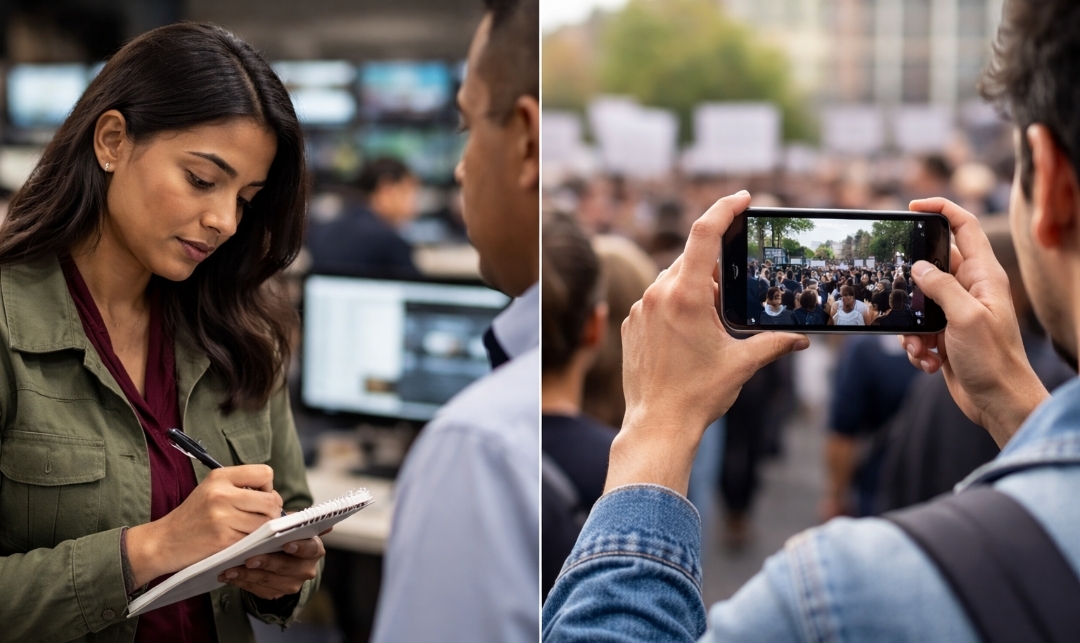
There is a fundamental difference between a trained journalist and a social media influencer, even if both appear to be sharing “news.” Journalism is a profession grounded in responsibility, ethics, verification, and accountability.
A journalist is trained to verify facts, cross-check sources, understand the broader context of an issue, and present information in a balanced and fair manner. Every report carries consequences, and professional journalists are aware of the social, political, and legal implications of what they publish.
In contrast, much of the content circulated on social media lacks editorial discipline.
Many self-proclaimed journalists operate without any formal training in media ethics, reporting standards, or fact-checking. As a result, captions are often poorly framed, information remains incomplete or misleading, and sensationalism frequently takes precedence over accuracy. In the race for likes, views, and viral reach, truth often becomes a casualty.
This is not an argument against social media users or digital content creators. Social media has played an important role in highlighting grassroots issues, exposing injustices, and providing platforms for alternative voices. Citizens have every right to express opinions, document events, and raise concerns affecting their lives.
However, problems arise when individuals misrepresent themselves as journalists without the necessary knowledge, training, or understanding of the profession.
Such misrepresentation ultimately weakens the credibility of journalism itself. Unfortunately, the general public often fails to differentiate between professional journalism and casual content creation, leading to the dangerous assumption that every person holding a microphone or camera is a journalist. This confusion not only undermines trained reporters but also erodes public trust in the media.
In an era flooded with information, misinformation, and half-truths, responsible journalism matters more than ever. Journalism is not about instant reactions or personal popularity; it is about public service, truth, and accountability. Respecting the profession means recognizing its seriousness and the discipline it demands.
Social media can complement journalism and act as a tool to support it—but it can never replace the principles, ethics, and responsibility that define true journalism.

Comments are closed.