

Convener News Desk
New Delhi, Jan 28: The Union Ministry of Environment, Forest and Climate Change has notified the Solid Waste Management (SWM) Rules, 2026, replacing the Solid Waste Management Rules, 2016. Issued under the Environment (Protection) Act, 1986, the new rules will come into full force from April 1, 2026, marking a significant overhaul of India’s waste governance framework with a strong emphasis on source segregation, accountability and environmental compliance.
The revised rules incorporate principles of the Circular Economy and Extended Producer Responsibility (EPR), while introducing stringent provisions for environmental compensation based on the Polluter Pays principle. Violations such as operating without registration, false reporting, submission of forged documents and improper waste handling will attract penalties. The Central Pollution Control Board (CPCB) will frame guidelines, while State Pollution Control Boards (SPCBs) and Pollution Control Committees (PCCs) will be responsible for levying compensation.
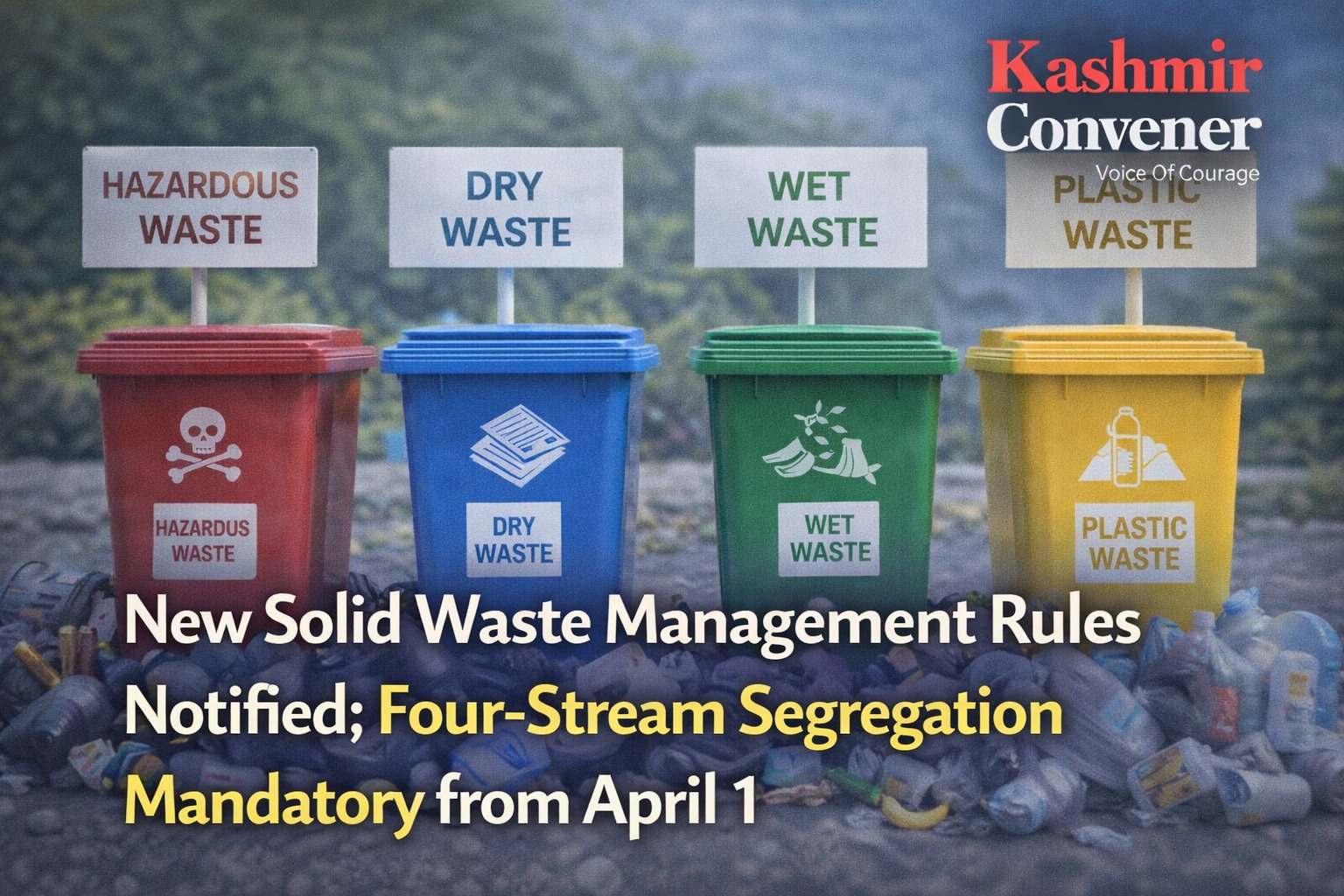
Under the SWM Rules, 2026, four-stream segregation of waste at source has been made compulsory across urban and rural areas. Waste must now be segregated into wet waste, dry waste, sanitary waste and special care waste.
Wet waste—such as kitchen waste, vegetable and fruit peels, meat and flowers—must be composted or processed through bio-methanation at the nearest facility. Dry waste, including plastic, paper, metal, glass, wood and rubber, will be routed to Material Recovery Facilities (MRFs) for sorting and recycling. Sanitary waste like diapers and sanitary napkins must be securely wrapped and stored separately, while special care waste such as paint cans, bulbs, mercury thermometers and expired medicines will be handled by authorised agencies or deposited at designated centres.
The rules clearly define Bulk Waste Generators (BWGs) as entities with a floor area of 20,000 square metres or more, water consumption of 40,000 litres per day or more, or waste generation of 100 kg per day or more. These include government departments, PSUs, institutions, commercial establishments and residential societies.
Bulk Waste Generators have been mandated to ensure environmentally sound collection, transportation and processing of the waste they generate. A new framework of Extended Bulk Waste Generator Responsibility (EBWGR) has been introduced, making BWGs directly accountable for nearly 30 per cent of total solid waste generation. Wet waste is to be processed on-site wherever feasible, or through certification under EBWGR norms.
To improve transparency and efficiency, the rules provide for a centralised online portal to monitor the entire solid waste management chain—from generation and collection to processing, disposal and remediation of legacy dumpsites. All registrations, authorisations and reporting by waste processing facilities will be conducted online, replacing physical submissions. Mandatory audits of processing facilities and landfills will also be uploaded on the portal.
The rules also introduce graded buffer zone norms for waste processing facilities with capacities exceeding five tonnes per day, aimed at facilitating faster land allocation by States and Union Territories.
Urban local bodies have been entrusted with the responsibility of collection, segregation and transportation of waste, in coordination with Material Recovery Facilities, which have now been formally recognised. MRFs may also act as deposition points for e-waste, sanitary waste and special care waste.
Local bodies have been encouraged to generate carbon credits, while special focus has been laid on peri-urban and rural areas, particularly in sanitation planning.
The rules mandate industries such as cement plants and waste-to-energy units to increasingly substitute conventional solid fuels with Refuse Derived Fuel (RDF). The fuel substitution rate will be progressively increased from 5 per cent to 15 per cent over six years, promoting waste-to-energy solutions and reducing landfill dependence.
Landfilling has been strictly restricted to non-recyclable, non-energy recoverable and inert waste. Higher landfill fees have been prescribed for unsegregated waste to discourage poor compliance. Annual audits of landfills will be conducted by SPCBs, with oversight by District Collectors.
The rules also mandate time-bound biomining and bioremediation of all legacy waste dumpsites, with quarterly progress reports to be submitted through the online portal.
Recognising ecological sensitivities, special provisions have been introduced for hilly regions and islands, including the levy of user fees on tourists, regulation of tourist inflow based on waste handling capacity, and establishment of designated collection points for non-biodegradable waste. Hotels and restaurants in such areas will be required to undertake decentralised wet waste processing.
To ensure effective implementation, the rules provide for Central and State-level Committees, with State-level committees to be chaired by the Chief Secretary or UT Administrator, tasked with recommending measures to the CPCB.
The notification of the SWM Rules, 2026 marks a decisive shift towards accountability-driven, technology-enabled and environmentally sustainable waste management across the country. (PIB)

Comments are closed.