

Muntazir Muneer
“NEP 2020 is not merely a policy document; it represents a paradigm shift in India’s educational thinking by placing learners at the centre, restoring the dignity of teachers, and aligning school education with the demands of the 21st century.”
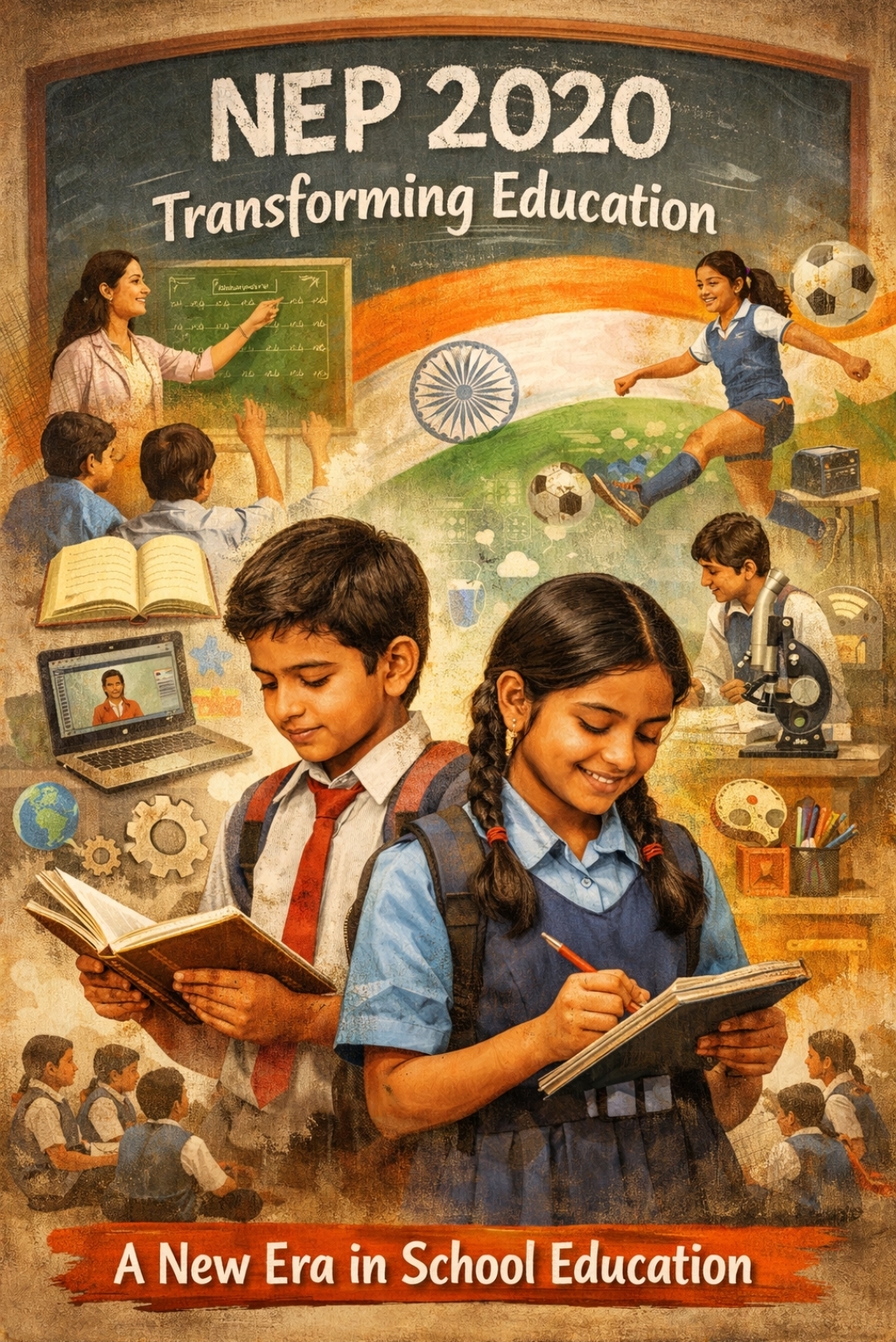
Education remains the most powerful instrument for shaping the destiny of a nation. It determines not only economic progress but also social harmony, democratic values, and national character. With this foundational belief, India introduced the National Education Policy (NEP) 2020—a visionary, forward-looking, and transformative framework that marks a decisive break from decades-old practices. More than a policy document, NEP 2020 represents a paradigm shift in educational thinking—placing learners at the center, restoring the dignity of teachers, and aligning school education with the evolving demands of the 21st century.
After several years of implementation, the journey of NEP 2020 in the school education sector has begun yielding visible and encouraging results. While the reform process is gradual and ongoing, its impact is increasingly evident in classrooms, teaching practices, assessment methods, and community engagement across the country.
One of the most defining contributions of NEP 2020 is its clear departure from rote memorization toward conceptual clarity, critical thinking, creativity, and experiential learning. The policy recognizes that education should not merely train students to reproduce information in examinations, but prepare them to question, analyze, innovate, and solve real-life problems. Consequently, classrooms are slowly transforming from exam-centric spaces into environments of curiosity, dialogue, and discovery—where learning is engaging, participatory, and meaningful rather than mechanical or burdensome.
The renewed emphasis on Foundational Literacy and Numeracy (FLN) stands out as a cornerstone of the policy. Through initiatives such as NIPUN Bharat, NEP 2020 acknowledges a long-neglected truth—that strong foundations in reading, writing, and numeracy during the early years are indispensable for all future learning. Schools are now focusing more seriously on age-appropriate pedagogy, play-based learning, storytelling, and activity-oriented instruction in the foundational and preparatory stages. Continuous assessment mechanisms ensure early identification of learning gaps, enabling timely interventions so that no child is left behind during these formative years.
Equally significant is NEP 2020’s vision of holistic development, which seeks to nurture the intellectual, emotional, physical, social, and ethical dimensions of every learner. The introduction of multidisciplinary learning and flexibility in subject choices has expanded students’ horizons beyond rigid curricular boundaries. Arts, sports, vocational education, and life skills are no longer treated as peripheral but integrated into the mainstream curriculum. Importantly, the policy challenges the long-standing and artificial divide between “academic” and “vocational” streams, restoring dignity to skills, craftsmanship, and hands-on learning, and fostering respect for all forms of work.
Assessment reforms under NEP 2020 represent another progressive shift. By advocating competency-based, formative, and continuous evaluation, the policy aims to move away from high-stakes, memory-driven examinations that often induce stress and anxiety among learners. This evolving assessment culture focuses on understanding, application, and skill development rather than rote recall. As a result, students experience reduced academic pressure, while teachers gain deeper insights into learning outcomes, allowing for personalized instruction and targeted academic support.
At the heart of any educational transformation lies the teacher, and NEP 2020 rightly places educators at the center of reform. Recognizing that motivated and empowered teachers are key to successful implementation, the policy emphasizes continuous professional development, pedagogical autonomy, and institutional respect. Capacity-building programs, innovative training modules, and efforts to reduce non-academic administrative burdens are gradually enabling teachers to focus on their core mission—teaching, mentoring, and inspiring young minds. A confident, well-supported teacher ultimately nurtures confident and capable learners.
Equity and inclusion form the moral backbone of NEP 2020. Special emphasis on Socially and Economically Disadvantaged Groups (SEDGs), children with special needs, girls, and learners in remote or underserved areas reflects the policy’s commitment to leaving no child behind. Measures such as scholarships, digital access initiatives, localized curricula, and mother-tongue-based instruction in the early grades are helping bridge long-standing gaps in access, participation, and learning outcomes. By valuing linguistic and cultural diversity, NEP 2020 strengthens both inclusivity and national integration.
The thoughtful integration of technology in education has emerged as another important outcome of the policy. Digital platforms, online learning resources, virtual classrooms, and teacher training portals have expanded the reach of education beyond physical boundaries—particularly during times of disruption. Crucially, NEP 2020 positions technology as an enabler rather than a replacement, reinforcing the idea that digital tools must complement, not substitute, the human connection that lies at the heart of meaningful education.
Although NEP 2020 is still in its implementation phase, early indicators are promising. Improved student engagement, greater teacher enthusiasm, declining dropout rates, and increased parental and community participation suggest that the reform is moving in the right direction. However, reforms of this scale require patience, sustained political will, adequate resources, and collective ownership by governments, educators, parents, and society at large.
As the Coordinator of Education Zone Hajin, District Bandipora, I have personally witnessed the positive impact of NEP 2020 at the grassroots level. Learner-centric approaches and activity-based pedagogy introduced under the policy have significantly benefitted students. Extensive teacher training programs conducted by DIET Bandipora in collaboration with the Chief Education Office Bandipora, along with multiple capacity-building initiatives organized by SCERT Kashmir, have strengthened classroom practices and enhanced teaching effectiveness. These structured and continuous professional development efforts have produced visible, meaningful, and lasting improvements in learning outcomes.
Furthermore, as the Head of Institution (HOI) of a role model school—PCO Government Girls Middle School, Prang, Zone Hajin—I have observed a marked improvement in student learning levels across schools affiliated under my charge as PCO Head. Holding the additional responsibility of Zonal Cultural Coordinator, Hajin, has further broadened my engagement with students from diverse social and academic backgrounds, reinforcing the holistic vision of NEP 2020 in nurturing talent, creativity, cultural awareness, and social cohesion.
In essence, NEP 2020 is not merely an educational reform—it is a renaissance in Indian education. Its impact is increasingly visible in classrooms that are more inclusive, dynamic, and learner-friendly. As the policy continues its journey, it holds the promise of nurturing informed, skilled, ethical, and confident citizens capable of leading India toward a brighter, more equitable, and knowledge-driven future. With collective commitment and faithful implementation, NEP 2020 is poised to stand as a historic milestone in the evolution of India’s education system.
The author, Muntazir Muneer, is a State Awardee. He can be mailed at muntazirmuneer123@gmail.com

Comments are closed.