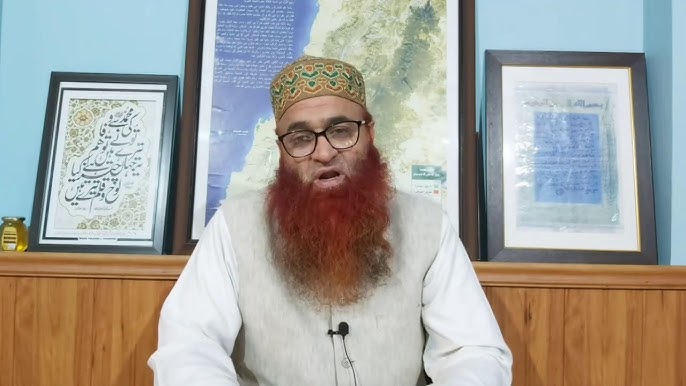
From the earliest stages of the intellectual life of Mufti Nazir Ahmad Qasmi, his writings, whether reformative or biographical, display a maturity of thought matched by an uncommon facility with language. His prose frequently transforms descriptive reflection into vivid narrative, imbuing scenes with a delicate luminosity, as though each sentence were strung like a polished bead upon a thread of eloquence.
His association with poetic literature is by no means incidental. Rather, it constitutes a central and sustained strand of his intellectual development. Among the earliest influences that shaped his literary sensibilities was the poetry of Dr Muhammad Iqbal. What began as admiration soon matured into rigorous study during his years at Darul Uloom Deoband, where he undertook a thorough reading of Iqbal’s collected works and committed substantial portions of the Kulliyāt-e-Iqbal to memory.
His engagement with Iqbal went beyond private study. While still a student, he eagerly took part in bait-bāzī (poetic competitions) centred on Iqbal’s poetry, where his literary enthusiasm and intellectual insight were widely recognised. Similarly, under the influence of Maulana Altaf Hussain Hali, he memorised a significant portion of Hali’s works. His strong interest in Iqbaliyat (Iqbal Studies) prompted him to explore the writings of notable scholars such as Maulana Abdul Salam Nadwi, Dr Khalifa Abdul Hakim, Faqir Wahiduddin, Abdul Majeed Salik, Shorish Kashmiri, and Professor Yusuf Saleem Chishti. Through these studies, he gained a deeper understanding of Iqbal’s philosophy, poetry, and intellectual outlook. This scholarly engagement helped him develop a refined understanding of Iqbal’s poetic symbolism, philosophical nuances, and intellectual visions.
In recognition of this intellectual trajectory, he selected Iqbal Studies as the principal subject for his postgraduate oral examination. The ensuing viva voce, lasting nearly three hours and conducted by three senior Urdu professors, evolved into an extended scholarly dialogue rather than a conventional examination. His interpretative insight and analytical depth were of such calibre that he confidently offered alternative readings where necessary. When the session concluded, the examiners observed that what had transpired was “not merely an assessment but an enriching academic exchange.”
His scholarly command and intellectual depth did not go unnoticed beyond the examination hall. Professor Hamidi Kashmiri, former Vice-Chancellor of the University of Kashmir, formally invited him to join the University’s esteemed Iqbal Institute, a proposal further supported by the renowned Bandipora literary figure, the late Rashid Ahmad Nazki. Yet, with characteristic grace, he declined the offer owing to his existing religious and academic commitments at the seminary.
An Intellectual Method Rooted in Classical Scholarship
His scholarly temperament reflects the classical tradition of intellectual discourse, reminiscent of early Islamic jurists, particularly Imam Abu Hanifah, who engaged specialists from various fields to refine and expand their understanding. He embraces this legacy with deliberation, conversing with experts from diverse disciplines to supplement his own research. A notable example of this method was his lecture delivered at a degree college on the life and thought of Allamah Iqbal, a talk that remains significant for its clarity, analytical depth, and literary sensitivity.
Viewed in totality, his intellectual journey stands as a distinctive testament to a rare synthesis of religious devotion, literary brilliance, and academic excellence, a combination that offers both inspiration and guidance to contemporary scholars and students of knowledge.
The Breadth of His Scholarly Output
His corpus of writing is striking in its thematic diversity, encompassing discussions on the Hajj, the Sīrah (Prophetic biography), biographical studies, jurisprudential issues and debates, lexical inquiry, social commentary, and a spectrum of contemporary concerns. Numerous scholarly, religious, reformative, intellectual and biographical essays have appeared in leading journals and periodicals, reflecting both the breadth and consistency of his intellectual engagement.
What distinguishes his writing, above all, is its simplicity, clarity, natural flow, and absence of artificiality or affectation. His prose is free from artifice and affectation; it flows with a natural elegance that renders it accessible even to readers possessing only an elementary command of Urdu. Simplicity does not detract from scholarly rigour; rather, it serves as the conduit through which complex ideas are communicated with precision and grace.
His balanced judgement and measured temperament soon earned him recognition across the Kashmir Valley. The region’s leading Urdu daily, Kashmir Uzma, established a dedicated weekly column for him entitled Kitāb-o-Sunnat se Masāil ka Ḥal (“Resolving Issues through the Book and the Sunnah”). Since 2006, the column has addressed an expansive range of inquiries — academic, social, intellectual, economic, and spiritual, with remarkable clarity and scholarly depth. The strength of his responses lies in their synthesis of authoritative Islamic sources with rational argumentation, a quality that has garnered respect from both scholars and the wider public.
Formation of Linguistic Mastery
A key influence in the refinement of his Urdu proficiency was Maulana Sayyid Ahmad Akbarabadi, former Head of the Department of Theology at Aligarh Muslim University and a distinguished disciple of Allamah Anwar Shah Kashmiri. By attending Akbarabadi’s sessions, he gained direct exposure to the linguistic precision and literary artistry that shaped the master’s scholarship.
The testimony of Dr Faiz Ghaziabadi, Professor of Urdu at GDC College Handwara, attests to this mastery. Dr Faiz Ghaziabadi writes;
“Mufti Sahib possesses a deep and natural command over the Urdu language. The first chapter of my M. Phil dissertation, being based on Qur’anic and Hadith principles, was reviewed and corrected by Mufti Sahib with the permission of my supervisor, Professor Qudoos Javed. When I later showed the revised chapter to the Professor, he was astonished and expressed a strong desire to meet Mufti Sahib. Professor Qudoos Javed remarked, ‘This person is extraordinarily capable.’ Mufti Sahib corrected around twenty orthographical and phonetic errors in Arabic and Urdu expressions.”
(Reference: “Madaris aur Urdu,” compiled by Dr Faiz Ghaziabadi)
Such testimonies solidify his standing among the relatively few scholars in Kashmir endowed with mastery over the subtleties of Urdu syntax, idiomatic finesse, and precise pronunciation.
Advocacy for Linguistic Integrity
His contribution to the discourse on Urdu language reform is substantial. A series of essays published in Kashmir Uzma drew a wide readership and is regarded as a significant contribution to contemporary Urdu scholarship. In one of his essays, he emphasised the moral and intellectual importance of linguistic accuracy. Among his notable observations is the assertion that the corruption of language, whether written or spoken, reflects a decline in personal discipline. He writes:
“Among the factors that tarnish human character is the inability to use language correctly, both in writing and speech.”
(Source: Daily Kashmir Uzma, 9 March 2014)
In another article, he underscores the responsibility of Muslims to learn, teach, and cultivate Urdu, particularly among younger generations; educational institutions, he argues, bear a special obligation to uphold and disseminate standard Urdu. He also offers a stark warning: should the present generation limit its exposure to Urdu to casual speech alone, it will, within two decades, find itself unable to read even the most basic works of religious literature, leaving the vast repositories of Islamic texts untouched on library shelves. He writes:
“It is incumbent upon every Muslim to learn and teach Urdu, and to cultivate among their children a keen interest in reading and writing it. Likewise, those who administer Muslim educational institutions must make serious and committed efforts to promote the teaching of Urdu, and that too, standard Urdu.”
For him, the cultivation of Urdu literacy is not merely a cultural preference but an ethical charge: to equip one’s children with Urdu is, in essence, to preserve a heritage, and to adorn one’s home with books of religious learning is to affirm one’s devotion. He warns:
“If today’s generation remains deprived of Urdu literacy and confines its connection to mere spoken usage at home, then within the next 15–20 years, this generation will be unable to even hold or read a religious book written in Urdu. Consequently, the libraries of Islamic literature will be left to gather dust.”
To adorn one’s children with Urdu is, in essence, a religious duty, and to enrich one’s home with religious books is an expression of Islamic zeal and love for faith.
(Source: Quarterly Urdu Academy, Vol. 1),
Special Thanks
The biographical content of this booklet about Biography Of Mufti Nazir Ahmad Qasmi Sb was provided to me in brief form by his son, Muhammad Anees. His contribution made it possible to compile this work in a meaningful and coherent manner. I extend my heartfelt and special thanks to Muhammad Anees for sharing this valuable content.
May Almighty Allah reward him abundantly, accept his service, increase him in beneficial knowledge, and grant him health, strength, and steadfastness in faith.
Author is Student at Darul Uloom Nadwa Tul Ulama Lucknow and can be reached at shahbaazshah469@gmail.com



Comments are closed.