

S. Ahmad
“India’s first electric train ran in 1925 on a short suburban stretch in Bombay. At Independence, only 388 route kilometres were electrified. A century later, nearly the entire Broad Gauge network runs on electric traction. This transformation compresses decades of infrastructural evolution into a single generation.”
Some revolutions announce themselves with slogans, ribbon-cuttings, and prime-time headlines. Others unfold quietly—kilometre by kilometre, wire by wire—until one day the transformation becomes undeniable. The near-complete electrification of Indian Railways belongs firmly to the second category. With approximately 99.2 per cent of its network electrified by November 2025, Indian Railways has not merely modernised its traction system; it has fundamentally reshaped the energy logic, economic structure, and environmental footprint of one of the world’s largest transport networks.
To appreciate the magnitude of this achievement, one must first understand what electrification truly means for a railway system of India’s scale. Moving trains on electricity rather than diesel is not simply an environmental gesture or a technological upgrade. It determines operating costs, energy security, service reliability, hauling capacity, and long-term sustainability. In a country where railways remain the backbone of passenger mobility and freight movement—carrying over 8 billion passengers and more than 1.4 billion tonnes of freight annually—this transition carries implications far beyond transport policy. It reshapes national logistics, industrial competitiveness, fiscal health, and even public health.
The pace of this transformation tells a story of intent rather than accident. Between 2004 and 2014, railway electrification progressed at an average of 1.42 kilometres per day. Electrification was steady but cautious, treated as one priority among many. That approach changed decisively after 2019. Between 2019 and 2025, electrification accelerated to over 15 kilometres per day—a tenfold increase. Such numbers are not achieved through incremental reform. They reflect mission-mode execution, tighter project monitoring, institutional coordination across railway zones, and sustained political prioritisation.
The cumulative impact of this acceleration is striking. Electrified track coverage, which stood at just 24 per cent in 2000, rose to 40 per cent by 2017, crossed 96 per cent by the end of 2024, and now stands on the verge of completion. In barely two decades, Indian Railways has transitioned from a diesel-dominated system to an overwhelmingly electric one—an infrastructural shift that many developed rail networks have struggled to achieve even over longer timeframes.
The journey, however, has been a long and uneven one. India’s first electric train ran in 1925, between Bombay Victoria Terminus and Kurla Harbour, powered by a 1,500-volt DC system. It was a modest suburban stretch, but symbolically powerful—a glimpse of cleaner, faster, and higher-capacity rail travel. Yet progress thereafter was slow. At the time of Independence, only 388 route kilometres were electrified. For decades, steam and later diesel traction dominated the network, driven by capital constraints, fuel availability, and fragmented energy planning.
For much of the twentieth century, electrification remained selective rather than systemic—confined to dense suburban corridors, mineral routes, and a few high-traffic trunk lines. What distinguishes the last decade is not merely the availability of better technology, but a shift in strategic thinking. Electrification was no longer viewed as optional or incremental. It became foundational.
Between 2014 and 2025 alone, Indian Railways electrified approximately 46,900 route kilometres. As of November 2025, 69,427 route kilometres—almost the entire 70,001-kilometre Broad Gauge network—carry electric traction. Only 574 kilometres, spread across five states, remain unelectrified. Rajasthan has 93 kilometres pending, Tamil Nadu 117, Karnataka 151, Assam 197, and Goa a mere 16 kilometres. In functional terms, the mission is already complete.
This achievement places Indian Railways among global leaders. According to the International Union of Railways (UIC) data from June 2025, only Switzerland has achieved full electrification. China stands at 82 per cent, Spain at 67 per cent, Japan at 64 per cent, France at 60 per cent, Russia at 52 per cent, and the United Kingdom at 39 per cent. India’s 99.2 per cent electrification is therefore not just a domestic milestone; it is a global benchmark—especially remarkable given the sheer scale and diversity of its network.
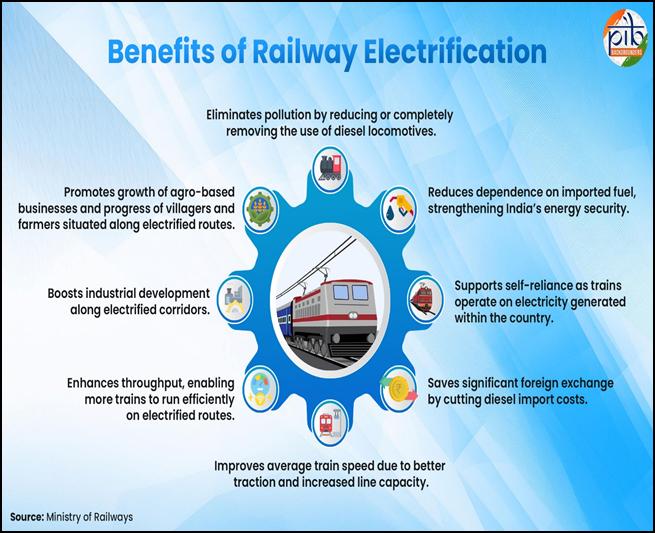
Why does this matter so deeply? The most immediate answer lies in economics. Electric traction is nearly 70 per cent more economical than diesel. For a railway system operating thousands of trains daily, this translates into massive recurring savings on fuel costs. Reduced dependence on diesel improves the financial sustainability of Indian Railways and frees up resources for safety upgrades, passenger amenities, track renewal, and network expansion.
Energy security is another decisive factor. Diesel fuel exposes rail operations to global oil price volatility and geopolitical risks. Electrification shifts energy dependence inward, allowing railways to draw power from the national grid and, increasingly, from renewable sources. This transition strengthens national energy sovereignty while insulating railway operations from external shocks.
Operational benefits are equally significant. Electric locomotives offer higher acceleration, better speed control, and superior hauling capacity. Freight trains can be longer and heavier, improving asset utilisation and lowering logistics costs. For passengers, electric traction means smoother rides, fewer breakdowns, and more reliable timetables. On high-density routes, electrification enables faster services without proportionately higher operating costs.
Environmental gains, often mentioned but rarely quantified in public discourse, are substantial. Diesel locomotives emit particulate matter, nitrogen oxides, and greenhouse gases—contributing to air pollution and climate change. Electrification dramatically reduces local air pollution, particularly in densely populated urban and peri-urban areas where railway lines pass close to residential neighbourhoods. Noise pollution also falls, improving quality of life along railway corridors.
What makes India’s electrification story especially compelling is its deliberate integration with renewable energy, particularly solar power. Electrifying trains using coal-dominated electricity would have delivered efficiency gains but limited climate benefits. Recognising this, Indian Railways simultaneously pursued aggressive renewable energy adoption. Solar capacity expanded from 3.68 megawatts in 2014 to an impressive 898 megawatts by November 2025—a nearly 244-fold increase.
These solar installations are not symbolic add-ons. Panels now cover rooftops, sheds, and land parcels across 2,626 railway stations. Crucially, around 629 megawatts—nearly 70 per cent of installed capacity—is used directly for traction, powering trains themselves. The remaining 269 megawatts supplies non-traction needs such as station lighting, workshops, service buildings, and railway colonies. This integrated energy strategy reduces electricity bills, improves grid resilience, and aligns railway operations with India’s climate commitments.
Behind these visible outcomes lies a quieter engineering revolution. Electrification today no longer relies on slow, labour-intensive excavation methods. Mechanised cylindrical foundations, installed through augering, have replaced conventional digging, accelerating overhead equipment installation. Automatic Wiring Trains now lay catenary and contact wires simultaneously, ensuring precision in tension and alignment across long stretches. These technical innovations explain how electrification could be scaled rapidly without compromising safety or quality.
Yet electrification is not merely a technical upgrade. It represents a deeper reimagining of Indian Railways’ future. A system once defined by diesel smoke, fuel depots, and tanker logistics is evolving into a cleaner, quieter, electrically driven network aligned with long-term climate and development goals. Each newly energised route reduces carbon emissions, cuts operating costs, and improves service reliability for millions of passengers.
It would be a mistake to view Mission 100% Electrification as an engineering achievement alone. It is equally a governance story—of coordination between railway zones, power utilities, equipment manufacturers, contractors, and policymakers. It is also a developmental story, because electrified corridors enhance freight efficiency, stimulate industrial growth, and strengthen connectivity to remote regions.
As the final kilometres are wired and the mission formally concludes, Indian Railways stands transformed. What began a century ago on a short suburban line has matured into one of the world’s most extensive electrified rail networks. This is not just modernisation; it is momentum—a forward motion where infrastructure, sustainability, and national ambition converge.
In an age when progress is often measured by speed alone, Indian Railways’ electrification reminds us that endurance, consistency, and scale matter just as much. To the traveller, the tracks may look the same. But the energy that drives the trains—and the future they point toward—has fundamentally changed.
The article is based on the inputs and background information provided by the Press Information Bureau (PIB) Author is Writer, Policy Commentator. He can be mailed at kcprmijk@gmail.com

Comments are closed.