

Huda Showkat Shah
The story of human progress does not begin in a vacuum. It begins in the fertile crescent of the Near East. As the renowned historian Samuel Noah Kramer famously wrote, “History begins at Sumer.” And it truly feels that way. While much of the world was still searching for its first steps, the people of Mesopotamia were already building something extraordinary- not just cities, but the very idea of society itself.
They turned wandering into belonging, survival into structure, and uncertainty into vision. These were people who lifted their eyes to the night sky and found meaning in its patterns, who felt the pain of injustice and dared to demand laws, and who carved their thoughts into clay so that their voices would not vanish with time. Their story is not only the beginning of history, it is the beginning of humanity.
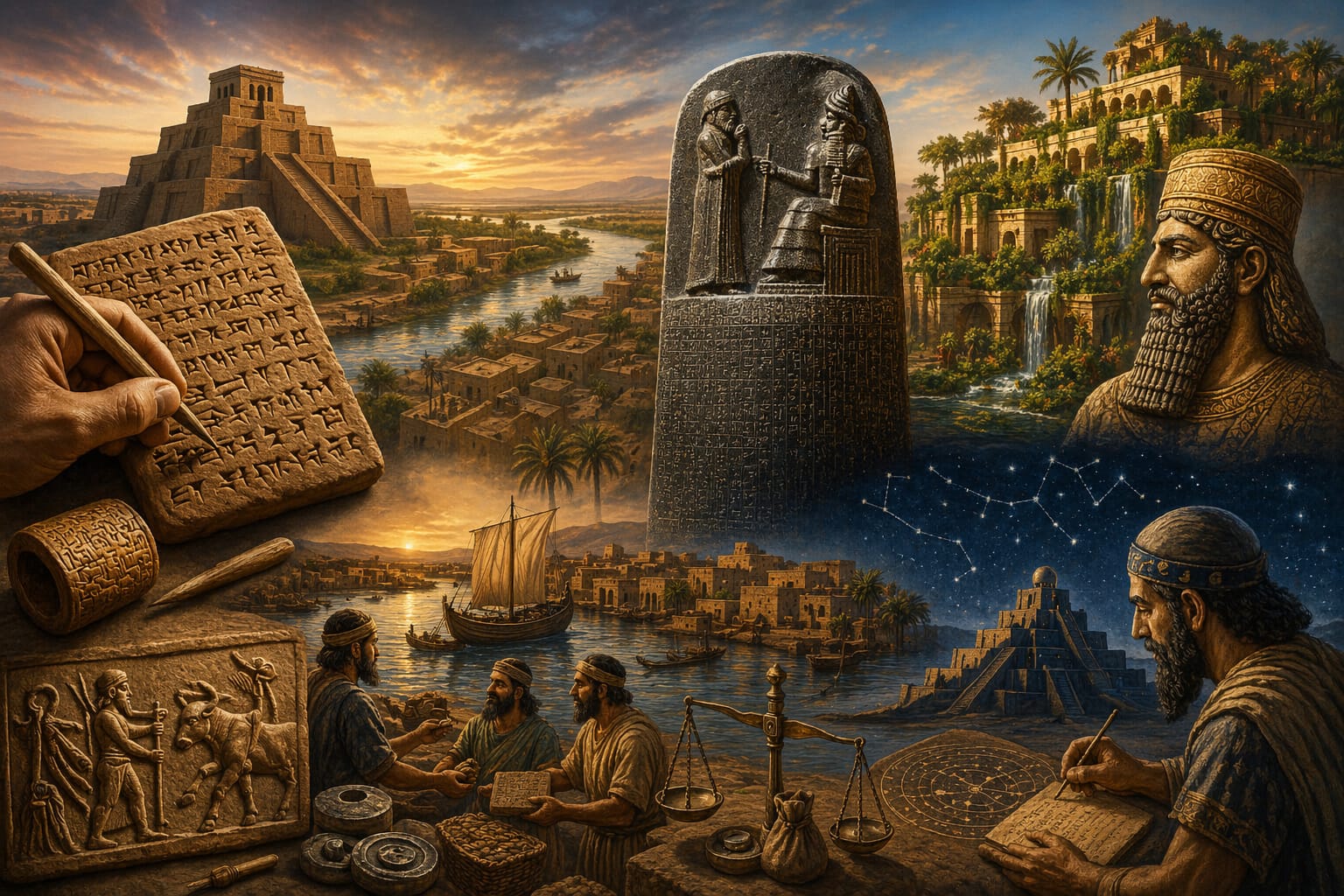
From Hammurabi’s code of laws to the hanging gardens of Babylon, cuneiform writing to ziggurat observatories, Mesopotamia has been rightly termed as the “cradle of civilization” across the world. Around 3300 B.C.E, four contemporary civilizations emerged along the river banks:
i) Mesopotamian
ii) Egyptian
iii) Chinese
iv) Indus Valley Civilization
It was during the Bronze Age when the civilization of Mesopotamia flourished between rivers Tigris and Euphrates. Mesopotamia in Greek means “land between rivers.” Various city-states emerged, starting from Sumerians.
These were the first to set up civilization around 3000 B.C.E in southern Mesopotamia region of Sumer — therefore called as the “cradle of civilization.” Lagash, Ur and Erech were other famous cities ruled by separate leaders. Sumerians developed the cuneiform writing and the practice was done on wet clay tablets which were baked later on. Bone stylus was used for writing the script from left to right in wedge-shaped symbols.
Sumerians were followed by Akkadians, and the Akkadian empire is considered to be the world’s first empire. King Sargon united the Akkadian and Sumerian kingdoms. After them, the mighty Babylonians took over — who have been the pioneers in the unification of Mesopotamia; now called Iraq. Babylon, in the north-east of Sumer, was ruled by famous Hammurabi in 1792 B.C.E; recognised for his “code of laws” all over the world.
“In the fertile land between the Tigris River and Euphrates River, humanity first learned how to live not as wanderers, but as a society”
The code envisaged 282 legal decisions egraved on a steel basalt slab. The sun god is shown to be handing over this code to Hammurabi. It covers the multiple aspects of trade, marriage, criminals and family. It suggested punishments and penalties which followed the theme “an eye for an eye”, “a tooth for a tooth”.
Babylonians, followed by Hittites city-state, were eventually succeeded by Assyrians and then Chaldeans. Ashurbanipal (668–627) was the last strong ruler of his empire; apart from being a great poet, having significant collection of cuneiform documents in his royal library. The Chaldeans were Semitic descendants of Babylonians.
Nebuchadnezzar II is the greatest ruler credited for the “Hanging Gardens of Babylon”. Mesopotamian civilization speaks of its glory and splendour in this century too. Apart from crafts and agricultural activities, they were busy traders. They imported raw materials, then exported the finished goods even outside Mesopotamia.
Sumerian seals have been found in the remains of I.V.C and vice-versa; depicting the trading acumen of these people. They were the first ones to come up with the idea of issuing receipts and bills after business transactions. Not only this, they invented coins and used “Mina”, “Shakel” as units for measuring weights. They were the first to develop religion, study sky and planets in stepped pyramid-like observatories called Ziggurats, which present the finest examples of their architecture.
Mesopotamians showed keen interest in Mathematics and calculations and they were the first to split hour into 60 minutes and a minute into 60 seconds. They adopted the famous Pythagoras theorem, codified the principles of astronomy and even figured out how to calculate the length of day and night. Though the Hanging Gardens have long since died, and the Great Ziggurats have been worn down by the winds of the desert, the spirit of Mesopotamia lives on.
These were the first people to show the world that chaos could be turned into connection and that lives that were all over the place could come together to form a society. Their glory is not in the ruins of Iraq, but in the way we live our lives every day. Every word we write and every star we map reminds us that the sparks of human creativity will never die, even when empires do.
Comments are closed.