

Dr. Reyaz Ahmad
“Mathematics is infinite not merely because numbers never stop, but because every answer generates deeper questions, and every proof opens new landscapes of inquiry.”
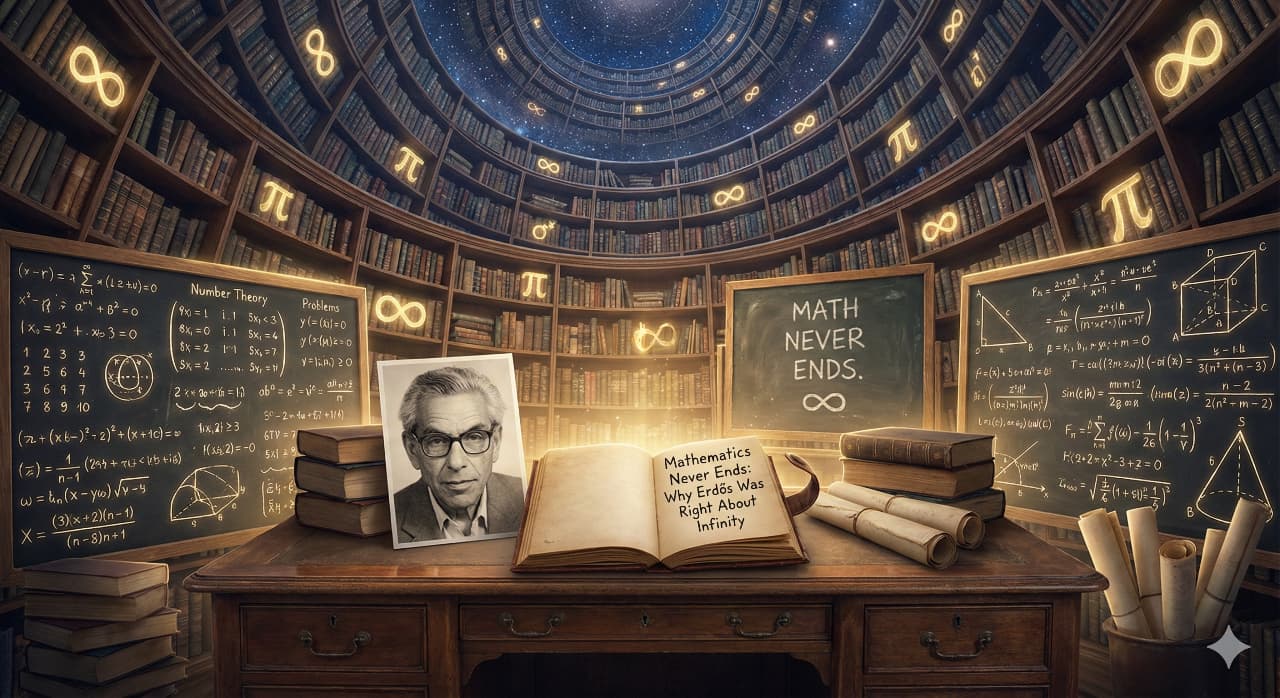
“Mathematics is the only infinite human activity.” When Paul Erdős made this remark, he was not speaking in poetry. He was stating a philosophical and logical truth about the nature of mathematics itself. Erdős believed that humanity might one day understand everything in physics or biology. But mathematics, he argued, can never be completed. Its objects are infinite. Its questions are infinite. Even its logical foundations guarantee that there will always be truths beyond proof.
At first, this may sound exaggerated. Every discipline grows. Every field expands. Why should mathematics be different? The answer lies in the structure of mathematics. It does not merely accumulate facts about the world. It generates new worlds through definitions, logic and proof. Every step forward opens more paths than it closes.
Consider the simplest example: the counting numbers. One, two, three, four, and so on. No matter how large a number you write down, you can always add one more. There is no “largest number.” This is not a matter of opinion. It is a logical fact. If someone claims to have found the biggest number, you can immediately construct a bigger one. The infinite nature of mathematics begins at this elementary level. It is built into arithmetic itself.
But Erdős’s insight goes further. Mathematics is not infinite merely because numbers continue without end. It is infinite because questions continue without end. Even in the most familiar territory, deep mysteries remain.
Take prime numbers. These are numbers divisible only by one and themselves: two, three, five, seven, eleven, thirteen, and so on. Over two thousand years ago, Euclid proved that there are infinitely many primes. His argument is elegant and decisive. Suppose you list all primes. Multiply them together and add one. The result cannot be divided evenly by any prime on your list. So either the new number is itself prime or it contains a prime not on your list. In either case, your list was incomplete. There must always be another prime.
The conclusion is clear: primes never end. Yet even after accepting their infinity, we still do not fully understand them. Their distribution appears irregular. They cluster unpredictably. And some of the simplest questions about them remain unanswered.
For example, mathematicians suspect that there are infinitely many twin primes — pairs such as eleven and thirteen, or seventeen and nineteen, that differ by two. This idea feels natural. Primes are infinite. Why should such pairs stop? Yet despite enormous progress, no complete proof exists.
Another famous problem is Goldbach’s conjecture. It states that every even number greater than two can be written as the sum of two primes. Ten equals five plus five. Eighteen equals seven plus eleven. Computers have tested this claim for extremely large numbers. It always works. Yet a general proof remains unknown. These examples show that infinity in mathematics is not just about size. It is about depth. Even simple objects generate endless puzzles.
The pattern continues when we examine familiar number patterns. A child can observe that the sum of consecutive odd numbers produces perfect squares. One equals one. One plus three equals four. One plus three plus five equals nine. Add seven and you get sixteen. The pattern never stops. But mathematics does not stop at observing a pattern. It asks why the pattern must hold. It demands proof. When the proof is understood, it reveals geometric structure. Each square can be built by adding an L-shaped layer of dots. This simple observation leads to deeper studies of number shapes, algebraic identities and geometric reasoning. One small curiosity unfolds into a wider field of inquiry.
Infinity appears again in a more surprising way when we consider different kinds of infinite sets. Many people assume that infinity is a single idea. Mathematics shows otherwise. There are infinitely many whole numbers. There are infinitely many fractions. In fact, these two infinities are the same size in a precise mathematical sense. Fractions can be arranged in a sequence so that each one corresponds to a whole number.
But the story changes with real numbers — numbers that include endless decimals such as 0.1010010001 and so on. In the nineteenth century, Georg Cantor proved that real numbers form a strictly larger infinity than counting numbers. His diagonal argument shows that no matter how you attempt to list all real numbers between zero and one, you can always construct a new number not on your list. This discovery shattered the assumption that infinity is uniform. Mathematics contains not just infinity, but a hierarchy of infinities. Each level introduces new questions about continuity, measurement and space.
The picture becomes even more profound when we consider the limits of proof itself. Erdős loved elegant arguments. He imagined “The Book” in which God keeps the most beautiful proofs. Yet twentieth-century logic revealed something startling. Even if we establish a clear and consistent set of axioms, there will always be true statements that cannot be proved within that system. This was demonstrated by Kurt Gödel in his incompleteness theorems. Any sufficiently powerful logical system cannot be both complete and consistent. Some truths will escape formal proof.
This is not a temporary gap in knowledge. It is a structural limitation. Mathematics is not unfinished because we are slow or limited. It is unfinished because it cannot, in principle, be finished.
There are also problems that illustrate this mystery in a simple way. Consider the Collatz conjecture. Start with any positive number. If it is even, divide by two. If it is odd, multiply by three and add one. Repeat. Every number tested eventually reaches one. Yet no proof confirms that this always happens. The rules are simple. The question is easy to state. The answer remains unknown. Mathematics repeatedly presents us with problems that appear elementary but resist resolution.
Unlike physics or biology, mathematics does not depend on observing the natural world. Physics studies matter and energy. Biology studies living organisms. Their scope is tied to what exists in nature. Mathematics begins with definitions and logical rules. When mathematicians introduce a new structure, such as non-Euclidean geometry or complex numbers, they are not merely describing the world. They are exploring the logical consequences of ideas. Each new definition creates a new landscape. Within that landscape, new truths arise.
This generative power explains why mathematics continues to expand. Define a new concept and you open new questions. Solve a problem and you develop new methods. Those methods then reveal further problems. The process has no natural endpoint.
Erdős suggested that we might someday learn everything in physics or biology. Whether that is possible remains open to debate. Nature may also be inexhaustible. Yet mathematics is different in a fundamental way. Its infinity is not empirical. It is logical. It is embedded in its very structure.
This endlessness is not abstract or useless. Prime numbers form the basis of modern cryptography. Geometry shapes computer graphics and imaging. Topology informs data science. Probability underlies finance and artificial intelligence. Many ideas that began as pure curiosity later became essential tools. Mathematics grows because it is free to ask questions beyond immediate application.
When Erdős said mathematics is infinite, he was identifying its defining characteristic. The objects never end. The questions multiply. The hierarchy of infinities stretches beyond intuition. Logic itself ensures incompleteness. And new concepts continuously generate new domains.
The horizon in mathematics is not distant. It is unreachable by design. That is not a limitation. It is the source of its vitality. Mathematics never ends because its foundation is infinity itself.

Comments are closed.