Srinagar, Jul 06: The first lavender distillation has commenced at the Medicinal and Aromatic Plants Farm in Trikanjan, Boniyar, even as the Agriculture Department prepares to distribute 4,000-5,000 lavender and rosemary saplings among farmers in the Uri border belt—a move officials hope will mark a turning point for agrarian livelihoods in this militancy-affected region.
The saplings, raised through cuttings this year, will be given out under the Holistic Agriculture Development Programme (HADP) to encourage cultivation of high-value medicinal and aromatic crops on barren and hilly land that has long remained underutilised.
Officials said the region’s terrain is particularly suited to such crops, which promise better economic returns than traditional cereals with lower input costs.
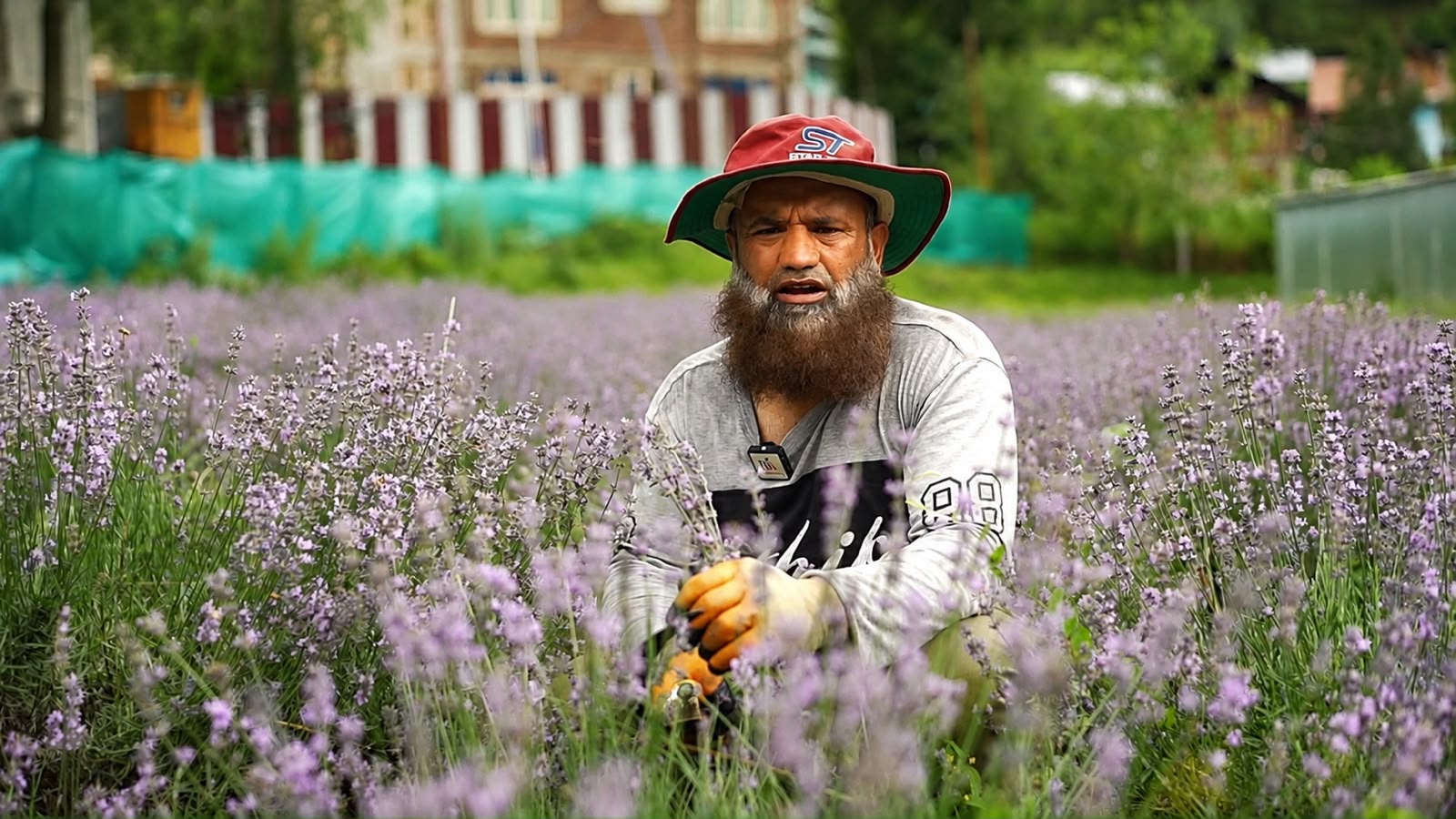
For locals, the farm has already become a lifeline. “It has generated employment for residents and created new livelihood opportunities. People in nearby villages are also benefiting. It has become a source of hope,” said Mahmood Khan, a local farmer.
Another cultivator, Mohd Yousuf Naikoo, said the shift to aromatic farming required less effort than conventional crops. “With technical guidance from the Agriculture Department, barren land can be made productive. This can improve our incomes,” he told Kashmir Convener.
Dr Sharan Gurdev Singh, a farm official, said the facility currently grows ten species of medicinal and aromatic plants, including kuth, artemisia, digitalis, musk bala and zakhmi hayat, apart from lavender and rosemary. “Lavender is in full bloom and we have begun the first distillation process,” he said, adding that the initiative was being implemented under the supervision of Mushtaq Ahmad Allaie, Sub-Divisional Agriculture Officer, Uri.
Fayyaz Ahmad Mir, another official, said nearly 4,000-5,000 lavender and rosemary saplings had been raised and would be distributed under the HADP area expansion programme. “The aim is to develop the border area, increase farmers’ incomes and promote wider cultivation of medicinal and aromatic plants. Farmers will receive technical guidance on cultivation, harvesting and processing,” he said.
Officials said lavender flowers harvested from the farm are being processed in the distillation unit to extract essential oil, which has significant medicinal and aromatic value. The initiative, they added, is expected to strengthen rural livelihoods while bringing vast tracts of unused land under productive use across Uri’s border villages.
Notably, In the picturesque valleys of Jammu and Kashmir, a fragrant revolution is underway as Lavender cultivation takes root and blooms, transforming the lives of farmers and empowering local communities.
Introduced to the region decades ago as an experimental crop, Lavender has now emerged as a promising profit-making opportunity, thanks to the efforts made by CSIR-Indian Institute of Integrative Medicine, Jammu under various societal and farmers oriented Missions and Projects like CSIR Aroma Mission, Project K-5000 and JAAG.
Lavender was first brought to India in the 1970s by Dr. Akhtar Hussain and introduced at the Field Stations of Manasbal and Pulwama. However, it wasn’t until its expansion under various projects and Missions including CSIR-Aroma Mission spearheaded by CSIR-IIIM Jammu that Lavender cultivation gained momentum.
Since the past more than 12 years more than 1000 acres of land in the Kashmir Valley and hilly areas of Jammu division have been brought under Lavender cultivation, where previously traditional crops were grown and suffered from poor profitability due to climate change and animal grazing.
Small and marginal maize farmers have found a new ray of hope with Lavender, witnessing a significant increase in profitability.
According to experts, the lavender oil production averages around 50 liters per hectare per year, contributing to a net annual income of between Rs. 3,50,000/- to Rs. 4,00,000/- per hectare. The enhanced economic returns have enabled farmers to secure a better future for themselves and their families.
In the union territory of Jammu and Kashmir, the Lavender cultivation has not only offered economic benefits to farmers but also created employment opportunities for unemployed youth through their involvement in the value chain of Lavender.
The CSIR-IIIM’s efforts have empowered women in the region, who are actively involved in Lavender fields for harvesting and processing the flowers.
As more than 2,000 farming families embrace Lavender farming, the region embarks upon the growth of a new industry and a flourishing ecosystem of startups.
Officials said that CSIR-IIIM under Aroma Mission has played a vital role in the establishment of infrastructure for facilitating the processing, value addition, and marketing of Lavender products.


Comments are closed.