
Kashmir Ecology Gasping For A Breath
Time to act and contribute towards a safe and healthy environment.

Peerzada Aarif
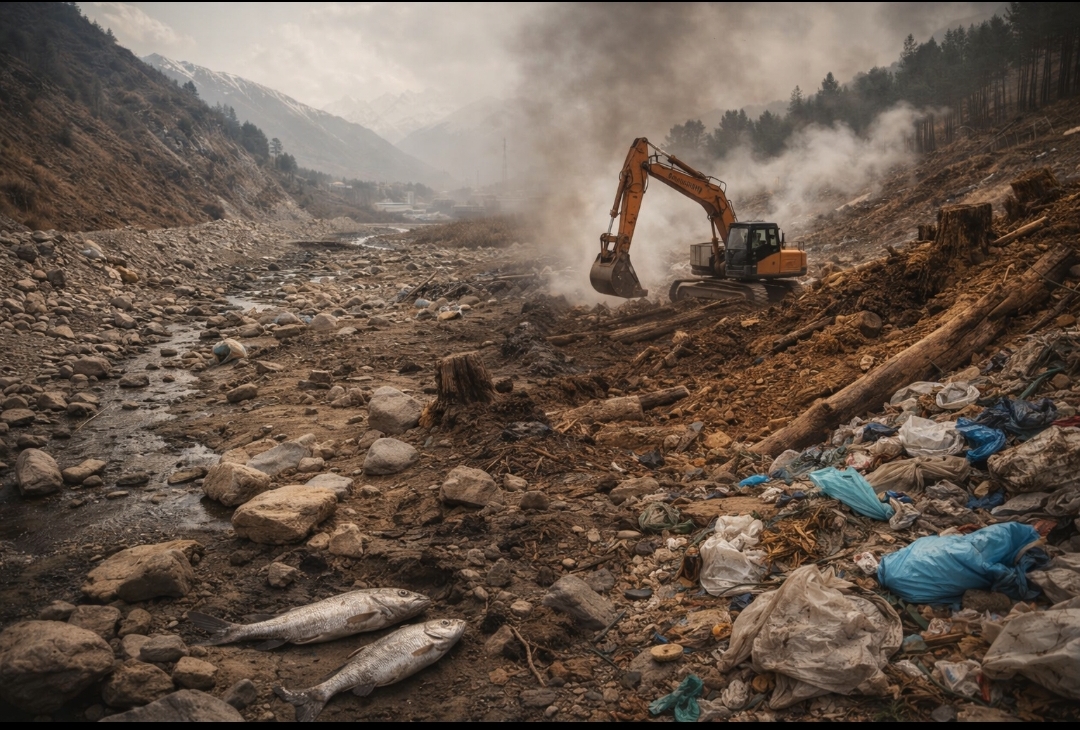
“Almost all major nallahs of the valley have dried up, leaving behind lifeless streambeds. The loss of flowing water has wiped out aquatic life and reduced fish production drastically. What once sustained communities now stands as a warning of ecological collapse.”
The prolonged lack of precipitation, which has left the Kashmir Valley parched during what should be its wettest season, is a serious environmental concern. Over the past few years, the valley has been grappling with unprecedented climatic dynamics that have raised alarms among environmental experts. This unusual weather pattern is characterized by the fact that the valley received very less or no snowfall during the peak winter months. While the higher reaches have recently received some snow, the accumulation is far from sufficient to replenish the region’s vast water reserves or sustain the glaciers. This deficit has severely threatened the region’s agriculture and horticulture sectors, as the absence of both rain and snow has led to critical water scarcity in many urban and rural areas alike.
This prolonged dry spell is entirely adverse to the region’s natural ecology. Almost all the major Nallahs (streams) of the valley have dried up, leaving them with a deserted appearance. The drying of these streams has not only resulted in water shortages but has also led to the loss of many aquatic species and a drastic reduction in local fish production. Furthermore, the lack of moisture in the air and the resulting dust have contributed to an increase in respiratory disorders among vulnerable groups, particularly children and the elderly.
These adverse weather conditions are indeed the result of shifting global climatic patterns and global warming. The Kashmir Valley was once referred to as “Paradise on Earth” due to its evergreen meadows, snow-capped mountains, and gushing streams; however, prevailing conditions have badly affected its natural ecosystems. The rise in average temperatures has resulted in the rapid melting of many Himalayan glaciers, including the Kolhoi Glacier. Over the years, the Kolhoi Glacier has lost substantial length and volume, resulting in its fragmentation into smaller ice bodies.
Decreased meltwater affects summer flows in major rivers like the Jhelum, Lidder, and Sind, threatening agriculture and drinking water supplies and causing drought fears among farmers. This also leads to the loss of grazing lands for wildlife, shifts in stream patterns, and negative impacts on species like the snow leopard. Furthermore, reduced water availability threatens the region’s power generation.
All these adverse environmental conditions are linked to human interference and developmental activities specifically industrialization, urbanization, transportation, the construction of roads and highways, the laying of railway lines, and large-scale deforestation. These developmental activities have not only led to the deterioration of the natural environment but have also disrupted various food chains. The destruction of natural habitats for many wild species has led to increased human-animal conflict.
Widespread deforestation, unplanned mining, and extraction activities in the streams have resulted in the drying up of natural springs. Additionally, the large-scale cutting of natural meadows for construction materials has made certain areas highly vulnerable to landslides. Illegal encroachment on lakes, wetlands, and pasture lands for construction has significantly increased the threat of flooding.
Another major environmental concern confronting the valley is poor waste management. Inadequate sewage and garbage treatment mechanisms have compounded the problem. In both rural and urban areas, tons of garbage are being dumped in the open or thrown into rivers and streams. This mismanagement, combined with the absence of a proper disposal system at both the governmental and individual levels, is putting the health of the population at grave risk.
The segregation sheds in villages, constructed under the Swachh Bharat Mission, currently present a dismal picture; garbage often overflows from these sheds, making life miserable for local inhabitants.
Kashmir valley is experiencing the impacts of climate change in subtle yet profound ways. Winters are becoming warmer, snowfall is less predictable, and glaciers are retreating at unprecedented rates. This rapid glacier loss threatens long-term water security. Rainfall patterns have also shifted. Sudden cloudbursts and heavier downpours lead to erosion and flash floods, while prolonged dry spells impact agriculture. These climate stresses carry deep economic consequences for farmers and residents.
All these environmental concerns must be taken seriously, as experts have already sounded the alarm. It is time to act and abstain from activities that harm our environment. Let us pledge to protect our surroundings and contribute to a healthier, greener future. Otherwise, the time is not far off when our very existence will be at stake.
The author is a teacher and a freelance writer. He hails from Baramulla and can be mailed at aarifpeerzada1@gmail.com

Comments are closed.