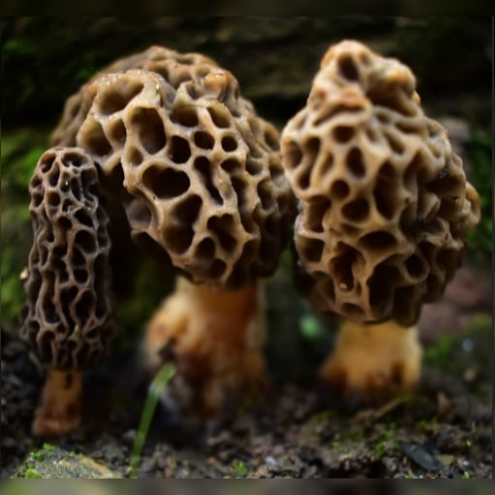
Srinagar, Apr 10: In a first, scientists at the Sher-e-Kashmir University of Agricultural Sciences and Technology (SKUAST) here have successfully cultivated the rare and expensive morel mushroom — locally known as ‘Kanneh-Gitchh’ — under controlled conditions, a development that could transform the region’s bioeconomy.
The wild morel (Morchella), which grows naturally in high-altitude forests during a narrow rainy season, commands a price between Rs 15,000 and Rs 40,000 per kilogram owing to its distinct flavour, nutritional profile, and medicinal properties.
“This is a game-changing breakthrough,” SKUAST-K Vice Chancellor Prof Nazir Ahmad Ganai told Kashmir Convener. “This innovation marks a paradigm shift — from dependence on uncertain wild collection to a controlled, scalable production system. It opens new opportunities for farmers, youth and entrepreneurs and contributes to ecological conservation.”
The cultivation has been achieved independently by three researchers — Prof Tariq Ahmad Sofi, his student Kamran Muneer from the Faculty of Horticulture, and Prof Vikas Gupta from the Faculty of Agriculture.
“We have been working on it for more than five years now,” Prof Sofi said. “We collected wild Morchella from over 1,000 locations, studied the soil, microclimate, flora and fauna surrounding each location. We shortlisted 10 strains and created similar conditions for their cultivation under a controlled system. Of the 10, we have had fruit in three strains.”
While Prof Sofi and his team cultivated morels in polyhouse conditions, Prof Gupta successfully cultivated them in open conditions. The team has applied for a patent.
Harvesting wild morels is a laborious process, with foragers often returning empty-handed even after days of searching dense forests in harsh weather. The artificial cultivation has remained a major scientific challenge due to the species’ complex life cycle and highly specific environmental requirements.
“Morchella needs specific moisture and temperatures both in terms of soil and weather to grow. Different strains need association with different specific plants,” Prof Sofi said.
The university has successfully cultivated morels in several microclimatic zones of the Valley, including Baramulla, Anantnag and Srinagar. Officials said the technology holds significant promise for Jammu and Kashmir’s agricultural transformation and high-value bioeconomy.
“It has a high export demand, and this technology is likely to enable farmers to diversify into a premium crop with exceptionally high market value, thereby enhancing farm incomes and profitability,” Prof Sofi added.



Comments are closed.