
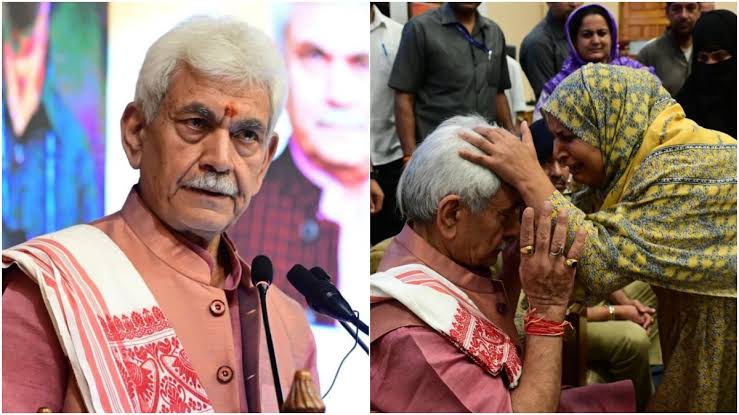
Justice, Jobs and an End to Silence LG Sinha Rewrites Script for Terror Victims
“For thirty years, we carried this wound alone, with no one to hear our cry”

Suhail Khan
Srinagar, Dec 28: For three decades, a silent anguish has permeated the Kashmir Valley. Since the onset of insurgency in the 1990s, over 14,000 civilians have been killed by Pakistan-sponsored terrorists, with thousands more disappeared their fates lingering as unanswered questions in official records. Behind each statistic lies a shattered home and a story of loss suspended in a void of uncertainty.
A decisive shift in policy has now ignited a fragile hope among Kashmir’s most scarred inhabitants. Following the establishment of direct central rule in 2019, the Jammu and Kashmir administration, led by Lieutenant Governor Manoj Sinha, has directed authorities to comprehensively reopen and re-examine cases of civilians killed by terrorists over the past 30 years.
Announced in 2023, this initiative represents more than a bureaucratic review for families who have waited decades for acknowledgment. It is coupled with a tangible rehabilitation effort: nearly 300 youths from terror-affected families have been provided government employment, offering critical sustenance to households stripped of their primary earners.
The move has unlocked voices long stifled by fear or a perceived absence of institutional support. Across Kashmir, survivors and next of kin are stepping forward to recount harrowing narratives of targeted violence, familial disintegration, and childhoods abruptly orphaned.
“For thirty years, we carried this wound alone, with no one to hear our cry,” said Ghulam Rasool, 72, whose son was abducted and killed by militants in 1992, in an exclusive conversation with Kashmir Convener. “We had buried hope along with our son. Today, for the first time, we feel the weight of our grief is being acknowledged. This inquiry has lit a small candle in a very long, very dark night.”
Saja Begum, whose only son was killed in a 2001 attack, stated, “This is not just a file being reopened. It is a door opening for thousands of us. It is a lifeline a promise that our suffering was not invisible, that our loved ones were not just numbers. They were people, and their memories demand justice.”
The administration has assured families that the reviews will be meticulous, aiming for substantive accountability rather than symbolic closure. “They have told us the truth matters, that punishment for the guilty matters, even if it comes late,” said Mohammad Altaf, a shopkeeper whose brother was killed in 2006. “For the first time, we are speaking without looking over our shoulder.”
“Our village lost its laughter. It became a museum of whispers,” Abdul Majeed Wani, 70, a resident of Kupwara, told Kashmir Convener. “When they announced this, I saw neighbors speaking openly on their porches for the first time in years. It is not just about one case it is about stitching the torn fabric of our community with threads of truth. Maybe our grandchildren will inherit a story with an ending, not just an endless question.”
Parveena Akhtar, 58, whose brother disappeared in the late 1990s, stated in a conversation with Kashmir Convener, “We became experts in silence. Fear was a language we all learned to speak fluently. Now, to sit in an office and give a statement, to see it recorded officially… it feels like we are slowly exhaling a breath we have held for a lifetime. The silence itself is finally being investigated.” She expressed profound gratitude, adding, “There are no words left to thank LG Sinha, who has truly helped us to survive.”
“My father was taken when I was four. I have no memory of his voice, only the echo of his absence,” shared Arif Hussain, 28, one of the youths provided employment. “This job is not just a salary; it is a thread connecting me to the man I never knew. It says his loss is recognized, and his legacy my future is worth investing in. For my mother, it is the first peace in twenty-four years.”
“For decades, our lives were suspended in a silent question mark,” said Fatima Bano, 65, whose husband, a school teacher, was killed in 1994. “We were told to move on, to forget, as if grief has an expiration date. This review is the first time the state has paused to ask that question with us. It is a validation of our endless yesterday.” She described Lieutenant Governor Sinha as “a hope a hope for which I live my tomorrow, for my survival.”
Earlier this month, Lieutenant Governor Sinha articulated a clear doctrinal shift, vowing support exclusively for victims’ kin while unequivocally isolating perpetrators and their affiliates. “From the emergence of terrorism until 2019, 41,949 civilians lost their lives to terrorism and separatism,” Sinha stated in an address, as per Kashmir Convener. “Justice will now reach the right people. Employment reaches the families of victims, not of terrorists. The era of terrorism is over.”
Contrasting current policy with past practices, Sinha noted that previous systems had seen benefits “directed to a large number of people connected with terrorism and separatism.” He credited the change in approach to the leadership of Prime Minister Narendra Modi and Union Home Minister Amit Shah.
“All cases, current and historic, will be scrutinized. Wherever possible, they will be reopened,” Sinha asserted. “Terrorists, whether within our borders or beyond, will be held accountable for their heinous crimes. This initiative is about restoring dignity, providing livelihood, and delivering justice to those who have endured the gravest loss.”
Notably, the abrogation of Article 370 has yielded substantive developments in the Union Territory of Jammu and Kashmir, particularly for the region’s victims of terrorism. Where once there were only promises, there is now action. The commitment to grant official recognition and conduct systematic investigations marks a pivotal if belated turning point.
Credit must also be given to the Save Youth Save Foundation, the driving force behind this government initiative, for its active participation in the mission to help families access justice.
The organization once again demonstrated its commitment on Sunday by organizing a large-scale humanitarian program, “DARDNAMA: A Chronicle of Pain, Truth, and Human Resilience,” at the Dak Bungalow in Baramulla. The event brought together nearly 400 families from across North Kashmir who have been affected by terrorism over the past three decades.
The program provided a dignified and inclusive platform for victims—many of whom have remained unheard, undocumented, and without redress for over thirty years—to share their stories of loss, suffering, and resilience. It focused primarily on families whose cases had never been systematically recorded or adequately addressed by previous mechanisms.
On this occasion, the Foundation acknowledged and commended the victim-centric humanitarian initiatives undertaken under the leadership of Lieutenant Governor Sinha. Particular note was made of efforts in rehabilitation, relief, and employment support for terrorism-affected families, which were described as significant steps toward long-awaited justice and healing.
The event was chaired by the Foundation’s Chairman, Wajahat Farooq Bhat. In his address, he highlighted the immense sacrifices, prolonged suffering, and remarkable resilience of the victims. He stated that for over three decades, a great number of affected families had remained voiceless and invisible despite enduring irreparable losses, emphasizing the urgent need for sustained institutional attention.
Bhat further noted that the recent victim-focused measures initiated under Lieutenant Governor Sinha’s leadership have instilled renewed confidence among long-neglected families, with several decades-old cases now receiving concrete attention and support.
After decades in the shadows of conflict, Kashmir’s long-forgotten victims are beginning to envision a future where their past is honorably memorialized and their deferred pursuit of justice finally charts a definitive course.

Comments are closed.