Srinagar, Feb 5: Jammu and Kashmir’s annual budget has expanded sharply over the past 17 years, growing more than fourfold. But this rise in size has been accompanied by a steady decline in the UT’s ability to independently raise and manage its finances, according to a detailed study by Kashmir Convener.
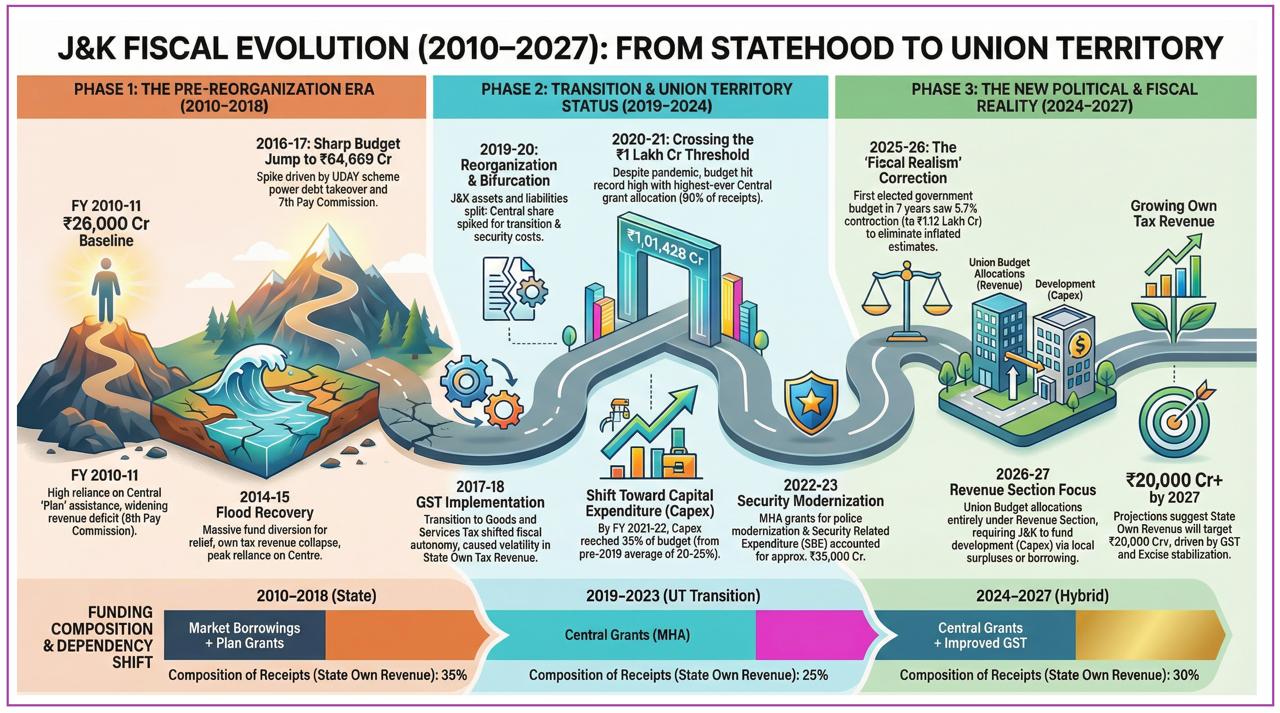
The study shows that J&K’s budget increased from ₹26,000 crore in 2010–11 to ₹1.12 lakh crore in 2025–26 — an increase of nearly 4.5 times. Despite this expansion, the study notes that fiscal autonomy has steadily eroded, especially after Jammu and Kashmir was reorganised as a Union Territory in August 2019.
Tracking public finances across the statehood, reorganisation and Union Territory phases, the study says J&K’s budget is now closely integrated with the Centre’s fiscal system, leaving limited room for independent decision-making.
“In effect, the budget has grown larger, but the steering power has shifted away from Srinagar,” the study observes.
According to the analysis, during the statehood period, Central assistance made up around 40–50 per cent of total budgetary resources — meaning ₹40–₹50 out of every ₹100 came from New Delhi. After 2019, this share increased to over 65 per cent, or nearly two-thirds of the entire budget.
The study notes a fundamental change in how deficits are financed. “Borrowings raised by the J&K Finance Department have been largely replaced by direct Grants-in-Aid from the Government of India, routed mainly through the Ministry of Home Affairs,” it states.
Between 2010 and 2018, J&K followed a typical “special category” fiscal model, depending on Central transfers, Plan assistance and market borrowings. During this phase, revenue expenditure accounted for nearly 75 per cent of total spending, largely due to salaries and pensions. This left only about one-fourth of the budget for development-related capital works.
The study also highlights the impact of the Sixth and Seventh Pay Commissions, which sharply raised salary bills, and the 2014 floods, which led to a collapse in local tax collections and increased dependence on Central relief.
From 2019 to 2024, budgets were passed by Parliament amid administrative restructuring and the COVID-19 pandemic. In 2020–21, J&K’s budget crossed ₹1 lakh crore for the first time, with Central grants forming nearly 60 per cent of total receipts to compensate for revenue losses during the pandemic.
During this period, the study records a relative improvement in development spending. Capital expenditure rose to around 35 per cent of the total budget in 2021–22, compared to an average of 20–25 per cent in earlier years.
The 2025–26 budget, presented by Chief Minister Omar Abdullah — the first by an elected government in seven years — marked an exception to the growth trend. The total budget declined by about ₹6,400 crore compared to 2024–25.
According to the Kashmir Convener study, this contraction reflects a move towards “fiscal realism”, with inflated estimates being trimmed and a zero revenue deficit targeted. For 2025–26, revenue expenditure was pegged at ₹79,703 crore, while capital expenditure was fixed at ₹32,607 crore.
Looking ahead, the Union Budget for 2026–27 has allocated ₹43,290 crore as Grant-in-Aid to Jammu and Kashmir, an increase of nearly ₹1,950 crore over the revised estimates of the previous year. Based on current trends, the study projects the total budget size to reach between ₹1.20 lakh crore and ₹1.25 lakh crore.
However, the study flags a key concern: the entire Central grant for 2026–27 has been provided under the revenue head, with no capital component earmarked for development projects. This could constrain infrastructure spending unless J&K improves its own revenue generation or resorts to fresh borrowing.
The study concludes that despite headline budget growth, financial independence has weakened. J&K’s own revenue contributed around 35 per cent of total receipts during the statehood era, fell to nearly 25 per cent in the initial UT years, and is projected to recover only partially to around 30 per cent.
“In functional terms, the J&K budget now operates as an extension of the Union Home Ministry’s fiscal framework,” the study states, “significantly limiting the policy space available to the elected government.”



Comments are closed.