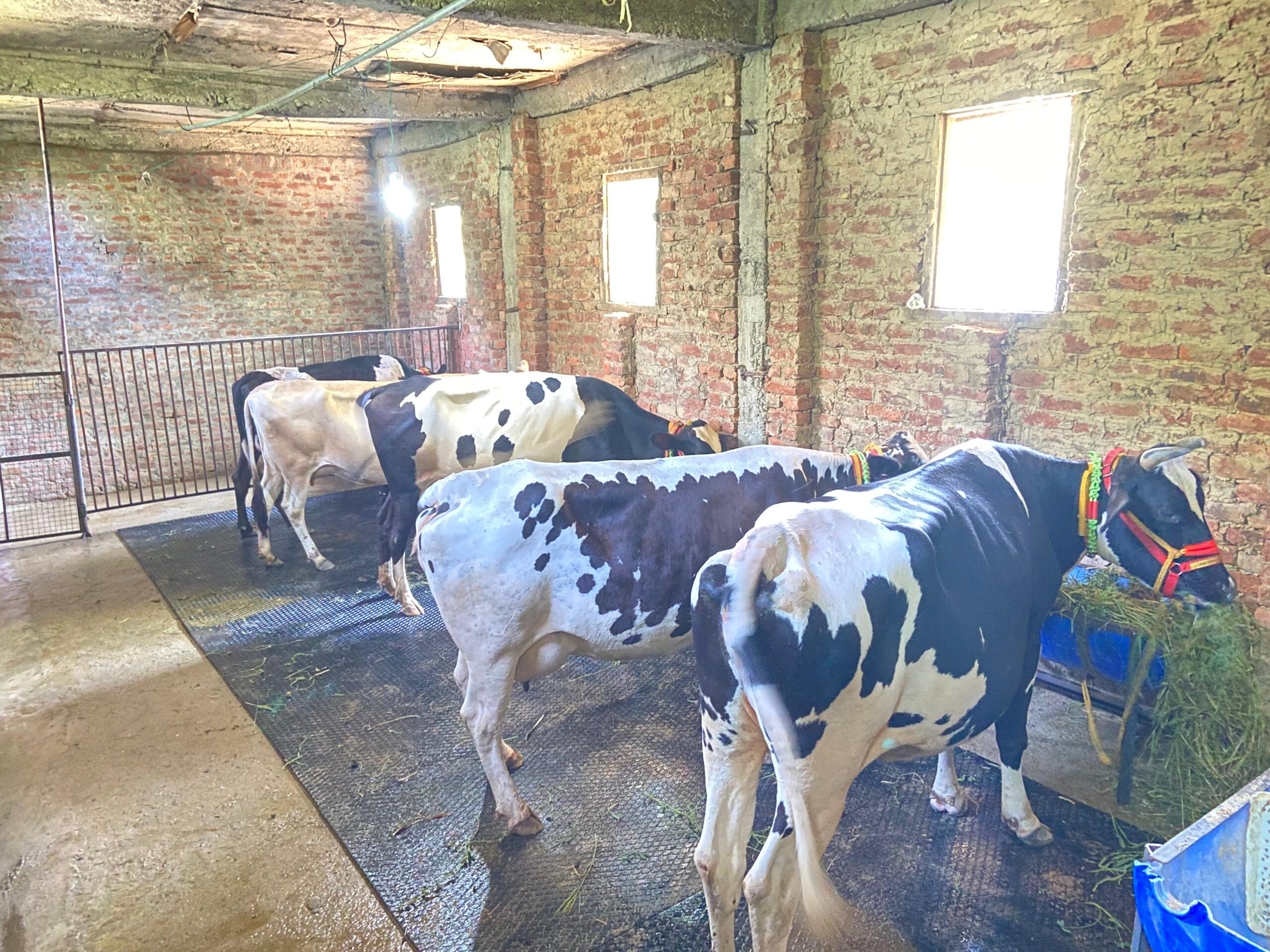
SRINAGAR, JULY 29: The morning cup of noon chai in Kashmir has long been a ritual. What is changing is the economics behind it. In a shift, dairy farming — once a subsistence affair confined to the backyard — is emerging as a serious income generator for rural families across the Union Territory, pulling women into the formal economy in ways that were unthinkable a decade ago.
The trigger has been a combination of policy push and institutional support. The Animal Husbandry department’s integrated dairy development scheme, offering a 50 per cent subsidy, has spurred the establishment of modern dairy units across the Valley. Artificial insemination programmes have progressively replaced local, low-yielding cattle with high-quality germplasm, lifting both milk output and farmer incomes.
The numbers tell the story. Over the past five years, J&K’s dairy production has surged, with new farms contributing to a 250 per cent increase over two decades. The milk economy in the region is now valued at an estimated Rs 9,080 crore — a figure that places dairy alongside horticulture and tourism as a pillar of the UT’s rural economy.
Speaking to Kashmir Convener Muhammad Ramzan a senior animal husbandry department official said the most significant social impact has been the entry of women into the dairy value chain — not as unpaid family labour, but as entrepreneurs.
He said under the Integrated Dairy Development Programme (IDDP), over 4,224 dairy units have been distributed in the Kashmir division alone, with a specific focus on women-led enterprises. The design, officials say, is deliberate: financial inclusion bundled with skill development to build self-reliant communities at the grassroots.
In Pulwama — historically known as the “Dudha-Kul of Kashmir” — women self-help groups now operate automated milk collection centres. The steady incomes from these ventures provide a buffer to households once entirely dependent on the seasonal rhythms of tourism and horticulture — sectors known more for their volatility than their reliability.
Another official said that organisations such as the ICICI Foundation have complemented government efforts by establishing dairy value chains that cover breed enhancement, improved feed management, and linkages to government resources like NRLM and KVKs. The result, according to official is a tangible increase in milk production, sale realisation, and household financial security.
Another official similar to the department said that the infrastructure is improving, but without local cooperatives for value addition, the producer remains at the mercy of middlemen.
The push for self-help groups and farmer producer organisations, they argue, is critical to ensuring that the benefits of the White Revolution reach the last mile.
In a significant development that underscores the UT’s institutional capacity, the Union Ministry of Fisheries, Animal Husbandry and Dairying informed Parliament on Wednesday that dairy cooperatives in J&K now have an installed milk processing capacity of 2.5 lakh litres per day — comfortably exceeding the average daily procurement of 1.713 lakh kg.
Data tabled in the Rajya Sabha for 2025-26, in response to an unstarred question from member Shri Terash Gowalla, shows the UT’s processing-to-procurement ratio at 1.46 — a 46 per cent capacity buffer. Nationally, the cooperative sector procures 69,688 thousand kg per day against a capacity of 1,22,558 thousand litres per day, a ratio of 1.76. J&K’s ratio, while below the national average, nevertheless places it ahead of several major dairy states in terms of processing infrastructure relative to procurement.
The cooperative network in J&K includes 78,000 pourer members. Ladakh, by contrast, has about 1,100 members and a near one-to-one ratio of 1.04. The Ministry clarified that the data pertains exclusively to the cooperative sector, as comparable statistics for private infrastructure are not centrally maintained.
Industry sources indicate that the Jammu and Kashmir Milk Producers Cooperative Limited (JKMPCL), the apex federation, manages a network of nearly 1,700 societies and processes approximately 2.5 lakh litres daily.
J&K’s annual milk production has risen to 29.73 lakh metric tonnes, contributing 1.2 per cent to national output. However, its cooperative procurement remains substantially lower than leading states. Gujarat leads with 31,733.7 thousand kg per day, followed by Karnataka and Rajasthan. The Ministry noted that Haryana (16.46) and Mizoram (21.88) recorded significantly higher ratios, while Himachal Pradesh (0.80) reported the lowest — an indicator of processing capacity falling short of procurement.
The Centre, for its part, is not short of schemes. The National Programme for Dairy Development (NPDD) provides 50 per cent grant assistance for procurement and chilling infrastructure, with enhanced support of up to 75 per cent for modern processing and cold-chain projects in J&K. The Rashtriya Gokul Mission focuses on genetic upgradation, while the Animal Husbandry Infrastructure Development Fund (AHIDF) offers a 3 per cent interest subvention to cooperatives and private players.
The Union Government maintains that India is self-sufficient in meeting domestic milk demand, with production in 2024-25 estimated at 247.87 million tonnes against projected demand of 243 million tonnes.
For the thousands of rural families now part of J&K’s dairy economy, the gains are tangible. The recent introduction of high-yielding Swiss Saanen goat breeds — dubbed the ‘Milk Queen’ — at the Mountain Livestock Research Institute in Shuhama is part of broader efforts to diversify and boost production.
Notably, the transformation is visible in villages where families once struggled to make ends meet. Milk, once just a staple of the Kashmiri kitchen, is slowly becoming a ticket to a better life — one cow, and one woman entrepreneur, at a time.


Comments are closed.