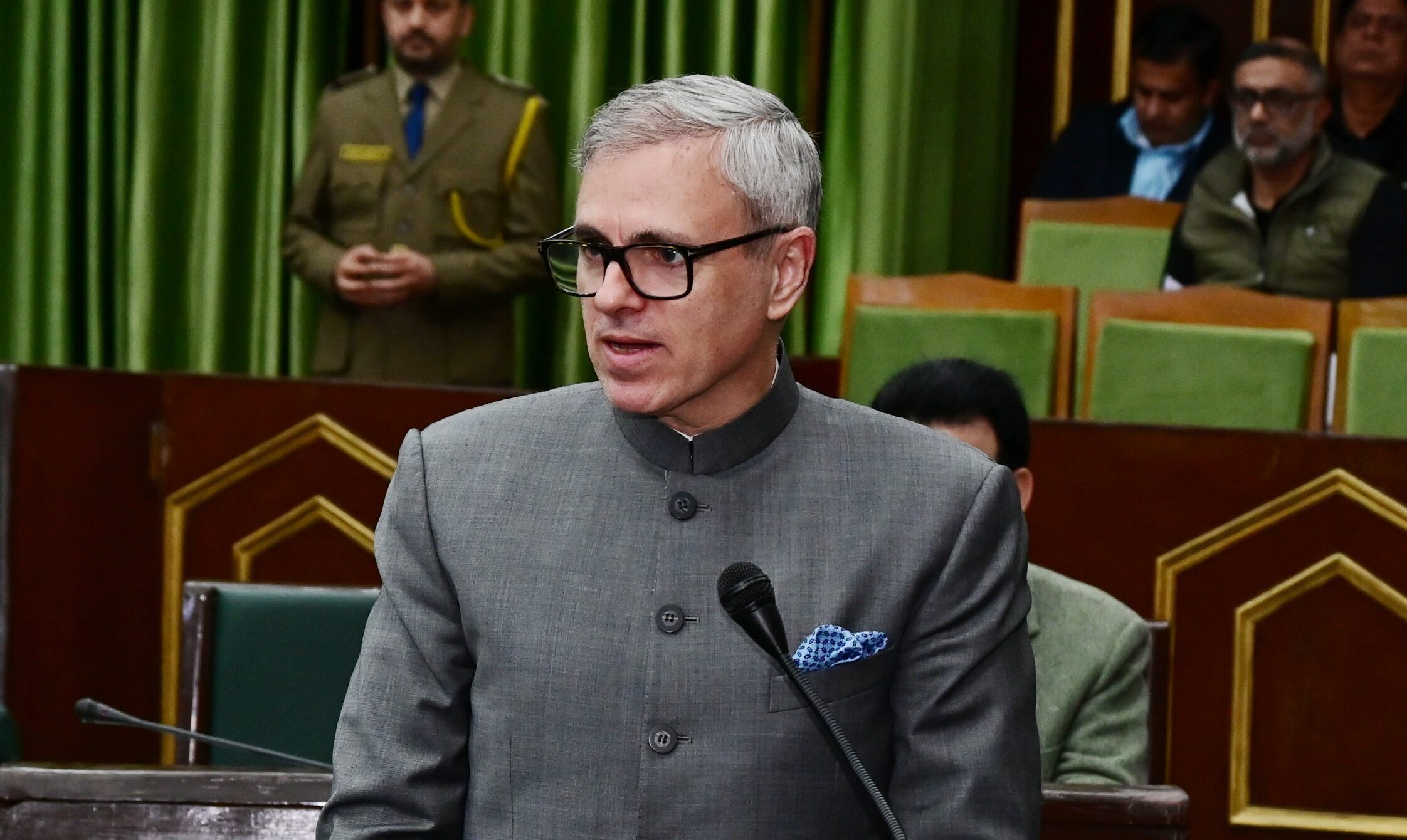
Jammu, Feb 10: Jammu and Kashmir Chief Minister Omar Abdullah expressed hope on Tuesday that work will soon begin on two long-pending water projects following the suspension of the Indus Waters Treaty. The projects involve lifting water from the Chenab River for supply to Jammu city and constructing the Tulbul Navigation Barrage to regulate the Jhelum River’s waters in Kashmir.
According to a Kashmir Convener correspondent covering the Budget session of the J&K Legislative Assembly in Jammu, CM Omar informed the house that work on these projects could not be undertaken earlier due to the Indus Waters Treaty. “We had submitted these proposals to the Asian Development Bank, but they were not permitted; they were effectively blocked under the treaty,” he said.
“Now that the Indus Waters Treaty has been suspended, we are working with the Government of India on two initiatives: first, the Tulbul Navigation Barrage on the Jhelum near Sopore, and second, lifting water from the Chenab near Akhnoor for supply to Jammu city,” he added. “Efforts are in progress, and I hope that work on both projects will start soon.”
Responding to a question from BJP MLA Sham Lal Sharma regarding steps to meet the water supply demands of areas under the Jammu Municipal Corporation, CM Omar stated, “We must plan to meet Jammu’s water supply needs for the next 30 to 40 years. The current traditional supply system cannot meet this demand.”
The Indus Waters Treaty, which had ensured the uninterrupted flow of river waters from Jammu and Kashmir and Ladakh to Pakistan, was suspended by India following the Pahalgam terror attack on April 22 last year.
J&K CM Omar has long opposed the Indus Waters Treaty as “deeply unfair,” arguing that it has disadvantaged the people of Jammu and Kashmir by restricting the region’s ability to store river water and permitting only run-of-the-river hydroelectric projects. The Tulbul Navigation Project was conceived in the early 1980s, with work commencing in 1984. It aimed to install drop gates at the mouth of Wular Lake near Sopore to regulate water levels in the Jhelum River, thereby facilitating navigation and increasing electricity generation during winter.
However, following objections from Pakistan, work was suspended in 1987.
The Chenab Water Supply Scheme is also a long-standing project designed to meet the water supply needs of Jammu city. It envisages lifting water from the Chenab River near Akhnoor to supply residents of Jammu city and its outskirts. Currently, the city’s water is supplied from the Tawi River, whose capacity is insufficient for the growing population’s demands.
Chief Minister Omar Abdullah also clarified that the ropeway project for the Shri Mata Vaishno Devi shrine was approved by the Lieutenant Governor in 2024 and not by the state cabinet or the Administrative Council.
Setting the record straight in the Legislative Assembly, the Chief Minister said he had personally examined the official records on the matter.
“One member claimed that the cabinet had approved the ropeway project. I checked the records and found that the cabinet did not approve it. It was also not a decision of the Administrative Council,” Omar Abdullah stated.
Emphasizing the Lieutenant Governor’s role, he informed the House, “The project was approved by the Lieutenant Governor in September 2024, prior to the formation of the elected government.”
He asserted that the House and the public had been misled on the issue, adding, “In an emotional moment, the member threatened to resign yesterday.”
The Chief Minister’s statement came a day after BJP MLA from the Mata Vaishno Devi constituency, Baldev Raj Sharma, claimed in the Assembly that the cabinet had approved the project and threatened to resign if his assertion was proven incorrect.



Comments are closed.