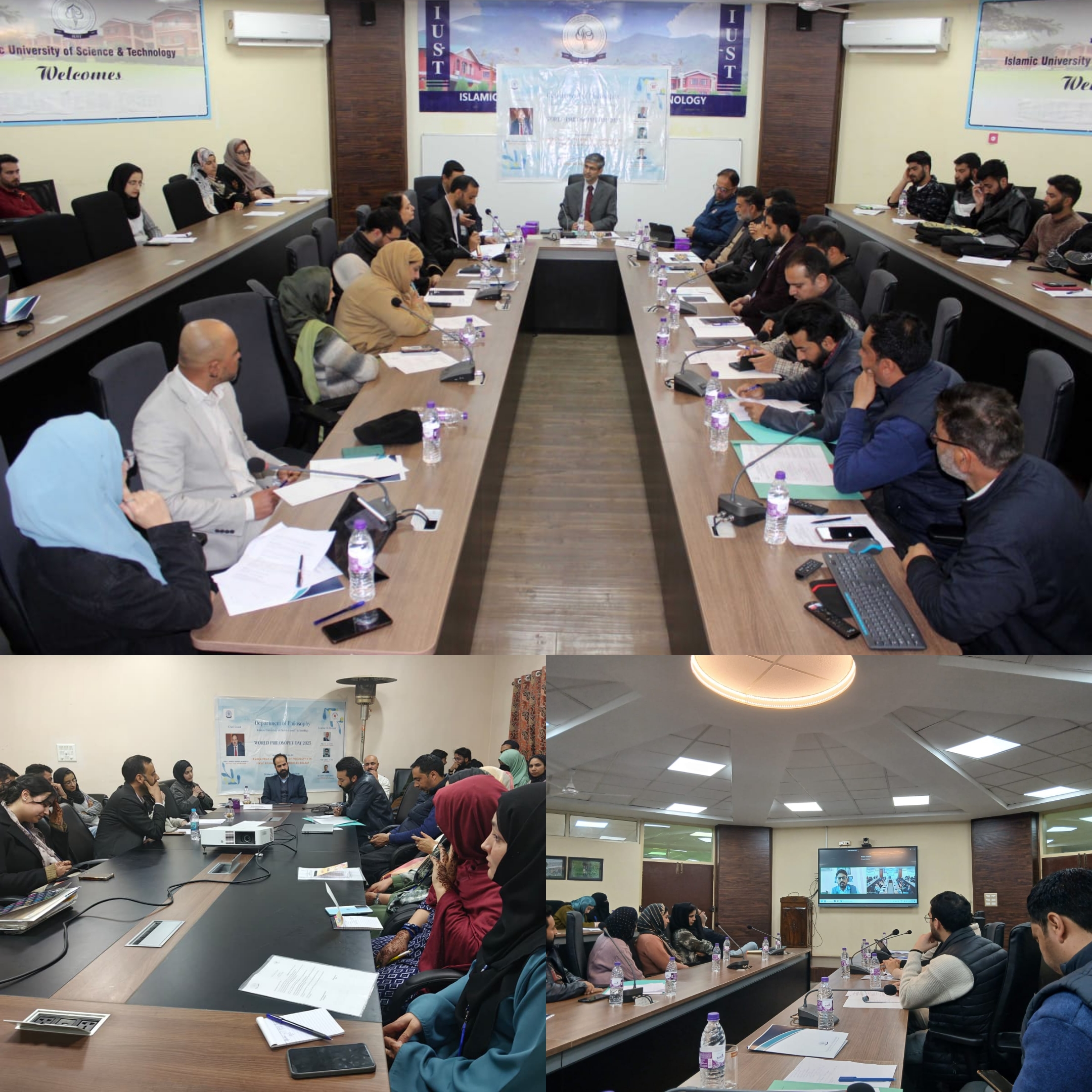
Awantipora, March 25: The Department of Philosophy, Islamic University of Science and Technology (IUST), commemorated World Philosophy Day by organizing a National Symposium on “Panch Pran and the Role of Philosophy in Viksit Bharat and Atmanirbhar Bharat,” sponsored by the Indian Council of Philosophical Research (ICPR). The event brought together scholars, researchers, and students to deliberate on the philosophical foundations of a self-reliant and developed India.
In his keynote address, Prof. Wahid Makdoomi, Registrar, IUST, underscored the relevance of the Panch Pran (five pledges), noting that “these pledges provide a moral and civic framework essential for shaping a progressive and self-reliant nation.” Dr. Afroz Ahmad Bisati, Dean, School of Humanities and Social Sciences, described philosophy as “the backbone of all knowledge, fostering critical and interdisciplinary thinking.” Welcoming the participants, Dr. Muzaffar Ali Malla highlighted the enduring significance of philosophy, stating that “philosophical inquiry remains central to understanding and addressing contemporary societal challenges.”
Different sessions of the symposium were conducted by distinguished academicians, including Prof. Meenal Katarnikar from the University of Mumbai, Dr. Surendra Kumar from the University of Hyderabad, Dr. Syed Jaleel Hussain, Head, Centre for International Relations, and Prof. Showkat Hussain Dar, Head, Department of Islamic Studies, along with research scholars. The sessions focused on the challenges of the digital age, emphasizing the need to rethink human identity in the era of Artificial Intelligence, alongside a socio-moral perspective on Viksit Bharat that highlighted the continued relevance of Gandhian ideals such as trusteeship and self-reliance in addressing modern inequalities. They also showcased emerging scholarship, with discussions on the symposium’s central theme and “Decolonizing Knowledge,” advocating intellectual frameworks beyond civilizational binaries.



Comments are closed.