

Afreen Manzoor
“In a society where degrees are treated as symbols of intelligence and professional titles as proof of wisdom, we rarely pause to ask whether education is meant to elevate status—or to elevate character.”
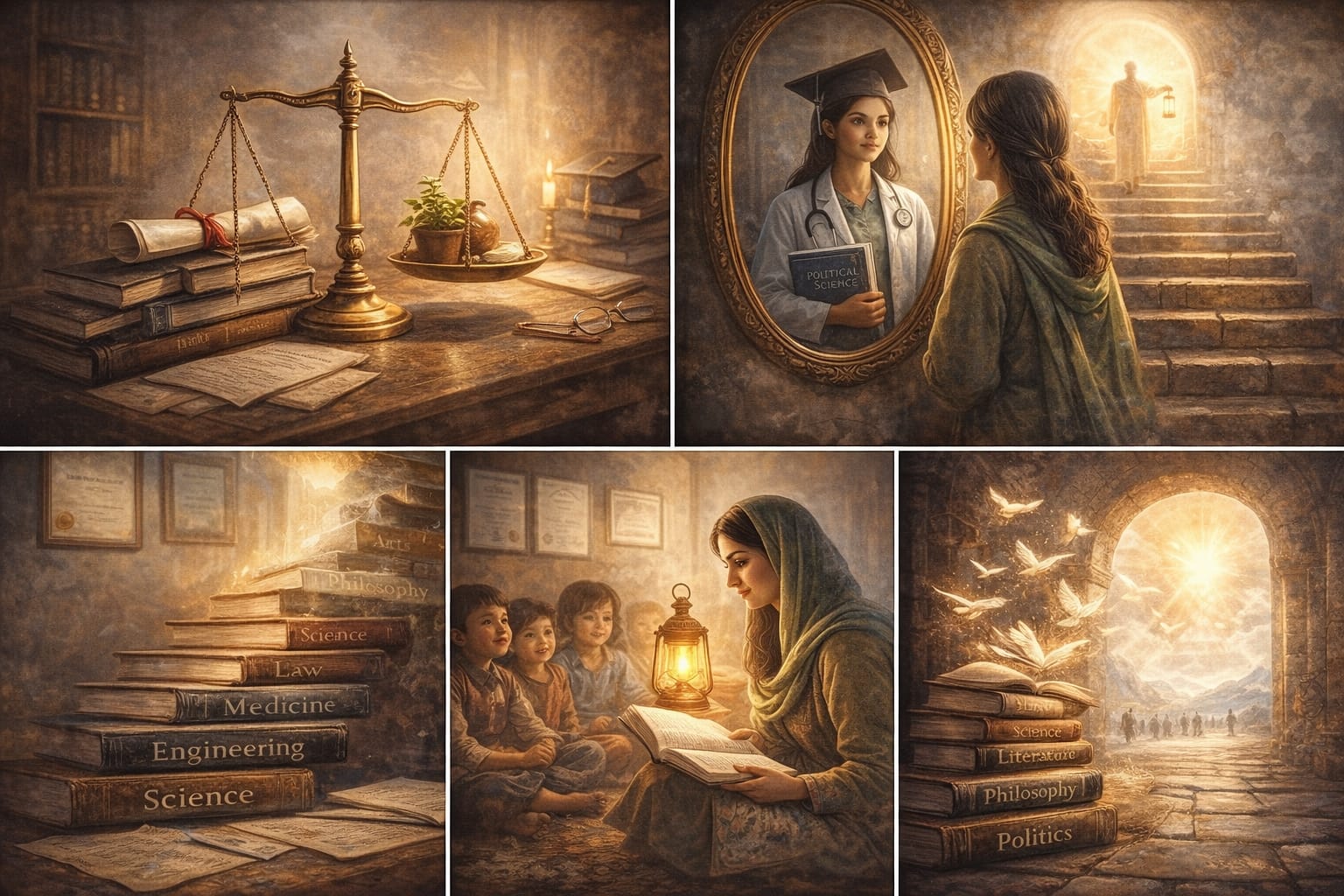
A few days ago, I attended a social gathering where a seemingly ordinary question unsettled me in an unexpected way. Someone asked what I was doing these days. I replied that I was studying. The next question followed immediately: “What degree?” When I answered that I was pursuing a Master’s in Political Science, the expression on her face changed. It was not curiosity. It was not admiration. It was a faint, dismissive look, as though my choice of discipline had quietly diminished my worth.
In that brief exchange lay a larger truth about our society, particularly in Kashmir. Degrees in medicine, engineering or commerce are often celebrated as markers of intelligence and success. A “Dr.” prefix or a government job is treated as proof of calibre, wisdom and rationality. Meanwhile, social sciences are viewed with suspicion, sometimes even contempt, as though they lack seriousness or substance. It is astonishing that in an age defined by rapid change, we still cling to such narrow definitions of education and achievement.
This encounter forced me to reflect deeply. Is education merely a ticket to a government job? Is wisdom measured only by income, title or professional label? Is literacy sufficient to make life meaningful and worthy of recall?
The confusion between literacy and education remains one of the most pressing dilemmas in our society. Literacy is the ability to read and write. Education, however, is far more profound. It is a lifelong process that shapes character, nurtures ethics and sharpens critical thinking. Education enables individuals to reason, to question, to analyse and to empathise. It expands the mind beyond stereotypes and prejudices. It teaches us not just how to earn, but how to live.
A degree is important. It reflects years of study, effort and intellectual growth. But it does not define the entirety of a person. Education is only a part of one’s being, not the whole of it. A person’s academic qualification and professional path may not always align, yet success is not restricted by this difference. People think in multidimensional ways. They carry diverse passions, ambitions and stories. To reduce human potential to a single metric is to ignore the richness of individuality.
Consider the example of Kriti Sanon. She holds a degree in electronics and telecommunication engineering, yet she carved her path in the film industry and later ventured into entrepreneurship. She built a successful brand, proving that one’s academic background does not confine one’s destiny. Similarly, Mukesh Ambani, a chemical engineer by qualification, did not pursue an MBA, yet he stands among the wealthiest business leaders in the world. Arnab Goswami studied sociology and social anthropology before becoming a prominent journalist and founder of the Republic Media Network. Gautam Adani left college before completing his degree, yet today he is one of Asia’s leading industrialists. These examples are not meant to glorify wealth or fame, but to illustrate that life’s trajectory is rarely linear. Passion, perseverance and vision often matter more than conventional labels.
What education truly instils is reason, rationality and respect. It nurtures the capacity to distinguish between right and wrong. It widens horizons and deepens understanding. It empowers individuals to innovate, to create and to contribute meaningfully to society. Education is not static; it evolves with experience. It is a continuous engagement with ideas, values and self-improvement.
Yet, in our social fabric, stereotypes persist. There is an unspoken hierarchy of professions. Certain careers are romanticised while others are undervalued. These perceptions are often shaped by insecurity and fragile egos, where societal validation becomes more important than intellectual authenticity. A truly educated person, however, does not measure worth through comparison or prejudice. Instead, education should cultivate humility and openness.
There is a thin line between being literate and being educated. A literate individual may possess information. An educated individual possesses wisdom. Literacy equips us with skills. Education equips us with discernment. Literacy may help us secure employment. Education helps us build character.
If life is to be purposeful and worthy of remembrance, it cannot rest solely on degrees or titles. It must be anchored in growth, empathy and contribution. It must reflect the courage to choose one’s path despite societal pressure. It must embody integrity and critical thought.
As young people navigating expectations and ambitions, we must ask ourselves what we want to be remembered for. A designation? Or a difference made? A prefix before our name? Or the values we upheld?
Education, in its truest sense, is a ray of hope that dispels darkness. It broadens our intellectual capacity and strengthens our moral compass. It invites transformation. The choice lies with us: to remain merely literate, or to become genuinely educated.
Life becomes meaningful not when society applauds our titles, but when we evolve into better, brighter human beings.

Comments are closed.