
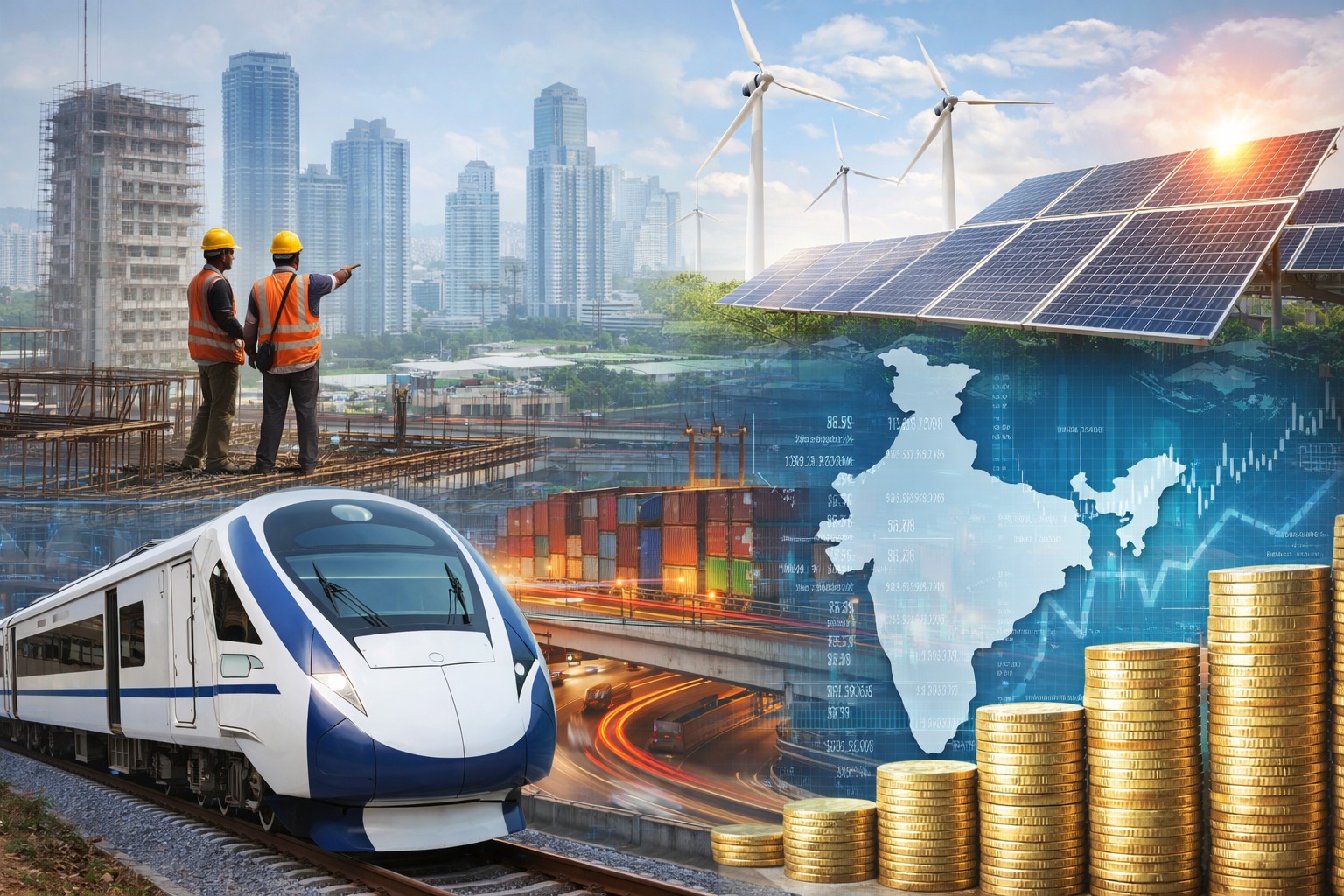
Infrastructure Financing in India: Trends, Institutions, and Innovations Shaping a New Development Era

S Ahmad
“What was once dependent on annual budgetary allocations has evolved into a diversified financing ecosystem blending public capital, institutional investment, debt reforms, and asset monetisation.”
In the story of India’s rise, infrastructure has steadily moved from the margins of policy debate to its very centre. Highways cutting across once-isolated districts, freight corridors easing supply chains, renewable energy parks powering new industries, metro lines redefining urban life, and digital infrastructure connecting millions—these are not merely construction projects. They are instruments of economic transformation. Behind them lies an equally transformative story: the evolution of infrastructure financing in India.
Over the past decade, India has undertaken a structural shift in the way it funds and manages infrastructure. What was once heavily dependent on annual budgetary allocations has matured into a diversified ecosystem blending public expenditure, institutional capital, debt market reforms, asset monetisation frameworks, and risk mitigation instruments. The Union Budget 2026–27 signals that this shift is not episodic but strategic, reinforcing the idea that infrastructure-led growth is central to the vision of a “Viksit Bharat” — a developed India built on resilient, modern foundations.
The numbers alone reflect the scale of ambition. Public capital expenditure has risen dramatically from ₹2 lakh crore in FY2014–15 to a Budget Estimate of ₹12.2 lakh crore for FY2026–27. This six-fold increase is not merely an accounting milestone; it represents a deliberate policy choice to use capital spending as a lever for economic expansion. In macroeconomic terms, capital expenditure carries a high multiplier effect. When the government invests in roads, railways, ports, irrigation systems, digital infrastructure, or urban transport, it does more than create physical assets. It stimulates demand for steel, cement, machinery, engineering services, and labour. It triggers secondary investments, unlocks private sector confidence, and creates long-term productivity gains.
The strategic logic is clear. In times of global uncertainty and domestic transition, infrastructure spending acts as both stimulus and structural reform. By expanding capital expenditure, the government aims to “crowd in” private investment. Large-scale public projects reduce risk perception, improve connectivity, and create bankable ecosystems where private players feel secure committing capital. Infrastructure becomes not only a public good but a signal to markets that growth momentum is real and sustained.
Employment generation is another critical dimension. Infrastructure projects are labour-intensive during construction and employment-enhancing in the long run. When highways are built, railway lines electrified, airports expanded, and renewable energy plants installed, millions of jobs are generated directly and indirectly. The World Bank has noted that India ranks among the top five countries globally in job creation through infrastructure among low and middle-income economies. In a country with a youthful demographic profile, such job-intensive growth is not just desirable but essential.
Importantly, the infrastructure push is no longer confined to metropolitan centres. The Union Budget 2026–27 places renewed emphasis on Tier II and Tier III cities, particularly those with populations exceeding five lakh. This policy pivot reflects a recognition that India’s next growth wave will be driven not solely by megacities like Mumbai or Delhi, but by emerging urban clusters across states. Investment in housing, transport, sanitation, logistics, and urban amenities in these cities is intended to disperse economic opportunity more evenly and prevent overconcentration in already congested metros.
To institutionalise this decentralised growth model, the concept of City Economic Regions has been introduced. These regions are mapped according to their specific economic drivers—whether manufacturing, logistics, tourism, technology, or services—and are to receive structured funding support of ₹5,000 crore each over five years. The allocation will operate through a challenge-based model tied to reform and measurable outcomes. In essence, financing will be linked to performance, nudging cities toward governance improvements, project efficiency, and fiscal discipline. This marks a subtle but significant shift from entitlement-based grants to results-oriented financing.
Yet infrastructure ambition requires more than budgetary expansion. It demands deep, resilient capital markets capable of mobilising long-term funds. Recognising this, India has undertaken substantial reforms in its debt markets. Infrastructure projects typically require long gestation periods and stable financing structures. Bonds and debt instruments therefore play a central role in bridging funding gaps. The government has introduced measures to broaden participation in public debt issuances, offering incentives to retail investors, women, senior citizens, and members of the armed forces. This inclusivity signals an effort to democratise infrastructure financing, transforming it from an elite institutional space into a wider public investment avenue.
Compliance processes for issuers have also been simplified, including rationalised norms for large listed entities and digitised reporting mechanisms. Meanwhile, transparency in private placements has been strengthened through refinements in the Electronic Book Provider framework mandated by the Securities and Exchange Board of India. These reforms reduce friction in capital raising while enhancing investor confidence.
Environmental, Social, and Governance-linked financing has emerged as another pillar of debt market evolution. Frameworks for green bonds, social bonds, sustainability bonds, and sustainability-linked instruments have been formalised to align infrastructure expansion with climate and social objectives. In a world increasingly governed by ESG benchmarks, India’s infrastructure financing model is consciously positioning itself to attract responsible capital flows.
Alongside debt reforms, asset monetisation has become a cornerstone of financial innovation. Infrastructure Investment Trusts and Real Estate Investment Trusts have opened new channels for recycling capital locked in operational assets. By monetising mature projects and redirecting proceeds into new developments, the government is ensuring that infrastructure growth is not bottlenecked by fiscal constraints.
At the institutional level, India’s infrastructure financing ecosystem has undergone a profound transformation. The country has emerged as South Asia’s largest recipient of Private Participation in Infrastructure investment, accounting for more than 90 percent of the region’s total, according to the World Bank. This dominance is not accidental; it is anchored in the creation of specialised institutions designed to bridge financing gaps and mobilise global capital.
The National Investment and Infrastructure Fund, established in 2015, represents one such anchor. Structured as a sovereign-linked asset manager, it partners with global sovereign wealth funds, pension funds, and multilateral institutions to invest in infrastructure assets. With assets under management of approximately USD 4.9 billion, it operates across transportation, energy, logistics, airports, ports, and digital infrastructure. Its governance structure and market orientation have earned it credibility among global investors, including entities such as the Abu Dhabi Investment Authority, Temasek, Asian Infrastructure Investment Bank, and Asian Development Bank.
The fund’s architecture includes multiple verticals, ranging from a Master Fund focused on infrastructure equity to a Private Markets Fund and dedicated bilateral funds such as the India–Japan platform. By combining domestic anchoring with international participation, it exemplifies the blended capital model India increasingly relies upon.
Complementing this equity-focused structure is the National Bank for Financing Infrastructure and Development, established in 2021 as a specialised Development Finance Institution. Its mandate addresses one of India’s longstanding gaps: the availability of long-term, non-recourse finance for infrastructure. As of December 2025, it had sanctioned approximately ₹3.03 lakh crore and disbursed around ₹1.09 lakh crore across core, social, and commercial infrastructure sectors.
Beyond traditional lending, this institution has introduced instruments such as Partial Credit Enhancement to improve bond ratings and attract insurance and pension fund participation. It has also expanded into transaction advisory services, helping state governments structure investment-ready Public-Private Partnership projects. Engagements span tourism development initiatives in Jammu & Kashmir, port and airport projects in Andhra Pradesh, and ongoing discussions with states including Uttar Pradesh, Tamil Nadu, Maharashtra, Telangana, Assam, and Gujarat.
International collaboration forms a crucial dimension of its strategy. Memoranda of understanding and letters of intent have been signed with institutions such as the International Finance Corporation, the Asian Development Bank, the New Development Bank, the Asian Infrastructure Investment Bank, and KfW IPEX Bank. These partnerships aim to co-finance projects, promote climate resilience, and enhance technical capacity. The institution is also exploring investment vehicles in GIFT City to channel foreign capital more efficiently into Indian infrastructure.
Urban infrastructure financing has received targeted attention as well, including investments in municipal bonds. By supporting local bodies in accessing capital markets, the institution is strengthening fiscal federalism and decentralised project financing.
Rail infrastructure, long regarded as the backbone of national integration, has been reinforced through the Indian Railway Finance Corporation. Established in 1986 as the exclusive financing arm of Indian Railways, it raises funds domestically and internationally to meet extra-budgetary resource requirements. Operating on a leasing model, it has financed nearly 75 percent of Indian Railways’ rolling stock, including thousands of locomotives, passenger coaches, and freight wagons. Its model illustrates how sector-specific financial institutions can sustain capital-intensive networks without overburdening the exchequer.
Meanwhile, Infrastructure Investment Trusts have become powerful instruments of asset monetisation. Introduced by the Securities and Exchange Board of India in 2014, InvITs allow pooled investment in revenue-generating infrastructure assets. The cumulative monetisation achieved through Toll-Operate-Transfer models and private InvITs has crossed ₹1.5 lakh crore, with the first public InvIT expected in 2026. The National Highways Authority of India-sponsored National Highways Infra Trust has alone raised over ₹46,000 crore across multiple rounds, marking one of the largest monetisation exercises in India’s road sector.
Real Estate Investment Trusts, also regulated by SEBI, have similarly opened commercial real estate to small investors. Listed on stock exchanges, they provide liquidity, transparency, and diversification. The Union Budget 2026–27’s proposal to create dedicated REITs for Central Public Sector Enterprises signals a new phase in monetising government-owned real estate assets.
Despite these advances, infrastructure projects inherently carry risks—construction delays, regulatory hurdles, revenue uncertainties, and financing gaps. To mitigate such vulnerabilities, the Union Budget 2026–27 has introduced an Infrastructure Risk Guarantee Fund. By offering partial guarantees to lenders, this mechanism reduces perceived default risks and enhances creditworthiness. It is designed to attract private capital, ensure timely project completion, and align with the broader goals of the National Infrastructure Pipeline. In effect, the state is not merely spending more; it is strategically sharing risk to catalyse greater participation.
India’s infrastructure financing journey thus reflects a decisive shift from incrementalism to systemic reform. Public capital expenditure provides the anchor. Debt market reforms deepen liquidity. Institutional innovations mobilise global capital. Asset monetisation recycles resources. Risk guarantees de-risk private participation. Together, they form a multilayered architecture aimed at sustaining long-term growth.
Challenges remain. Infrastructure requires not only money but governance capacity, land acquisition clarity, regulatory stability, and environmental safeguards. Fiscal prudence must coexist with ambition. Yet the direction is unmistakable. India is constructing not just roads and bridges but a financial ecosystem capable of sustaining them.
As the country aspires toward developed-nation status, infrastructure financing will determine the speed and inclusiveness of its progress. Capital, after all, is the lifeblood of infrastructure. The transformation underway suggests that India has recognised this truth—and is building the institutional arteries to carry that lifeblood efficiently, transparently, and sustainably into the future.

Comments are closed.