

S. Ahmad
India’s industrial future is no longer confined to vision statements, policy notes, or high-profile investment summits. It is being built on the ground, quite literally, acre by acre, through a growing network of industrial parks spread across the country. These parks—ranging from plug-and-play manufacturing zones to digitally mapped land banks and sustainability-rated industrial estates—represent a fundamental shift in how India approaches industrial development. They are no longer just clusters of factories or parcels of land. Instead, they are emerging as the backbone of India’s next phase of industrialisation, shaping how production is organised, how jobs are created, and how economic growth reaches regions beyond traditional urban centres.
The scale of this transformation is significant. More than 4,500 industrial parks, covering nearly 7.70 lakh hectares, have already been mapped on the India Industrial Land Bank platform. Of this, over 1.35 lakh hectares remain readily available for new industrial development. These figures are not merely statistical achievements. They signal a structural departure from India’s earlier, fragmented model of industrial growth, where industries often struggled with land acquisition, infrastructure gaps, and regulatory uncertainty. In its place is emerging a more planned, transparent, and infrastructure-led approach that seeks to reduce risk for investors while maximising economic and social returns.
A key driver of this shift has been the changing role of the government. Traditionally seen as a regulator that controlled entry and enforced compliance, the state is now increasingly positioning itself as a facilitator of industrial growth. This transition reflects a deeper understanding that sustainable industrialisation requires partnership rather than command-and-control governance. Industrial parks are a tangible outcome of this philosophy. Developed through coordinated efforts between central and state governments and the private sector, they aim to provide industry with what it values most: ready-to-use land, reliable infrastructure, and regulatory clarity. For investors, such predictability often matters as much as fiscal incentives, if not more.
At its simplest, an industrial park is a master-planned area designated for industrial activity. It brings together essential infrastructure—internal roads, power supply, water systems, waste management facilities, telecommunications, and logistics support—within a single, organised zone. It also offers institutional backing through single-window clearances, security arrangements, and emergency services. However, the real value of an industrial park lies not in any single facility, but in the assurance it offers. Investors can plan projects with confidence, knowing that land titles are clear, approvals are streamlined, and basic services will not become operational bottlenecks.
What distinguishes today’s industrial parks from earlier industrial estates is their emphasis on responsible and balanced growth. Economic expansion is no longer viewed in isolation from environmental and social considerations. Park authorities are increasingly required to enforce environmental regulations, monitor emissions, prevent soil and groundwater contamination, and incorporate biodiversity concerns into land-use planning. Measures such as common effluent treatment plants, rainwater harvesting, renewable energy integration, and climate-risk assessments are becoming standard features rather than optional enhancements. This shift reflects both regulatory pressure and investor expectations, particularly as global markets demand greener and more transparent supply chains.
The social dimension of industrial parks has also gained prominence. Worker housing, healthcare facilities, safe transport, and gender-sensitive amenities are now integral to park planning in many regions. Transparent labour practices, engagement with trade unions, and dialogue with local communities help reduce conflict and build long-term stability. As a result, industrial parks are increasingly functioning not as isolated production zones, but as anchors of regional development that stimulate local economies, generate ancillary employment, and improve access to services.
From an economic perspective, the logic of industrial parks is compelling. By clustering firms within a defined geography, parks generate agglomeration effects that improve efficiency and productivity. Shared suppliers reduce input costs, common labour pools enhance skill availability, and proximity encourages faster diffusion of technology and best practices. These advantages translate into higher output, better wages, and improved competitiveness for firms operating within parks. Over time, such clusters can evolve into specialised industrial ecosystems, strengthening India’s position in global value chains.
Industrial parks have also emerged as powerful magnets for capital and technology. Domestic and foreign investors are far more willing to commit resources when land acquisition hurdles are minimised and infrastructure is already in place. This confidence is reflected in India’s strong performance in attracting global investment. According to the UNCTAD World Investment Report 2025, India continues to rank among the world’s top five destinations for Greenfield investments and international project finance. Between April and August 2025 alone, the country attracted USD 43.76 billion in foreign direct investment, marking a sharp increase over the previous year. Industrial parks have played a crucial role in sustaining this momentum by lowering entry barriers and reducing project timelines.
Behind every successful industrial park lies extensive planning, much of which remains invisible to the public eye. Before a park is approved, detailed feasibility studies assess connectivity to highways, ports, and rail networks, availability of power and water, sectoral demand, financial sustainability, environmental safeguards, and long-term economic impact. This rigorous planning process ensures that parks are demand-driven rather than speculative ventures. By aligning infrastructure development with actual industrial needs, the risk of underutilised assets is significantly reduced.
The government’s emphasis on plug-and-play industrial parks reflects a clear understanding of the competitive global investment environment. With a budgetary allocation of ₹2,500 crore in the Union Budget 2025–26, these parks offer fully developed infrastructure that allows firms to begin operations quickly. At present, 306 plug-and-play industrial parks are operational across India. In addition, 20 more industrial parks and smart cities are being developed under the National Industrial Corridor Development Corporation. Several of these projects are already complete, while others are progressing through construction and bidding stages. Together, they form part of larger industrial corridors that integrate manufacturing zones with ports, logistics hubs, and urban centres, creating interconnected industrial ecosystems rather than isolated facilities.
Transparency in land access, historically one of the most significant challenges for Indian industry, has been dramatically improved through the India Industrial Land Bank platform. Developed as a GIS-enabled digital tool by the Department for Promotion of Industry and Internal Trade, the platform allows investors to remotely assess industrial land parcels across states. Users can examine connectivity, infrastructure availability, environmental conditions, and plot status in real time. With more than 4,523 industrial parks and over 1.25 lakh vacant plots mapped, the platform has brought unprecedented openness and predictability to land acquisition, reducing delays and disputes.
However, expansion alone is not enough. Quality and performance are equally critical. This is where the Industrial Park Rating System plays an important role. By benchmarking parks on parameters such as infrastructure quality, governance standards, sustainability practices, logistics efficiency, digitalisation, and tenant satisfaction, the rating system encourages continuous improvement. The launch of IPRS 3.0 in September 2025 marked an important evolution, placing greater emphasis on green infrastructure, skill development linkages, and feedback from park users. Earlier assessments categorised parks as Leaders, Challengers, or Aspirers, providing a clear framework for upgrading facilities and sharing best practices across states.
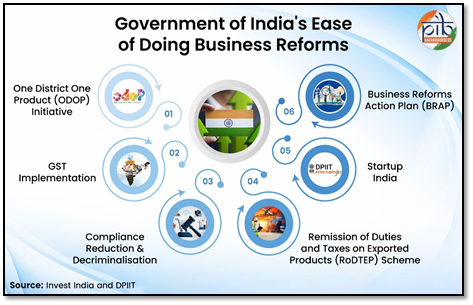
The success of industrial parks is further reinforced by broader ease of doing business reforms. Measures such as GST unification, single-window clearance systems, labour law rationalisation, Startup India incentives, ODOP clusters, and the systematic reduction of regulatory compliances have collectively created a more predictable business environment. Industrial parks benefit directly from these reforms, achieving higher occupancy rates and faster scaling than earlier industrial estates.
Today, India’s industrial parks stand at the intersection of infrastructure development, policy reform, and national aspiration. As global supply chains realign and manufacturing shifts toward greener and more resilient models, competition for investment is intensifying. India’s response has been to strengthen its foundations by offering planned land, shared infrastructure, digital transparency, and sustainability benchmarks.
In many ways, industrial parks are ultimately about confidence—confidence for investors to commit capital, for workers to build secure livelihoods, and for regions to envision futures beyond subsistence and migration. If these parks continue to evolve in line with global best practices, they are likely to deepen India’s integration into global value chains, strengthen regional economies, and reinforce the country’s emergence as a serious industrial power.
The challenge ahead is not merely to build more industrial parks, but to ensure that each one becomes a living example of inclusive, sustainable, and competitive growth. If India succeeds in this task, industrial parks may one day be remembered as the quiet but decisive engines behind the country’s next great industrial leap.
The article is based on the inputs and background information provided by the Press Information Bureau (PIB) Author is Writer, Policy Commentator. He can be mailed at kcprmijk@gmail.com

Comments are closed.