

S Ahmad
“India’s tunnel infrastructure reflects a clear shift toward smarter and more resilient development. These projects solve long-standing connectivity challenges while supporting economic growth and national priorities. Advances in technology and execution have strengthened India’s ability to build safely in complex terrain. As new tunnels come into operation, they will continue to improve mobility, reliability, and regional integration. Together, they signal a future where geography is no longer a limitation to progress.”
Infrastructure often captures attention when it rises above the ground—towering bridges, multilane expressways, and gleaming railway stations. Yet some of India’s most transformative infrastructure today lies hidden beneath mountains, rivers, and cities. Across the country, an expanding network of tunnels is quietly reshaping connectivity, strategic preparedness, regional development, and everyday mobility. These subterranean corridors are not merely feats of engineering; they represent India’s determination to overcome geography, climate, and terrain in pursuit of inclusive and resilient growth.
Tunnels in India have evolved into symbols of national resolve. By cutting through formidable mountain ranges, unstable rock formations, deep riverbeds, and densely populated urban spaces, they have unlocked year-round access to regions once rendered inaccessible by snow, landslides, avalanches, or congestion. From high-altitude Himalayan passes to underwater metro lines, tunnelling has emerged as one of the most critical pillars of India’s modern infrastructure strategy.
Why Tunnel Infrastructure Matters More Than Ever
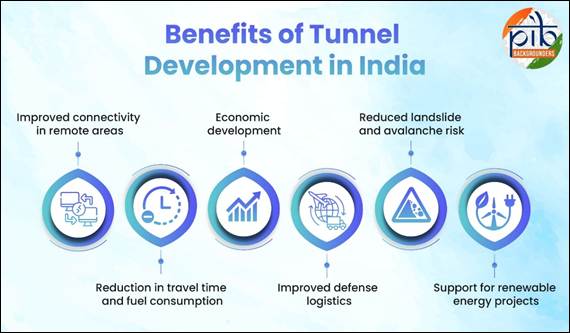
The importance of tunnel infrastructure today goes far beyond transport efficiency. Tunnels shorten distances, reduce travel time, enhance safety, and ensure reliability—especially in an era of climate uncertainty. In border regions, they strengthen defence logistics and emergency response. In remote areas, they improve access to healthcare, education, markets, and essential supplies. In cities, they ease congestion and redefine mass transit.
India’s current tunnelling boom is being driven by multiple converging priorities: rapid national highway expansion, strategic border-road development, metro rail growth, bullet-train corridors, dedicated freight links, and all-weather connectivity initiatives in some of the country’s most inhospitable terrain. As infrastructure ambitions scale up, tunnelling has become one of the fastest-growing and most technically demanding construction domains in India.
India’s Evolving Tunnel Technology
Over the past decade, India’s tunnelling capabilities have undergone a decisive transformation. The shift from conventional drill-and-blast methods to advanced, technology-driven approaches has enabled faster execution, improved safety, and greater precision. Modern projects now rely on detailed geological investigations, advanced rock-mass classification, and real-time monitoring systems that allow engineers to adapt construction strategies dynamically—an essential requirement in geologically young and unstable regions like the Himalayas.
Contemporary tunnels in India are no longer simple passageways. They are high-tech, safety-integrated corridors equipped with engineered ventilation systems, fire-suppression units, emergency escape routes, LED lighting, CCTV surveillance, public address systems, radio re-broadcast facilities, and centralised tunnel control rooms. Integrated Tunnel Control and Management Systems ensure continuous monitoring, rapid incident response, and enhanced disaster preparedness, significantly improving operational reliability.
Three technologies, in particular, have come to define India’s tunnel revolution. Tunnel Boring Machines (TBMs) are now extensively used in metro networks and long rail and road tunnels, offering high precision, reduced vibration, and safer construction in densely populated or geologically complex areas. The New Austrian Tunnelling Method (NATM), widely adopted in the Himalayas, allows excavation support to be modified in real time, making it ideal for fragile and variable rock formations. Integrated Tunnel Control Systems (ITCS) bring together ventilation, fire detection, surveillance, communication, and emergency management on a single digital platform, ensuring round-the-clock safety.
Landmark Tunnels Redefining Connectivity
India’s expanding infrastructure landscape is now marked by a series of landmark tunnels, each redefining how people and goods move across the country.
The Atal Tunnel, stretching 9.02 km beneath the Pir Panjal range, stands as a defining symbol of this transformation. Bypassing the Rohtang Pass, it has enabled seamless, year-round travel between Manali and the remote valleys of Lahaul-Spiti. Recognised in 2022 by the World Book of Records UK as the world’s longest highway tunnel above 10,000 feet, it has reduced the Manali–Sarchu distance by 46 km and cut travel time by four to five hours. Built in extreme Himalayan conditions—with winter temperatures dropping to minus 25 degrees Celsius and internal temperatures touching 45 degrees—the project faced fragile geology, heavy overburden, intense snowfall, and the notorious Seri Nala seepage that once flooded the tunnel. Its successful completion reflects the resilience and dedication of the Border Roads Organisation’s Karmyogis and has strengthened both civilian connectivity and defence mobility.
In Jammu and Kashmir, the 12-km Sonamarg or Z-Morh Tunnel represents another critical breakthrough. Built at an altitude exceeding 8,650 feet at a cost of ₹2,700 crore, the project includes a 6.4-km main tunnel, an egress tunnel, and modern approach roads. It creates an all-weather lifeline between Srinagar and Sonamarg, extending further towards Ladakh. Designed to withstand avalanches, landslides, and heavy snowfall, the tunnel ensures uninterrupted access to hospitals, essential supplies, and economic activity. Constructed using NATM, it incorporates an advanced Integrated Tunnel Management System featuring public address systems, electrical fire signalling, FM radio re-broadcasting, and dynamic road information panels. Designed to handle around 1,000 vehicles per hour, it will significantly boost defence logistics, winter tourism, adventure sports, and local livelihoods. When paired with the upcoming Zojila Tunnel, it will reduce travel distance from 49 km to 43 km and increase average speeds from 30 km per hour to 70 km per hour.
Further east, the Sela Tunnel in Arunachal Pradesh, built by the BRO at an altitude of 13,000 feet on the Tezpur–Tawang route, ensures all-weather connectivity in a strategically sensitive border region. Constructed at a cost of ₹825 crore using NATM, the tunnel holds immense importance for the Armed Forces while also catalysing socio-economic growth in remote mountain communities. Dedicated under the Viksit Bharat Viksit North East programme, it underscores how infrastructure can simultaneously serve national security and regional development.
In Jammu and Kashmir, the Banihal–Qazigund Road Tunnel has dramatically improved connectivity between the Jammu region and the Valley. The 8.45-km twin-tube tunnel, built at a cost exceeding ₹3,100 crore, has reduced the road distance by 16 km and cut travel time by nearly one and a half hours. Separate tubes for each direction, interconnected by cross passages every 500 metres, enhance safety, maintenance, and emergency evacuation, establishing a reliable all-weather road link.
Similarly transformative is the 9-km Dr Syama Prasad Mookerjee Tunnel, formerly the Chenani–Nashri Tunnel. Built at an elevation of around 1,200 metres, it bypasses 41 km of difficult terrain and reduces travel time between Jammu and Srinagar by nearly two hours. Featuring advanced ventilation, intelligent traffic systems, and a fully integrated control mechanism with minimal human intervention, the project also stands out for its socio-economic impact. Developed under the Make in India and Skill India initiatives, it generated employment for over 2,000 local workers, with nearly 94 percent drawn from Jammu and Kashmir.
Rail infrastructure has witnessed equally dramatic progress. Tunnel T50, stretching 12.77 km between Khari and Sumber under the Udhampur–Srinagar–Baramulla Rail Link project, is among India’s longest transportation tunnels. Constructed using NATM through quartzite, gneiss, phyllite, and jointed volcanic rock, engineers overcame high water ingress, landslides, and shear zones. The tunnel features a main tube and a parallel escape tunnel connected every 375 metres, with CCTV cameras placed every 50 metres and monitored from a central control room, ensuring safe and seamless rail operations.
Urban India, too, has entered the tunnelling era. In 2024, the launch of India’s first underwater metro tunnel beneath the Hooghly River in Kolkata, connecting Esplanade and Howrah Maidan, marked a historic milestone. This achievement redefined urban mobility while demonstrating India’s growing technological and infrastructural maturity in complex metropolitan environments.
The Next Wave of Mega Tunnels
The future of India’s tunnel infrastructure is even more ambitious. The Zojila Tunnel is emerging as one of the most consequential projects in the country’s infrastructure landscape. Rising at an altitude of 11,578 feet and extending across more than 30 km, with nearly 12 km already completed, it will establish a dependable all-weather link between Ladakh and the rest of India. Built using NATM and equipped with a Smart Tunnel SCADA system, CCTV surveillance, radio control, uninterrupted power supply, and semi-transverse ventilation, the project has already delivered cost savings exceeding ₹5,000 crore. On track for completion by 2028, it will become India’s longest road tunnel and Asia’s longest bi-directional tunnel, forming a critical component of the Srinagar–Kargil–Leh National Highway.
The Mumbai–Ahmedabad High-Speed Rail corridor represents a futuristic leap, particularly with the breakthrough of its 4.8-km undersea tunnel. Excavated simultaneously from Ghansoli and Shilphata, the project involved navigating challenging underwater terrain before achieving a precise breakthrough—an achievement hailed as a landmark in Indian engineering. Built using NATM and designed as a single tube capable of housing two high-speed trains, it exemplifies next-generation rail construction.
Equally significant is the Rishikesh–Karnaprayag new rail line in Uttarakhand. Spanning around 125 km, the project passes through some of the most geologically complex and environmentally sensitive Himalayan terrain, resulting in a predominantly tunnel-based alignment. It includes 16 main tunnels totaling approximately 105 km and 12 parallel escape tunnels of about 98 km. Of the total 213 km tunnelling scope, 199 km has already been completed. A major milestone is the first-ever deployment of a TBM in Himalayan geology for Indian Railways, successfully achieving a breakthrough in the 14.8-km Tunnel T-8. Advanced monitoring systems have been adopted to minimise ecological impact while ensuring long-term stability.
Light at the End of the Tunnel
India’s tunnel infrastructure reflects a decisive shift towards smarter, safer, and more resilient development. These projects address long-standing connectivity challenges while supporting economic growth, national security, and regional integration. They demonstrate that geography is no longer an insurmountable barrier but a challenge to be engineered around with vision and precision.
As new tunnels come into operation, they will continue to improve mobility, reliability, and opportunity—especially for regions long isolated by terrain and climate. In carving pathways beneath mountains, rivers, and cities, India is not merely building infrastructure; it is reshaping the relationship between geography and progress. Beneath the surface, a new India is taking shape—connected, confident, and prepared for the future.
The article is based on the inputs and background information provided by the Press Information Bureau (PIB) Author is Writer, Policy Commentator. He can be mailed at kcprmijk@gmail.com

Comments are closed.