

S. Ahmad
India is entering a defining phase of its digital transformation. Artificial Intelligence is no longer a futuristic concept or a niche research area. It is becoming a foundational technology that shapes how societies deliver healthcare, govern cities, educate children, grow food, respond to disasters, and manage economies. In this context, India’s approach to AI is guided by a clear and deliberate principle: artificial intelligence must be democratic, inclusive, and oriented toward public welfare.
The idea of “AI for Humanity” underpins India’s national AI strategy. It recognises that intelligence created by machines should not remain confined to a few global corporations, elite institutions, or wealthy nations. Instead, AI must work at population scale, address real problems, and deliver measurable social impact. For a country of India’s size and diversity, this ambition cannot be realised through isolated applications or pilot projects alone. It requires a strong, integrated AI stack that connects data, models, computing power, infrastructure, and energy into a single functional ecosystem.
An AI stack refers to the full set of technologies and systems that allow artificial intelligence to function in the real world. It includes the applications people interact with, the models that generate intelligence, the computing power that trains and runs these models, the digital infrastructure that enables connectivity and storage, and the energy systems that keep everything operational. When these layers work in harmony, AI can move beyond experimentation and deliver large-scale, reliable outcomes.
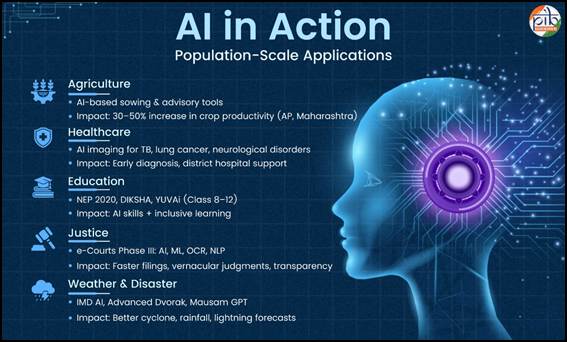
At the top of this stack lies the application layer. This is where citizens directly experience AI. Applications translate complex algorithms into usable tools. In India, this layer is increasingly defined by solutions designed for local needs rather than imported models. In agriculture, AI-powered advisory platforms help farmers decide when to sow crops, how much water to use, and how to manage pests. In states such as Andhra Pradesh and Maharashtra, such tools have already shown productivity gains of up to 30 to 50 percent. These improvements directly affect farm incomes and food security.
In healthcare, AI applications are enabling early detection of diseases such as tuberculosis, cancer, neurological disorders, and diabetic complications. For a country with limited doctor-to-patient ratios, these tools act as force multipliers, supporting clinicians and strengthening preventive care. In education, AI is being embedded through platforms aligned with the National Education Policy 2020. Initiatives on DIKSHA, CBSE curricula, and programmes like YUVAi aim to equip students with practical AI exposure rather than abstract theory.
AI is also reshaping governance and justice delivery. Under e-Courts Phase III, AI and machine learning are being deployed for translation, scheduling, case management, and citizen-facing services. This is especially significant in a multilingual country, where language often becomes a barrier to access justice. In weather forecasting and disaster management, AI models developed by the India Meteorological Department are improving predictions of rainfall, cyclones, fog, lightning, and forest fires. Tools such as Mausam GPT are helping farmers and disaster response agencies make informed decisions in real time.
These examples show that the application layer is not about novelty. It is about relevance. When AI applications are deployed at scale across priority sectors, they become embedded in daily decision-making and service delivery. This diffusion of AI across society determines its true economic and social value.
Beneath the application layer sits the AI model layer, which functions as the cognitive core of the ecosystem. AI models are trained on large datasets to recognise patterns, make predictions, and generate responses. Whether it is identifying disease markers in X-rays, translating languages, predicting crop yields, or powering conversational chatbots, models provide the intelligence that applications rely on.
India’s approach to model development emphasises sovereignty, openness, and localisation. Under the IndiaAI Mission, twelve indigenous AI models are being developed for India-specific use cases. To lower entry barriers, startups are receiving subsidised access to compute, with up to 25 percent of compute costs supported through grants and equity. This is critical because model development is often constrained not by ideas but by access to expensive infrastructure.
BharatGen represents a major step toward building India-centric foundation and multimodal models, ranging from billions to trillions of parameters. These models are designed to support research, startups, and public-sector applications. IndiaAIKosh functions as a national repository of datasets, tools, and models. By December 2025, it hosted over 5,700 datasets and more than 250 AI models contributed by 54 entities across 20 sectors. This shared ecosystem encourages collaboration and avoids duplication of effort.
Language inclusion is a central pillar of this layer. Startups like Sarvam AI are developing large language and speech models for Indian languages to support voice interfaces and citizen services. Bhashini, under the National Language Translation Mission, already hosts more than 350 AI models covering speech recognition, translation, text-to-speech, OCR, and language detection. This ensures that AI does not remain limited to English speakers but reaches citizens in their own languages.
The compute layer forms the muscle of the AI stack. Training and running AI models requires massive computational power. Globally, access to high-end compute has been concentrated among a few technology companies due to high costs. India is actively addressing this imbalance.
Under the IndiaAI Mission, more than ₹10,300 crore has been allocated over five years. The IndiaAI Compute Portal operates on a compute-as-a-service model, offering shared access to 38,000 GPUs and 1,050 TPUs at subsidised rates below ₹100 per hour. This is significantly lower than global market rates and allows startups, researchers, and public institutions to experiment and scale without prohibitive costs.
India is also investing in strategic infrastructure. A secure national GPU cluster with 3,000 next-generation GPUs is being established for sovereign applications. The India Semiconductor Mission, with an outlay of ₹76,000 crore, has approved ten semiconductor projects covering fabrication and packaging. Indigenous chip initiatives such as SHAKTI and VEGA processors are strengthening domestic design capabilities.
Supercomputing remains another pillar. Under the National Supercomputing Mission, over 40 petaflops of computing capacity have been deployed across IITs and national research institutions. Systems such as PARAM Siddhi-AI and AIRAWAT support AI workloads in natural language processing, weather modelling, and drug discovery. Together, these efforts ensure that compute power becomes a shared national resource rather than a private monopoly.
The next layer consists of data centres and network infrastructure. AI systems cannot function without reliable connectivity and secure storage. India has made rapid progress in this area. Optical fibre networks now support high-speed data movement across the country. Fifth-generation mobile services have been rolled out across all states and union territories, covering nearly 85 percent of the population.
India currently accounts for about three percent of global data centre capacity, with approximately 960 megawatts installed. This capacity is projected to grow sharply to over 9 gigawatts by 2030 as AI and cloud workloads expand. Mumbai and Navi Mumbai have emerged as the largest hubs, while Bengaluru, Hyderabad, Chennai, Delhi NCR, Pune, and Kolkata are also major centres.
Global technology companies are making large commitments to India’s AI infrastructure. Microsoft has announced investments of ₹1.5 lakh crore in data centres and AI training. Amazon plans to invest ₹2.9 lakh crore in cloud infrastructure and AI-driven digitisation by 2030. Google has committed ₹1.25 lakh crore to establish a one-gigawatt AI hub in Visakhapatnam. These investments anchor AI infrastructure within national borders and strengthen digital sovereignty.
Underlying every layer of the AI stack is energy. AI infrastructure is energy-intensive. Data centres and high-performance computing systems require continuous, reliable electricity. India’s power sector has undergone significant transformation to meet this challenge. In FY 2025–26, the country met a record peak demand of 242.49 gigawatts, with energy shortages reduced to almost zero.
India’s total installed power capacity has crossed 500 gigawatts, with non-fossil fuel sources accounting for more than 51 percent. This milestone aligns AI growth with sustainability goals. Future plans include achieving 100 gigawatts of nuclear capacity by 2047, expanding pumped storage projects, and deploying large-scale battery energy storage systems. These measures will stabilise the grid and support round-the-clock AI operations alongside renewable energy.
Globally, data centre power consumption is projected to more than double by 2030. India’s expanding clean and affordable energy base positions it well to support this growth without compromising climate commitments.
Taken together, these layers form a coherent and future-ready AI stack. India’s strategy is not to chase technological dominance for its own sake, but to ensure that intelligence at scale translates into real-world impact. Affordable compute, indigenous models, strong infrastructure, and clean energy create the conditions for innovation that is inclusive, sovereign, and sustainable.
By focusing on agriculture, healthcare, education, justice, governance, and disaster management, India is demonstrating how AI can improve productivity, service delivery, and public welfare. Anchored in the vision of AI for Humanity, the India AI Stack positions technology as a means to advance equity, resilience, and well-being. In doing so, it transforms data and compute into tools for collective progress, ensuring that the benefits of artificial intelligence reach not just a few, but the many.

Comments are closed.