
India–EU Partnership: Deepening Strategic Engagement Across Trade, Technology, and Global Governance

S. Ahmad
India’s engagement with the European Union (EU) has entered a decisive and forward-looking phase, reflecting the country’s growing focus on Europe as a strategic partner. This renewed momentum comes ahead of the much-anticipated India–EU Summit in New Delhi and coincides with ongoing Free Trade Agreement (FTA) negotiations, signaling both sides’ intent to expand and deepen collaboration across trade, investment, security, technology, connectivity, clean energy, and people-to-people exchanges. The evolving partnership underscores a shared vision for inclusive growth, sustainable development, and the promotion of democratic values in the global order.
Trade and Economic Engagement
Economic ties form a cornerstone of India-EU relations. Bilateral merchandise trade reached approximately $136 billion in 2024-25, positioning the EU as India’s largest goods trading partner. EU exports to India include machinery, transport equipment, and chemicals, while imports from India feature machinery, chemicals, base metals, mineral products, and textiles. Beyond goods, bilateral trade in services has steadily expanded. Between 2019 and 2024, Indian exports to the EU rose from €19 billion to €37 billion, while EU exports to India increased to €29 billion, reflecting a broadening and deepening of economic interdependence.
The economic engagement is complemented by growing investment flows, with the EU being among India’s top overall trading partners in goods and services. Initiatives like the Trade and Technology Council (TTC), launched in April 2022, are designed to facilitate technology-driven economic cooperation, particularly in digital technologies, green energy, and supply chain resilience. The second ministerial meeting of the TTC in February 2025 in New Delhi further strengthened collaboration, moving the partnership from conceptual dialogue to tangible, actionable outcomes.
Historical Foundations of India–EU Relations
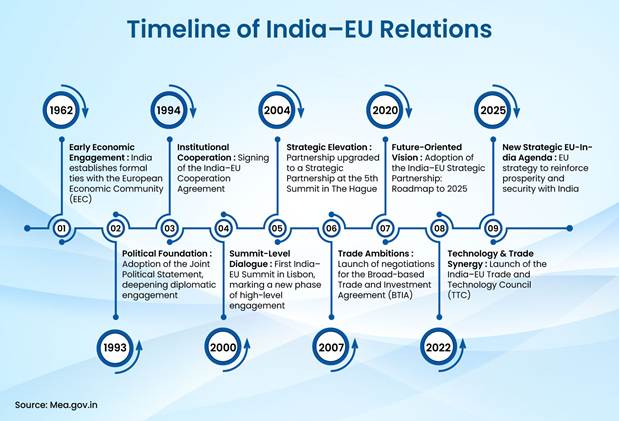
The India-EU relationship has deep roots. Diplomatic ties date back to the early 1960s, with India being among the first nations to engage with the European Economic Community (EEC) in 1962. This early recognition laid the foundation for formal cooperation, culminating in the 1993 Joint Political Statement and the 1994 Cooperation Agreement, which focused on strengthening political and economic links.
The first India-EU Summit in Lisbon in June 2000 initiated annual high-level dialogues on political and economic matters. The relationship was further elevated to a Strategic Partnership during the 5th Summit in The Hague in 2004, expanding the focus to include security, culture, and people-to-people exchanges. These milestones provided the structural and normative framework for contemporary engagement.
Strategic Partnership Architecture
In July 2020, India and the EU adopted the ‘India–EU Strategic Partnership: A Roadmap to 2025’, which has been pivotal in guiding the relationship. This framework emphasizes actionable cooperation across trade, technology, clean energy, security, science, connectivity, space, and migration. Complementing the Roadmap, India and the EU resumed FTA and investment negotiations in May 2021, reflecting a shift toward pragmatic economic integration.
High-level political engagement has strengthened significantly in recent years. In February 2025, the EU College of Commissioners, led by President Ursula von der Leyen, visited New Delhi—the first such visit to a bilateral partner outside Europe. Leaders have also met at global multilateral forums such as the G7 and G20, most recently in June 2025 in Canada, and have maintained close telephonic contact, including between Prime Minister Narendra Modi, President Ursula von der Leyen, and President António Costa in September 2025.
Security and Defence Cooperation
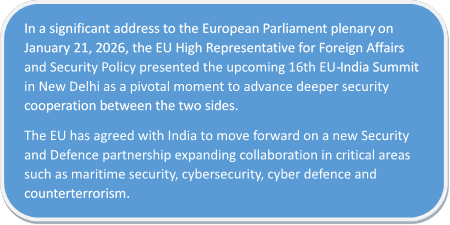
Security and defence cooperation has become an increasingly important pillar of India-EU engagement. The February 2025 Leaders’ Statement during the College of Commissioners’ visit highlighted plans to explore a Security and Defence Partnership, signaling convergence in addressing regional and global security challenges. The December 2025 delegation from the Society of Indian Defence Manufacturers to Brussels strengthened industrial collaboration, while the EU Political and Security Committee—representing all 27 EU member states—conducted its first-ever visit to Asia, holding high-level discussions in India with the Foreign Secretary, Deputy NSA, and Secretary (West).
Operational cooperation in maritime security has also deepened. Joint naval exercises were conducted in the Indian Ocean in June 2025, the Gulf of Guinea in October 2023, and the Gulf of Aden in June 2021. Collaborative escort operations near Somalia in 2018 and 2019 highlight ongoing engagement in humanitarian and security operations, cementing India’s role as a strategic maritime partner.
Clean Energy and Climate Action
Energy and climate cooperation is a defining pillar of the partnership. The Clean Energy and Climate Partnership (CECP), established in 2016 and entering Phase III in November 2024, has facilitated joint initiatives in renewable energy, sustainable transport, urban mobility, and climate-resilient infrastructure. The EU has supported India through the International Solar Alliance since 2018 and provided financing via the European Investment Bank for metro rail and urban transport projects. Collaboration extends to offshore wind energy, gas infrastructure, methane reduction, and technology transfer. In March 2021, the EU joined the Coalition for Disaster Resilient Infrastructure (CDRI), reflecting shared priorities in climate-resilient development.
Scientific collaboration in energy, environment, and advanced technologies has expanded. India signed an R&D agreement on peaceful nuclear energy uses with EURATOM in July 2020, and has been an associate member of CERN since 2017. Joint research under Europe’s Horizon 2020 framework, particularly in climate change and polar science, exemplifies the high-value technical and scientific dimension of the partnership.
Connectivity and Infrastructure
Connectivity has emerged as a strategic pillar, supporting sustainable economic integration across regions. The India-EU Connectivity Partnership, launched in 2021, focuses on transport, digital infrastructure, and energy networks while facilitating seamless movement of people, goods, and services.
In June 2025, India and the EU agreed on a trilateral development cooperation arrangement, enabling joint implementation of development projects in third countries. In September 2023, during the G20 Leaders’ Summit in New Delhi, India, the EU, France, Germany, Italy, Saudi Arabia, the UAE, and the U.S. signed a Memorandum of Understanding to develop the India–Middle East–Europe Economic Corridor (IMEC), a landmark initiative reflecting a multi-regional approach to trade, logistics, and sustainable infrastructure.
Science, Technology, and Space Cooperation
Science and technology have become central to bilateral engagement. The Science and Technology Cooperation Agreement of 2007, with a guiding Joint Steering Committee, facilitates collaboration in areas such as smart grids, water management, ICT, vaccines, polar science, and mobility of young scientists working with the European Research Council.
Space cooperation has grown from operational collaboration to structured institutional engagement. India-EU engagement dates back to the 1980s with Indian satellites launched via Europe’s Ariane launchers. Subsequently, agreements facilitated Earth observation cooperation, data sharing, and cross-support in satellite navigation and operations, including during Chandrayaan-3, Aditya-L1, and ESA’s Proba-3 mission launched by ISRO in December 2024. In May 2025, ISRO and ESA signed a Joint Statement of Intent for cooperation in human space exploration, and the inaugural India–EU Space Dialogue was held in Brussels in November 2025, signaling structured, future-oriented collaboration in space science.
Migration and Human Mobility
Migration and mobility frameworks have advanced significantly. The 2016 Common Agenda on Migration and Mobility (CAMM) laid the foundation for skilled worker flows, social security, and orderly migration. The 9th High-Level Dialogue in November 2025 proposed a pilot European Legal Gateway Office in India for ICT professionals, alongside expanded mobility frameworks for young professionals.
As of 2024, 931,607 Indians resided in the EU, with 16,268 holding Blue Cards, reflecting India’s growing role as a talent supplier for Europe. Over the last 20 years, 6,000+ Indian students have received Erasmus Mundus scholarships, further strengthening educational and cultural ties. These programs demonstrate India’s capacity to engage strategically with the EU on human capital, migration, and knowledge flows.
Upcoming Strategic Engagements
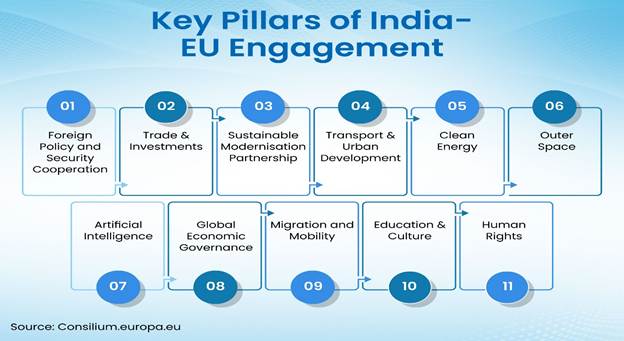
India’s invitation to President António Costa of the European Council and President Ursula von der Leyen of the European Commission for a State Visit from 25–27 January 2026 underscores the country’s intent to position Europe as a central pillar of its global strategy. Initiatives like the Trade and Technology Council, Global Gateway, IMEC, and ongoing FTA negotiations reflect deepening institutional alignment. These mechanisms are designed to produce tangible outcomes in trade, technology, connectivity, clean energy, security, and mobility, demonstrating the maturity of India-EU relations.
Conclusion
India–EU relations have evolved into a comprehensive, forward-looking partnership that combines shared values, strategic alignment, and practical cooperation. Rising trade, growing EU investment, deepening defence and security engagement, space and scientific collaboration, climate action, infrastructure development, and human mobility initiatives all reflect a partnership producing real-world results. The relationship exemplifies a model of bilateral engagement that is robust, action-oriented, and poised to address shared challenges such as climate change, sustainable development, and regional stability. As the 2026 India–EU Summit approaches, the partnership is expected to consolidate its strategic and operational dimensions, creating lasting value for both sides and contributing to global democratic governance and economic resilience.
The article is based on the inputs and background information provided by the Press Information Bureau (PIB) Author is Writer, Policy Commentator. He can be mailed at kcprmijk@gmail.com

Comments are closed.