

Suhail Khan
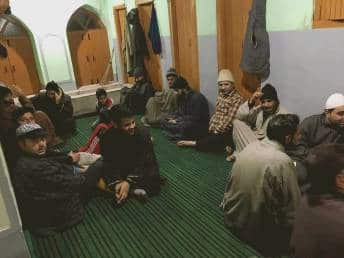
Srinagar, Dec 27 : As the chilling days of winter approach in Kashmir, public life visibly contracts, with most people preferring to stay indoors, Yet during Chillai Kalan, the harshest period, the traditional heated hamams of local Masjids become vital social hubs.
Besides offering prayers (Namaz), these hamams provide the simple pleasure of soaking in warmth. They buzz with conversation more than just casual chatter. Throughout the winter months, people, mostly elders, gather to warm themselves. Alongside discussions of world affairs, they talk about the various issues and challenges facing Kashmir.
These spaces become hotspots in winter, where the world’s most turbulent news is debated. In addition to the ever-simmering topic of politics, it is often said that the most intense and heated politics is “Hamam Politics.”
Ghulam Azam, a caretaker of one of the Masjid in Srinagar, said in conversation with Kashmir Convener: “In one way, it is really good to see people, especially the younger generation, coming to Masjids for prayers in winter something seen less often in summer. However, what is also concerning is that hamam gossip often involves people in trivial discussions, which is considered a sin for a Muslim, as it wastes precious time in unnecessary and irrelevant talk.”
He added, “Personally, I feel good to see people attending prayers at Masjids in winter, but I wish to see that same rush in summer as well.”
Moulana Zubair, a scholar, reflected on the architectural wisdom, “Our ancestors built these hamams with foresight, integrating community welfare into sacred spaces. The warmth is both literal and metaphysical. As we sit together, sharing tea and prayers, we are reminded of the Hadith that speaks of believers being merciful and compassionate to one another. In winter, the masjid becomes a true ‘house of warmth’ in every sense.”
Akbar Lal, a regular attendee of prayers at one of the largest mosques in North Kashmir, told Kashmir Convener, “These spaces are a lifeline, particularly for those who cannot afford constant heating at home. The masjid hamam embodies the principle of Barakah (blessing)—a single source of heat sustaining dozens, warming bodies and hearts alike. It is a beautiful, inclusive tradition where stories are passed down and the community’s bond is strengthened.”
He further said, “The hamam is more than bricks and fire it is a manifestation of hubb al-ikhlas (sincere brotherly love). In this warmth, differences melt away. The elderly find comfort, students find a quiet place to study, and the lonely find company. It is a living example of how our faith teaches us to care for one another, especially in times of hardship.”
Imran Yousuf, a teacher at a local madrasa, offered this perspective “The Prophet Muhammad (peace be upon him) said, ‘The believers, in their mutual mercy, love and compassion, are like one body; if one part feels pain, the whole body responds with sleeplessness and fever.’ The hamam is where this body comes together to heal. When we share its warmth, we are fulfilling a collective duty, a fard kifayah, to ensure no one in our community is left in the cold. It is a practical lesson in rahmah (mercy).”
Peerzada Tanveer, a university student, shared his view with Kashmir Convener: “For us students, it is a sanctuary. The Prophet (pbuh) emphasized seeking knowledge from the cradle to the grave. Here, amidst the elders’ wisdom and the quiet hum of remembrance, we find a unique concentration. The physical warmth seems to unlock a deeper focus for studying our deen and our world. It turns the hamam into a majlis al-‘ilm, a circle of knowledge, heated by both the fire below and our shared intention to learn.”
Notably, this tradition beautifully embodies the Islamic ethic of environmental and social care. However, with conversations often veering into unnecessary gossip especially regarding politics the trend is somewhat heartbreaking and concerning.

Comments are closed.