
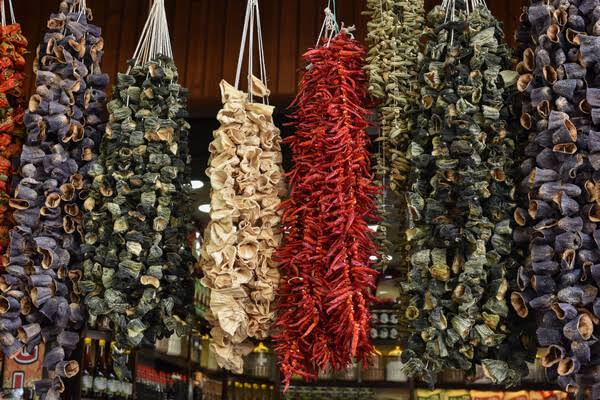
How Kashmir’s ‘Hokh Syun’ Puts Summer on the Winter Menu
A centuries-old food tradition sustains Valley households through the harsh winter months

Suhail Khan
Srinagar, Dec 24: As the Kashmir Valley braces for the biting chill of winter, a centuries-old culinary tradition is once again taking centre stage in households across Kashmir.
The practice of Hokh Syunsun-drying and preserving summer produce is not merely a method of food storage but a cherished cultural heritage that sustains communities through the harsh, snow-laden months.
With temperatures plummeting, the emphasis on nutritious, warming foods becomes paramount. While the famed Wazwan feasts hold cultural significance, it is the humble dried vegetable that has historically guaranteed food security and flavour during winter’s isolation.
“These vegetables have been used for generations in Kashmir,” said Fayaz Ahmad, a vegetable seller in Srinagar.
Speaking to Kashmir Convener, he said, “They are a part of our culture. Our forefathers relied on them when heavy snowfall blocked roads. Women would diligently dry surplus summer produce to ensure a steady winter supply.”
From Al Hachi (dried bottle gourd) and Ruwangan Hachi (dried tomatoes) to Gogji Aar (dried turnips) and Handh (dried dandelion greens), the variety is extensive. Each item undergoes a meticulous sun-drying process, often involving specific techniques like stringing turnip slices or smoking fish (Farrigad) over grass fires, he added.
The tradition remains a vibrant, living practice, particularly in rural areas. “We dry vegetables like turnips, brinjal, and tomatoes during the summer,” said Shazia Akhter, a resident of Baramulla.
Speaking to this newspaper she said, “These become essential during winters when fresh vegetables are scarce. They carry the warmth of summer into our meals.”
For many, the flavours evoke deep nostalgia. “There’s something comforting about a hot plate of dried spinach curry when the snow is falling outside,” stated Ghulam Rasool, a shopkeeper from Sopore. “It reminds me of my childhood.”
Despite its historical prevalence, the practice has faced modern scrutiny. In recent years, concerns were raised about potential health risks from consuming dried vegetables. However, health experts have robustly dismissed these fears.
Prominent oncologists in the Valley confirm there is no scientific evidence linking traditionally sun-dried vegetables to cancer or other illnesses.
“There has been no scientific proof that dried vegetables are harmful,” stated Dr. Saleem Ahmad, a senior physician.
Speaking to Kashmir Convener, he said the key is the method: sun-drying without chemical preservatives is a natural and safe process. He further clarified the context: “People relied on Hokh Syun in the past due to limited access to fresh produce in winter. Today, a balanced diet remains crucial, but these dried foods, prepared traditionally, pose no inherent threat.”
The practice is also intertwined with other winter specialties like Harissa—a slow-cooked mutton dish—and fruit preserves known as Murabba, which together form a holistic seasonal cuisine designed for nourishment and warmth.
Speaking with Kashmir Convener, vendor Fayaz Ahmad noted that urbanization is eroding this tradition in cities, even as it thrives resiliently in villages. “My family has sold dried vegetables for generations to preserve this tradition,” he said. “It has waned in urban households, but rural women still meticulously prepare and supply these goods to markets across the Valley.”

Comments are closed.