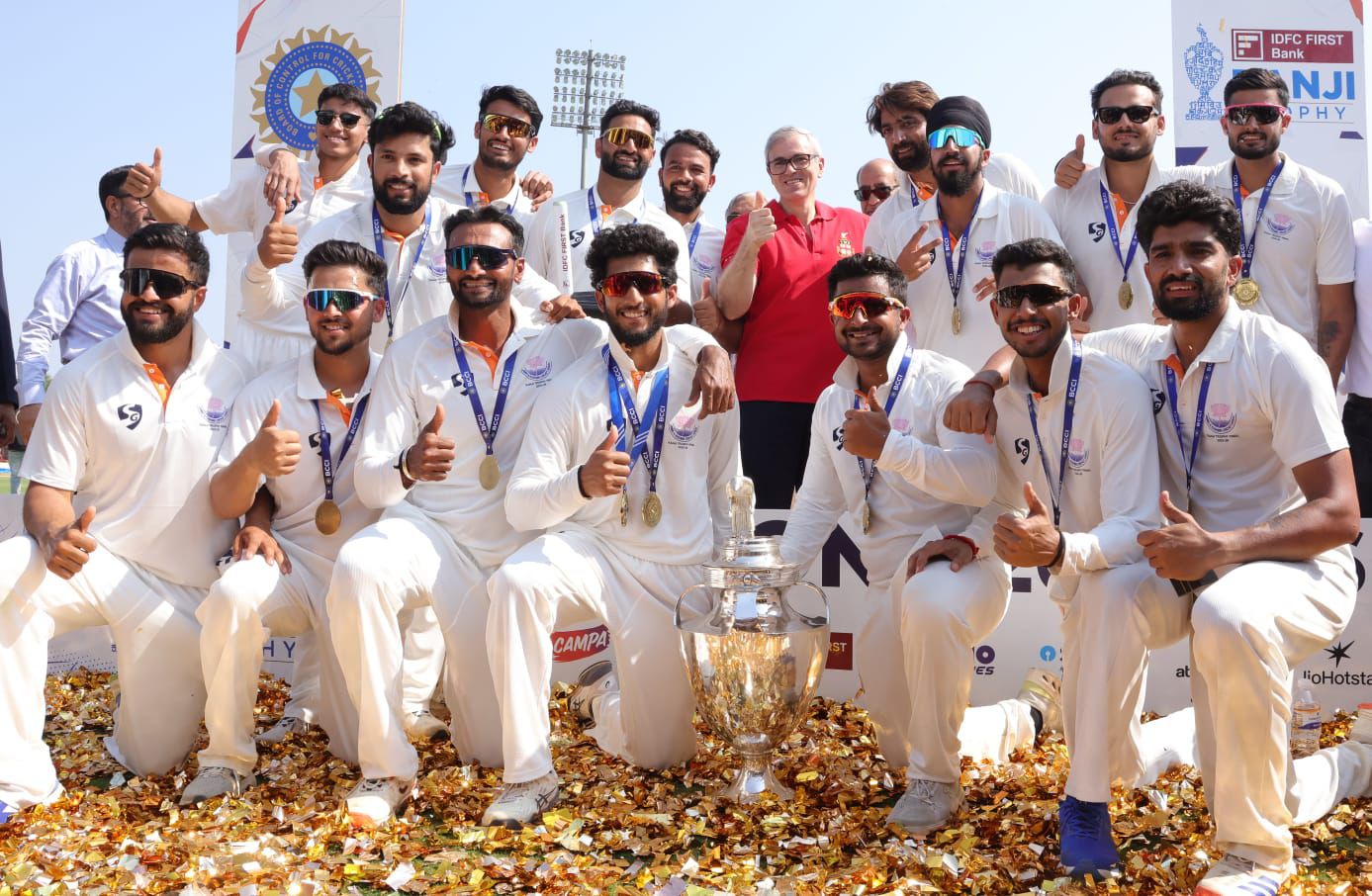
Hubballi, Feb 28: It was a little past 2 pm at the KSCA Stadium when Paras Dogra and Mayank Agarwal walked towards each other for the customary handshake. The formality of the draw confirmed what the preceding five days had already established: Jammu & Kashmir, the team from the Valley that has for decades been cricket’s perennial underdog, are the champions of Indian domestic cricket’s crown jewel.
The 92-year-old Ranji Trophy has a new name etched on its trophy. And it arrived via a 67-year-old dream.
J&K secured their maiden title on the basis of a massive first-innings lead, their total of 584 dwarfing Karnataka’s 293. Having declared their second innings at 342 for four, the visitors left no room for doubt, leaving the 19-time champions to ponder a final in which they were outplayed in every conceivable department.
The atmosphere in Hubballi’s Rajnagar area was distinct from the usual hum of a domestic final. Heavy security marked the arrival of Chief Minister Omar Abdullah, who had traveled to witness what many in the region consider a watershed moment. Nearly 7,000 fans packed the stands on the final day, swelling the five-day attendance to close to 20,000—a testament to the occasion’s magnitude.
If the first four days were about building a fortress, the fifth was about celebrating atop its ramparts. Resuming at 186 for four, J&K showed no intention of declaring prematurely. Qamran Iqbal, batting with the serenity of a monk, brought up an unbeaten 160. Sahil Lotra, meanwhile, reached his century and celebrated not with a wild roar, but with a simple push-up and a casual thigh-five—a moment of cool individuality in a team sport defined by collective grit.
For two full sessions, Karnataka’s vaunted attack toiled without taking a wicket. When the captains finally shook hands, the J&K dugout emptied. The red and blue of the J&K flag replaced the crease lines on the field. Players danced to the beat of drums that echoed from the stands. Auqib Nabi, the pacer who has been the wrecker-in-chief all season with 60 wickets, was hoisted onto shoulders, a folk hero in the making.
But this victory, as those in the J&K camp would attest, was never just about the cold numbers on a scorecard. It was the culmination of a journey that began in 1957-58, when the state first entered the competition. There were heartbreaks along the way—quarterfinal exits in 2013-14, 2019-20, and just last season—where frayed nerves and cataclysmic collapses undid the promise.
In Hubballi, however, there were no frayed nerves. Against a Karnataka side brimming with India internationals like KL Rahul, Prasidh Krishna, and Devdutt Padikkal, J&K displayed a tactical superiority that belied their final-debutant status.
This was a team effort in its truest sense. Shubham Pundir’s classy hundred laid the foundation. Captain Paras Dogra, now only the second batter to surpass 10,000 Ranji Trophy runs, provided the experience. Contributions from Yawer Hassan, Abdul Samad, and Kanhaiya Wadhawan ensured the total swelled to mammoth proportions.
And then there was Nabi, whose five-wicket haul in the first innings was his seventh such spell of the season.
The true testament to J&K’s character, however, was forged not in Hubballi, but a week earlier in Kalyani. In the semifinal against Bengal, they had conceded a first-innings lead—a precarious position in a knockout game. Where lesser sides would have crumbled, Nabi orchestrated a stunning collapse, bowling Bengal out for a mere 88 in the second innings. It was a script of resilience that made the players believe destiny was awaiting them in Karnataka.
For Karnataka, the defeat will sting for years. Having shown remarkable consistency throughout the season, a ninth title seemed a formality on paper. But paper doesn’t win trophies. The domestic heavyweight was swept aside not by a lucky punch, but by superior game awareness and relentless pressure.
The sight of KL Rahul rolling his arm over for a few overs of part-time spin on the final day was perhaps the most telling image of Karnataka’s dejection—a surrender to the inevitable. In the coming days, harsh words will be exchanged in boardrooms, and questions will be asked about how a team with such resources was outmaneuvered.
For now, however, the focus remains on the victors. The news cut through the entrenched lines of the region’s socio-political discourse, a unifying moment of pure sporting joy.



Comments are closed.