

Muntazir Ali
“The legacy of Ali Khamenei is often described symbolically as a spirit that lives on through institutions and ideological continuity rather than personality alone.”
In the history of political and ideological movements, certain leaders transcend their individual roles and gradually become symbols representing a broader set of beliefs and aspirations. Their influence is not limited to the period of their active leadership; rather, it extends into the collective consciousness of those who identify with the movement they helped shape. Over time, such figures come to embody faith, resistance, and continuity. When they grow older or withdraw from public life, their relevance often does not diminish. Instead, their ideas continue to guide followers who carry forward the same vision and ideological commitments.
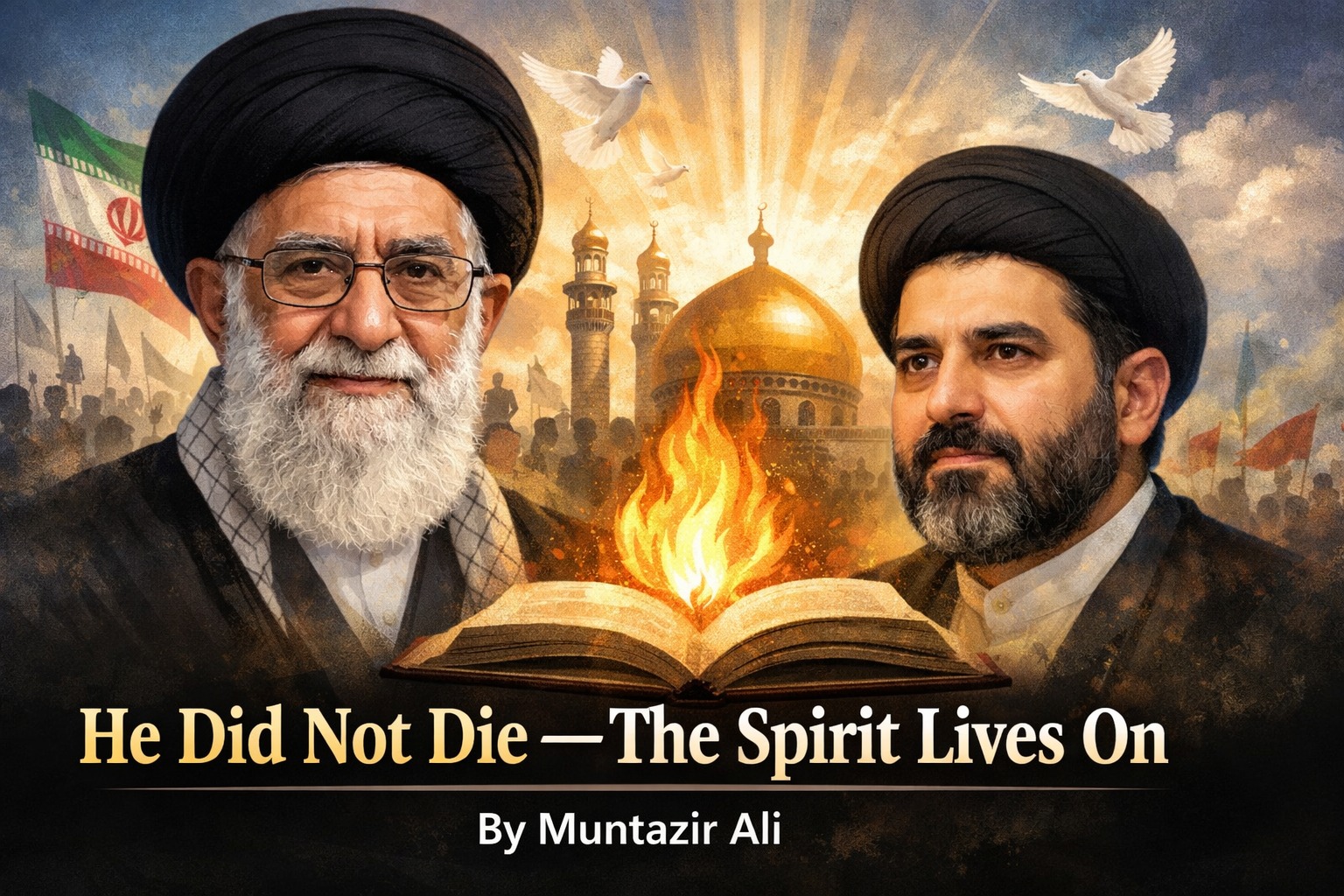
For many supporters across the Muslim world, Ali Khamenei has for decades remained one of the most influential figures in shaping the ideological and political direction of Iran following the Iranian Revolution. The revolution itself marked a major transformation in the country’s political structure, establishing a system in which religious authority and governance became closely intertwined. Within this framework, Khamenei’s leadership has been widely associated by his supporters with steadfastness, resistance and commitment to the ideals that emerged from the revolution.
However, movements built upon ideology and long-term institutional development rarely depend on a single individual. Their sustainability lies in the intellectual traditions, networks of scholars, and political institutions that nurture successive generations of leaders and thinkers. The ideas developed and reinforced over decades inevitably influence younger scholars and political actors who grow within the same ideological environment. Through this process, a movement gradually renews itself while preserving its core principles.
It is in this broader context that discussions sometimes turn toward individuals such as Mojtaba Khamenei. Although he maintains a relatively low public profile, his name periodically appears in conversations about the potential future trajectory of religious and political thought in Iran. Observers note that within ideological systems where leadership is closely tied to religious scholarship and institutional continuity, individuals shaped by the same intellectual traditions are often viewed as part of an evolving leadership structure.
For supporters of the revolutionary ideals, the central belief is that the spirit of a movement cannot simply disappear with the passage of time. Instead, it adapts and renews itself through those who remain committed to its teachings and sacrifices. In this sense, the legacy of Khamenei is often described symbolically as something that continues to live through the influence of his ideas and the institutions shaped under his leadership.
This perspective reflects a broader historical pattern. Throughout history, movements rooted in strong beliefs have demonstrated resilience beyond the lifetimes of their founders or key figures. Their survival has depended on the strength of their institutions, the depth of their ideological foundations, and the commitment of individuals who dedicate themselves to preserving and interpreting those principles for new generations.
For many who support the revolutionary vision, there is an expectation that the next generation will carry forward these ideals with wisdom and responsibility. The emphasis remains on continuity of principles rather than on personalities alone. Whether through scholars, political leaders, or community institutions, the enduring message is that ideas grounded in conviction and discipline possess the capacity to outlive any single era.
Ultimately, the history of ideological movements demonstrates that their longevity lies in collective commitment. When ideas resonate deeply with a community and are supported by enduring institutions, they continue to shape political and intellectual life long after the circumstances of their origin have passed. In that sense, the spirit of a movement does not fade; it evolves, adapting to new realities while remaining anchored in its foundational beliefs.

Comments are closed.