


Sameer Showkin Lone
“When India declared itself Open Defecation Free in 2019, it marked a watershed moment in public health. But as the euphoria settled, a more complex question emerged — what comes after ODF?”
When India declared itself Open Defecation Free (ODF) in 2019 under the Swachh Bharat Mission, it marked a watershed moment in the country’s public health journey. The construction of millions of toilets across rural India was not just an infrastructural achievement—it symbolized a shift in national priorities, bringing sanitation to the centre of development discourse. For the first time, cleanliness and dignity became part of everyday conversations in villages and households alike.
Yet, as the initial celebrations faded, a more complex and pressing question began to emerge: what comes after ODF?
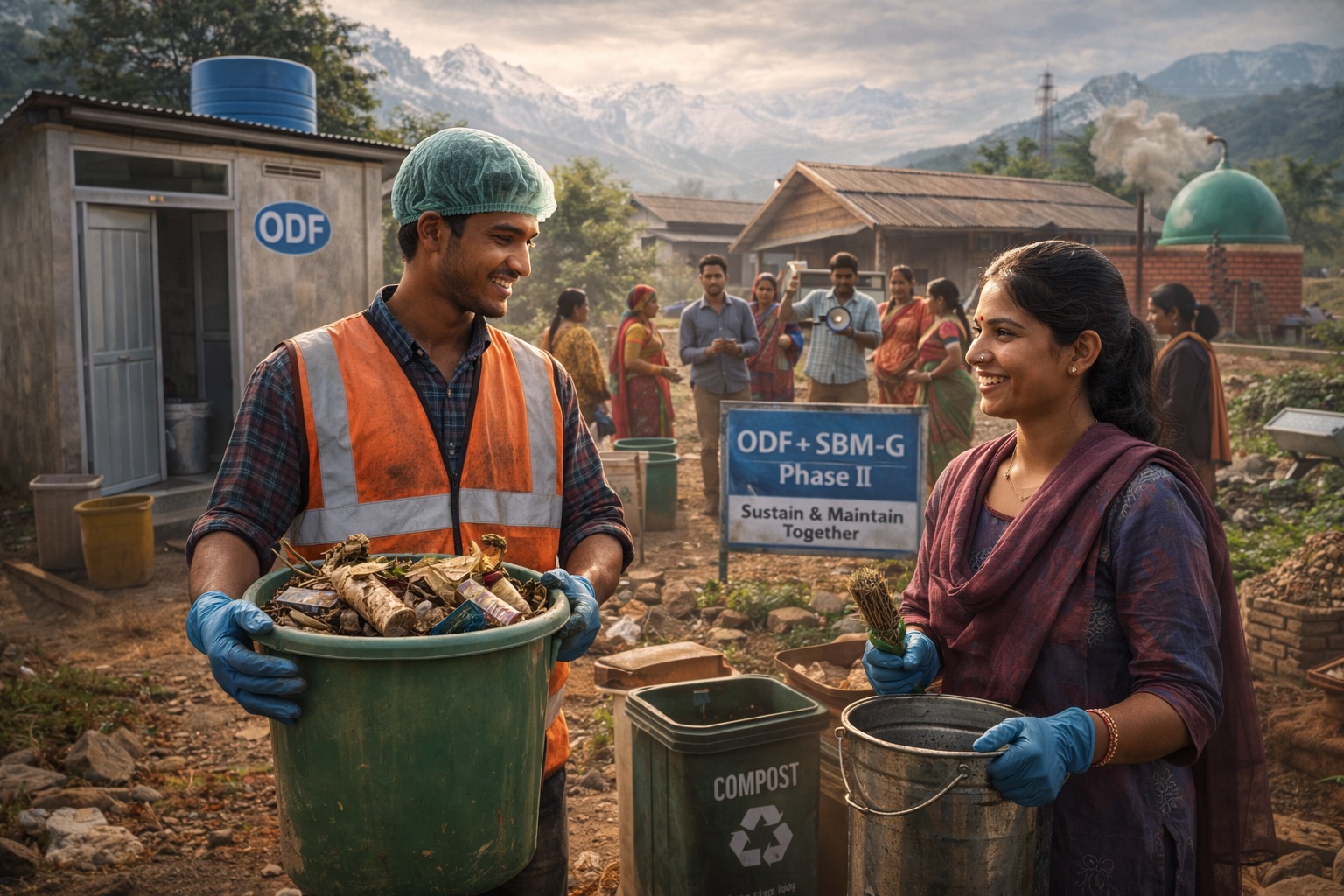
The answer lies in Swachh Bharat Mission (Grameen) Phase II—a phase that moves beyond the visible success of toilet construction to the less visible, but far more critical, domain of behavioural change, sustainability, and waste management. If Phase I was about building infrastructure, Phase II is about building habits. And at the heart of this transition lies one indispensable factor: community ownership.
The logic is simple but profound. Toilets can be constructed through government programmes, but their sustained use cannot be enforced through policy alone. Sanitation, at its core, is not merely a technical issue—it is deeply social and behavioural. The continued use, maintenance, and acceptance of sanitation facilities depend on how communities perceive them, value them, and integrate them into daily life.
This is where SBM-G Phase II represents a conceptual shift. It recognizes that infrastructure without ownership risks becoming redundant. Across parts of rural India, including regions that achieved ODF status, there have been instances where toilets fell into disuse, either due to poor maintenance, water scarcity, or deeply ingrained habits. Such setbacks underline a crucial lesson: sanitation is not a one-time achievement; it is a continuous process.
In regions like Jammu and Kashmir, the challenges of sustaining sanitation gains are even more pronounced. The region’s difficult terrain, harsh winters, and scattered habitations complicate both infrastructure development and service delivery. In many areas, water freezes during winter months, rendering toilets temporarily unusable. Remote villages often lack regular waste collection systems, making centralized solutions impractical. These realities demand not just innovation, but localisation of solutions.
Encouragingly, SBM-G Phase II has begun to embrace this need for context-specific approaches. Initiatives such as GOBARdhan biogas plants are particularly relevant. By converting cattle dung and organic waste into biogas and slurry, these systems not only manage waste effectively but also generate clean energy and organic fertiliser. In colder regions, adaptations like temperature-controlled units can ensure functionality even in extreme climates.
Similarly, decentralized wastewater treatment systems (DEWATS), faecal sludge treatment plants (FSTPs), and soak pits offer practical alternatives to conventional sewerage systems, especially in areas where terrain and population density make large-scale infrastructure unviable. These solutions, however, are not merely technical fixes—they require active participation from communities for operation and maintenance.
This is precisely where the role of community ownership becomes critical. When villagers are involved in planning, implementing, and managing sanitation systems, they develop a sense of responsibility and pride. Community-led waste collection models, for instance, have shown promising results in several parts of the country. When local youth or self-help groups take charge of waste management, it not only ensures efficiency but also creates livelihood opportunities.
Behavioural change is another pillar of sustainability. The success of sanitation initiatives ultimately depends on whether individuals internalize the importance of hygiene and cleanliness. Awareness campaigns, school-based education, and grassroots engagement must continue with the same intensity that marked the initial phase of the mission. Changing habits is a slow and often challenging process, but it is the only way to ensure lasting impact.
Equally important is the role of local governance institutions. Panchayats, village committees, and community leaders must act as custodians of sanitation gains. Their involvement ensures accountability and continuity, bridging the gap between government programmes and grassroots realities. Without strong local institutions, even the most well-designed schemes risk faltering.
At a broader level, SBM-G Phase II also reflects an evolution in development thinking. It moves away from a purely target-driven approach toward a more holistic understanding of outcomes. The focus is no longer just on the number of toilets built, but on the quality of life improved. This includes safe waste disposal, clean surroundings, and a healthier living environment.
However, the journey ahead is not without challenges. Sustaining momentum requires consistent funding, robust monitoring mechanisms, and continuous innovation. More importantly, it requires a shift in mindset—from viewing sanitation as a government responsibility to recognizing it as a collective societal duty.
The experience of the past decade offers a clear lesson: infrastructure can trigger change, but only people can sustain it. Community ownership is not an optional add-on; it is the foundation upon which the success of SBM-G Phase II rests.
As India moves forward in its sanitation journey, the emphasis must remain on deepening this sense of ownership. Because the real success of the mission will not be measured by the toilets that were built, but by the habits that endure.

Comments are closed.