

S Ahmad
In the grand narrative of India’s development, certain policy shifts unfold quietly, without spectacle, yet carry the potential to shape generations. The evolution of POSHAN Abhiyaan into Mission Poshan 2.0 is one such moment—subtle in its public reception, but profound in its implications. At its core, this transition reflects a growing recognition that nutrition is not merely a welfare concern to be addressed through subsidies or schemes, but a foundational pillar of human capital, economic productivity, and national progress.
For decades, India’s struggle with malnutrition has been a paradox. On one hand, the country has achieved remarkable progress in economic growth, technological advancement, and global standing. On the other, millions of children continue to suffer from stunting, wasting, anaemia, and undernutrition—conditions that silently undermine their potential before they even step into a classroom. These are not abstract statistics; they are lived realities that shape the trajectory of individuals and, by extension, the nation itself. A malnourished child is not only more vulnerable to disease but also more likely to face cognitive delays, poor educational outcomes, and limited economic opportunities later in life. In that sense, malnutrition is not just a health issue—it is a structural barrier to development.
It is against this backdrop that POSHAN Abhiyaan was launched in 2018 with an ambitious vision: to place nutrition at the centre of India’s development agenda. What distinguished this initiative from earlier efforts was not merely its scale, but its conceptual shift. It moved away from viewing nutrition as a fragmented sectoral responsibility and instead positioned it as a multidimensional challenge requiring coordinated action across health, sanitation, education, water, women’s empowerment, and livelihoods. This convergence-based approach acknowledged a simple yet often overlooked truth—malnutrition does not arise from a single cause, and therefore cannot be addressed through isolated interventions.
Over the years, this approach has evolved into the more integrated framework of Mission Poshan 2.0, which seeks to consolidate various nutrition-related schemes under a unified structure. The integration of programmes such as Integrated Child Development Services and Pradhan Mantri Matru Vandana Yojana reflects an effort to streamline delivery, reduce duplication, and ensure that beneficiaries receive comprehensive support across different stages of life. This lifecycle approach, particularly the emphasis on the first 1,000 days—from conception to a child’s second birthday—is grounded in scientific evidence. It is during this critical window that the foundations of physical growth, brain development, and long-term health are established. Interventions during this period have the highest impact, making it a focal point of the mission.
Yet, the ambition of Mission Poshan 2.0 extends beyond structural integration. It represents a broader attempt to redefine governance in the social sector through the use of technology. The introduction of the Poshan Tracker is emblematic of this shift. By enabling near real-time monitoring of over 14 lakh Anganwadi Centres and nearly 9 crore beneficiaries, the platform seeks to address one of the most persistent challenges in public service delivery—information asymmetry. For years, delays in data collection and reporting meant that policy decisions were often based on outdated or incomplete information. With digital tracking, the possibility of timely intervention becomes more realistic, and accountability is significantly enhanced.
However, the promise of technology must be approached with cautious optimism. While digital tools can improve efficiency and transparency, they also introduce new challenges. The success of the Poshan Tracker depends not only on its design but on its usability at the grassroots level. Anganwadi workers, who form the backbone of the system, must be adequately trained and supported to navigate these tools effectively. Issues such as digital literacy, connectivity in remote areas, and data privacy cannot be treated as peripheral concerns. If not addressed, they risk creating a gap between policy intent and ground-level implementation.
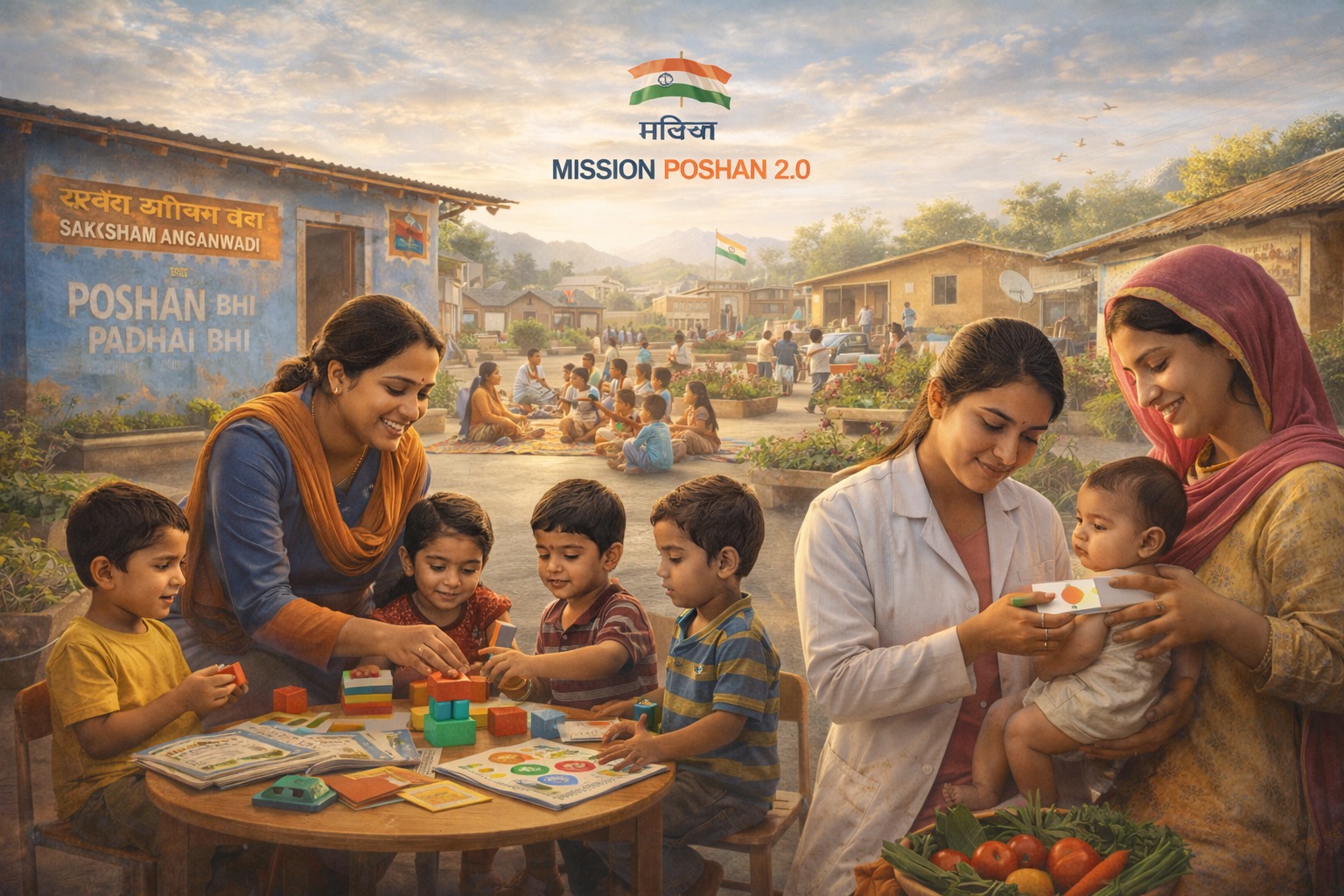
At the heart of Mission Poshan 2.0 lies the Anganwadi system—a vast network that has long served as the primary interface between the state and vulnerable communities. These centres are more than distribution points for supplementary nutrition; they are spaces where health, education, and social support intersect. The push towards Saksham Anganwadi reflects an understanding that improving infrastructure is essential for enhancing service quality. The introduction of modern amenities, smart learning tools, and nutri-gardens is a step towards creating an environment that is conducive to both learning and well-being.
Yet, infrastructure alone cannot drive transformation. The effectiveness of Anganwadi Centres ultimately depends on the people who run them. Anganwadi workers play a multifaceted role—monitoring child growth, counselling mothers, facilitating early childhood education, and fostering behavioural change within communities. Their work is often carried out under challenging conditions, with limited resources and recognition. Strengthening their capacity through training, fair compensation, and institutional support is not just desirable; it is indispensable.
One of the most promising dimensions of Mission Poshan 2.0 is its integration of nutrition with early childhood education. The alignment with the National Education Policy 2020 underscores a critical insight—that learning begins long before formal schooling. Cognitive development, language acquisition, and social skills are shaped in the early years, and interventions during this period can have lasting effects. Initiatives such as “Poshan Bhi Padhai Bhi,” along with frameworks like Navchetana and Aadharshila, seek to provide structured guidance for early stimulation and play-based learning. By equipping Anganwadi Centres with educational tools and training workers in pedagogical practices, the mission attempts to bridge the gap between care and education.
This integration is further strengthened by efforts to ensure a smooth transition from Anganwadi Centres to formal schooling. The introduction of Vidyarambh certificates and the co-location of centres with primary schools are aimed at creating continuity in a child’s learning journey. These measures, if implemented effectively, have the potential to address one of India’s most persistent challenges—poor foundational learning outcomes.
Equally significant is the mission’s emphasis on community engagement. By positioning nutrition as a Jan Andolan, POSHAN Abhiyaan recognises that lasting change cannot be achieved through government action alone. Behavioural practices related to diet, hygiene, and healthcare are deeply embedded in social and cultural contexts. Campaigns like Poshan Maah and Poshan Pakhwada aim to create awareness and encourage community participation, transforming nutrition from a policy issue into a shared social responsibility.
However, the effectiveness of these campaigns depends on their ability to move beyond symbolic participation. Counting activities or events does not necessarily translate into meaningful change. What matters is whether these efforts lead to sustained shifts in behaviour—whether families adopt diverse diets, whether mothers receive timely care, and whether communities take ownership of local nutrition initiatives. Achieving this requires continuous engagement, trust-building, and adaptation to local contexts.
Despite its comprehensive design, Mission Poshan 2.0 faces significant challenges. India’s diversity—geographical, cultural, and socio-economic—means that a uniform approach is unlikely to succeed everywhere. In regions with difficult terrain, such as parts of Jammu & Kashmir, logistical constraints can hinder service delivery. Seasonal disruptions, scattered populations, and limited infrastructure require flexible and context-specific strategies. Similarly, urban areas present a different set of challenges, including the rising prevalence of obesity and lifestyle-related diseases, which demand a reorientation of nutrition policies.
Another critical concern is the risk of over-reliance on quantitative metrics. While data-driven governance is essential, it can sometimes create a false sense of progress. High numbers of registered beneficiaries or conducted activities do not automatically translate into improved nutrition outcomes. There is a need to balance quantitative indicators with qualitative assessments that capture the lived experiences of beneficiaries.
Ultimately, the success of Mission Poshan 2.0 will depend on its ability to translate ambition into action. It requires sustained political will, adequate funding, and effective coordination across multiple levels of governance. It demands a focus on capacity building, particularly at the grassroots, and a commitment to continuous learning and adaptation. Above all, it calls for a recognition that nutrition is not a short-term project but a long-term investment in the nation’s future.
As India moves towards its vision of becoming a developed nation, the importance of building a healthy and productive population cannot be overstated. Nutrition is the foundation upon which all other aspects of development rest. Without it, the promise of growth remains incomplete, and the dream of equity remains unfulfilled.
Mission Poshan 2.0 offers a pathway to address this challenge, but it is only a beginning. Its true impact will be measured not in policy documents or digital dashboards, but in the lives it transforms—in children who grow up healthy and capable, in mothers who are empowered and supported, and in communities that take charge of their own well-being.
In the final analysis, the question is not whether India has the frameworks or the resources to tackle malnutrition. The question is whether it has the resolve to ensure that every child, regardless of where they are born, has an equal chance to thrive. If Mission Poshan 2.0 can rise to this challenge, it will not only strengthen India’s nutrition ecosystem but also lay the foundation for a more just, inclusive, and prosperous society.
Comments are closed.