India’s export story is no longer confined to large factories, major industrial corridors or cities connected directly to ports. A new and potentially transformative idea is taking shape: the possibility that a farmer, artisan, small manufacturer or entrepreneur sitting in a district far from India’s traditional commercial centres could become part of the country’s global trade story.
That is the central promise of the Districts as Export Hubs (DEH) Initiative.
India has built considerable momentum in international trade. Total exports of goods and services reached an all-time high of US$825.25 billion in 2024-25, and exports are estimated to have risen further to US$863.11 billion in 2025-26. These numbers are impressive. But the more important question is what lies beneath them.
Who is participating in this growth?
For decades, India’s export economy has been concentrated around established industrial clusters, metropolitan centres and locations with access to ports, large logistics networks and experienced exporters. That model helped India expand its presence in global markets, but it also left enormous local potential underused.
Across the country, districts possess products and skills that are deeply rooted in their geography, culture and local economies. Bastar has its distinctive iron craft. Jalgaon is known for bananas. Meghalaya produces its famous Mandarin oranges. Tiruppur has become synonymous with knitwear. Across hundreds of other districts are agricultural products, handicrafts, engineering goods, processed foods, textiles, minerals and services that could find buyers beyond India.
The challenge has never been a shortage of products. The challenge has been connecting those products with the world. That is where the Districts as Export Hubs initiative becomes important.
From Producing Locally to Selling Globally
India has traditionally viewed districts largely as administrative units and, in economic terms, as production centres. DEH attempts to introduce a different mindset.
A district can also be an export-planning unit. This is a subtle but significant change.
Instead of asking only what a district produces, the new approach asks what the district can produce competitively for national and international markets, what prevents it from exporting, what infrastructure it needs, what standards it must meet and how local enterprises can be connected with overseas buyers.
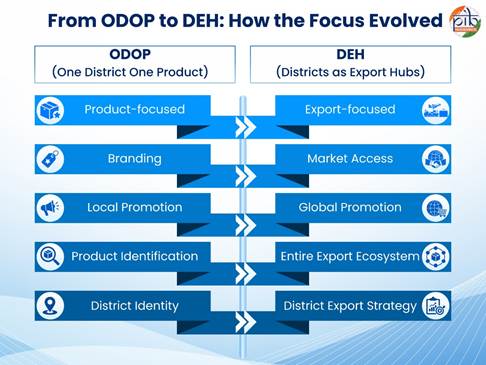
This approach builds upon the One District One Product (ODOP) concept.
ODOP began as a state initiative in Uttar Pradesh in 2018 and was subsequently scaled nationally. Its basic idea was straightforward: identify a distinctive product associated with each district, promote it, improve its visibility and turn local identity into economic opportunity.
The objective is no longer simply to promote a product. It is to build an ecosystem around that product so that it can actually reach a global customer.
That means identifying products and services, improving quality, strengthening packaging and branding, addressing logistics, building awareness about export procedures, facilitating testing and certification, connecting enterprises to markets and helping local businesses understand the demands of international trade.
This distinction matters.
A district may possess an excellent product but still have no meaningful export presence. A farmer may grow a high-quality crop but lack cold-chain facilities. An artisan may make an exceptional handicraft but know nothing about international packaging requirements. A small manufacturer may have the capacity to produce for foreign buyers but lack information about certification or customs procedures.
The product exists. The potential exists. What is missing is the bridge.
DEH is essentially an attempt to build that bridge.
More Than a Scheme
One of the most important aspects of DEH is that it is not designed as another standalone financial scheme.
It is better understood as a convergence framework.
This is important because development programmes often suffer from fragmentation. One department works on infrastructure, another on skills, another on credit, another on marketing, while the entrepreneur at the centre of all these interventions is left trying to connect the pieces.
Exports do not work in departmental compartments.
An exporter needs finance, quality testing, packaging, transportation, digital access, market information, regulatory knowledge and reliable logistics. A weakness in any one of these areas can make an otherwise competitive product unviable in an international market.
DEH attempts to bring existing Central and State schemes, institutions and industry support mechanisms together around district-level export potential.
That makes the initiative less about creating another layer of bureaucracy and more about making existing resources work together.
The institutional structure reflects this approach.
At the national level, the Department of Commerce provides policy direction, while the Directorate General of Foreign Trade plays a central role in implementation, coordination and monitoring.
At the State level, State Export Promotion Committees are expected to guide implementation and promote convergence between departments.
At the district level, District Export Promotion Committees identify export opportunities, work with local industries and exporters, examine bottlenecks and coordinate interventions.
This district-level structure could ultimately determine whether the initiative succeeds.
Because export promotion cannot be designed entirely from New Delhi or State capitals.
The people who understand why a product is not reaching markets are often the people working closest to the ground.
The District Export Action Plan
The District Export Action Plan (DEAP) is therefore one of the most significant components of the initiative.
A meaningful export strategy requires more than a list of products.
A district must know which products have genuine export potential, which markets could absorb them, what infrastructure gaps exist, whether production volumes are adequate, whether quality standards can be met and what prevents local businesses from scaling.
DEAPs are intended to provide that roadmap.
As of March 2026, draft District Export Action Plans had been prepared for 590 districts, with 249 formally adopted by the respective District Export Promotion Committees.
These numbers show both the progress and the work that remains.
Preparing a plan is the beginning, not the achievement.
The real test will be whether these plans translate into functioning cold chains, testing facilities, better roads and logistics, improved packaging, new exporters, stronger MSMEs and actual increases in export value.
A district should not measure success merely by the existence of a document.
It should measure success by the number of businesses that move from local markets to national and international markets because that document led to concrete action.
Finding the Hidden Exporters
Perhaps the greatest strength of the district-led model is its ability to identify businesses that conventional export statistics can overlook.
India has millions of small enterprises. Many operate within local or regional markets and never consider themselves exporters.
Some may believe international trade is meant only for large companies.
Others may be discouraged by documentation, certification requirements, freight costs or unfamiliarity with foreign markets.
DEH can change that mindset.
Consider a small food-processing unit producing a distinctive regional product. Its biggest market may currently be within a few districts. But with appropriate packaging, food safety compliance, branding, testing and market information, the same product could potentially reach overseas Indian communities or niche international consumers.
The same logic applies to handicrafts.
An artisan may produce an item with considerable cultural and aesthetic value but lack access to international buyers. Digital commerce and export facilitation can potentially shorten that distance.
This is where the phrase “Vocal for Local” acquires a practical economic meaning.
Being vocal about local products is not enough.
The local product must become globally competitive.
Global Markets Demand Global Standards
International markets are unforgiving. A product can be beautiful, inexpensive and locally popular and still fail internationally if its quality varies, its packaging is inadequate or it does not meet regulatory requirements.
This is why export promotion cannot be reduced to marketing.
DEH places emphasis on awareness and capacity-building around quality standards, testing facilities, packaging, branding and certification.
That is essential. The move from domestic commerce to international trade is also a move from familiar customers to unfamiliar customers who may have no connection with the product’s place of origin.
The buyer abroad does not necessarily know the artisan, farmer or manufacturer.
Trust therefore has to be built through standards. Certification, consistency, traceability, packaging and reliable delivery become part of the product itself.
For India’s smaller enterprises, this transition may initially appear difficult. But it can also become a powerful mechanism for upgrading local production.
Once a producer learns to meet international standards, the benefits do not necessarily stop with exports. Better packaging, quality control, process management and branding can also improve competitiveness in domestic markets.
In that sense, export readiness can become a broader business-development tool.
The Digital Door to the World
Technology is changing the geography of commerce. In the past, a small producer in a remote district faced a fundamental disadvantage: distance.
Today, a digital platform can make a product visible to a customer thousands of kilometres away. But visibility alone is not enough. The product must also reach that customer efficiently.
This is why DEH’s emphasis on e-commerce partnerships and postal export infrastructure is significant. Partnerships involving platforms and logistics providers such as Amazon, Shiprocket and DHL can offer MSMEs more accessible shipping options. Dak Ghar Niryat Kendras can provide low-cost postal export facilities for documentation, packaging and smaller consignments.
For a large exporter, freight arrangements may be routine. For a small enterprise shipping its first international order, they can be intimidating. A simple export process can therefore be as important as a financial incentive.
If a small producer understands how to package an order, complete documentation, ship it and receive payment safely, exporting stops looking like an activity reserved for large corporations.
This democratisation of export capability could become one of the initiative’s most important long-term outcomes.
Training the First-Time Exporter
There is another obstacle that cannot be solved through infrastructure alone: knowledge.
Many potential exporters simply do not understand international trade.
What documentation is required?
How are overseas buyers verified?
What standards apply?
How should products be packaged?
What happens if a payment is delayed?
How can freight costs be managed?
How does one identify a genuine foreign buyer?
These are practical questions, and for a first-time exporter they can determine whether an international opportunity becomes a success or a costly failure.
This makes capacity-building programmes important.
DGFT Regional Authorities and district administrations, along with organisations such as the Export Credit Guarantee Corporation of India, Export Promotion Council for Handicrafts, Federation of Indian Export Organisations, Ministry of MSME, India Post and Exim Bank, have contributed to awareness and capacity-building efforts.
The focus on e-commerce-related risks is equally relevant. Digital commerce creates opportunities, but it also introduces challenges involving payments, buyer verification and trust.
The new exporter needs not only access to a platform but also the knowledge to use it safely.
Turning Districts into Economic Ecosystems
The most interesting aspect of DEH may ultimately be its potential to transform the economic character of districts.
An export product rarely generates value in isolation.
Take an agricultural product.
If overseas demand increases, the benefits can extend beyond the farmer. There may be greater demand for sorting, grading, packaging, cold storage, transportation, processing, quality testing, warehousing and logistics.
Similarly, a successful handicraft export cluster can create demand for skilled workers, designers, packaging suppliers, digital marketers, transporters and small manufacturing units.
Exports can therefore generate an economic ecosystem around a product.
That is why district-level export growth can have a multiplier effect on employment.
The objective should not simply be to ship more goods.
It should be to create more value within the district before those goods leave the country.
If raw agricultural produce leaves a district and is processed, branded and packaged elsewhere, much of the value addition happens outside the producing region.
But if processing, packaging, branding and logistics develop locally, a greater share of the economic value remains in the district.
That is how exports can become a tool of regional development rather than merely a measure of national trade.
The Tiruppur Lesson
Tiruppur offers a powerful example of what a district-level export ecosystem can become.
India’s knitwear capital recorded exports of about ₹46,000 crore in FY 2025-26, and the Tiruppur Exporters’ Association has set an ambitious target of ₹1 trillion in exports by 2030.
The significance of Tiruppur lies not merely in its export figure.
It demonstrates what happens when a local industrial ecosystem develops the skills, suppliers, infrastructure, institutions and market connections required to compete globally.
The challenge before DEH is to help more districts develop their own versions of this story.
They will not all become another Tiruppur. Nor should they.
A district’s strength may lie in agriculture, handicrafts, engineering, food processing, textiles, minerals, tourism or services.
The objective is not to impose one model everywhere.
It is to discover what works in each place and build the ecosystem around it.
Learning from the Grassroots
The partnership between DGFT and Exim Bank under the Grassroots Initiatives for Development (GRID) programme reflects this district-specific approach.
Six districts—Anantapur, Raipur, Solan, Tiruppur, Kanpur and Kolhapur—have been selected for support.
The idea is to identify sector-specific constraints, potential beneficiaries and interventions suited to local circumstances.
This is the right philosophy. India is too diverse for a single export template.
The export challenge facing an agricultural district in central India will not be identical to that of a textile cluster in Tamil Nadu, a handicraft district in the Northeast or a horticultural district in Jammu and Kashmir.
The policy framework must therefore be national, but the solutions must often be local.
What It Could Mean for Jammu and Kashmir
For Jammu and Kashmir, the district-led export philosophy carries particular relevance.
The region possesses products with strong geographical, cultural and agricultural identities. Handicrafts, handloom products, horticulture, dry fruits, saffron, processed foods and other locally rooted products have potential beyond domestic markets.
But potential does not automatically become exports.
A Kashmiri apple, for example, competes not only on taste but also on grading, packaging, storage, transportation, consistency and delivery timelines.
A handicraft product competes on design, authenticity, quality, certification, branding and customer experience.
This is where district-level export planning can make a difference.
Instead of looking at exports as something handled primarily by established exporters in major commercial centres, districts can identify their own strengths and build targeted ecosystems around them.
The question should be asked in every district:
What do we produce that the world could buy, and what is stopping us from selling it?
The answer may be infrastructure.
It may be packaging. It may be certification. It may be skills. It may be logistics. It may simply be a lack of information.
Once the problem is identified, the district export plan should become a mechanism for solving it.
The Numbers Will Matter, But So Will the People
The Government has adopted a focused and phased approach to DEH implementation from June 1, 2026.
The first phase covers districts across 27 States and Union Territories, supported by 24 DGFT Regional Authorities and 11 partner agencies. The emphasis is on measurable outcomes, including new exporter registrations and growth in export value, while leveraging GI products, MSME clusters and existing Central and State schemes.
This outcome-oriented approach is welcome.
But the success of the initiative should ultimately be judged in human terms.
How many small enterprises became exporters?
How many farmers gained access to higher-value markets?
How many artisans acquired new customers?
How many young people found jobs in packaging, logistics, processing and digital commerce?
How many districts increased the share of value retained locally?
These questions matter because export growth is not an end in itself.
The real objective is broader economic opportunity.
Avoiding the Risk of Becoming Another Paper Exercise
There is, however, a danger that must be acknowledged.
India has no shortage of plans.
The difference between a successful policy and another government document lies in implementation.
District Export Action Plans should not become static reports sitting in offices. They need periodic review, measurable targets and local accountability.
Districts should know their baseline export value, their priority products, their target markets and their major bottlenecks.
They should also know who is responsible for solving each bottleneck.
If a testing facility is required, there should be a timeline.
If packaging is the constraint, there should be an intervention.
If exporters lack credit, the relevant institutions should be brought into the process.
If logistics is the problem, the solution should involve logistics providers and infrastructure agencies.
The district must become a problem-solving platform, not merely a reporting mechanism.
The Road to a Trillion Dollars
India’s ambition to reach US$1 trillion in exports will require more than increasing shipments from existing exporters.
The next phase of growth must broaden the export base.
More firms need to export.
More regions need to participate.
More products need to reach international markets.
And more value needs to be created before products leave Indian shores.
That is why the Districts as Export Hubs initiative deserves attention beyond its administrative structure.
Its deeper significance lies in changing the geography of opportunity.
For decades, economic development in many countries has followed a pattern in which investment flows towards established centres, while peripheral regions remain suppliers of raw materials or low-value goods.
A district-led export strategy offers an alternative possibility.
A village can produce for a district.
A district can produce for a State.
A State can produce for the country.
And the country can produce for the world.
That progression can turn local identity into economic strength.
India’s Global Story Can Begin Locally
The most compelling idea behind Districts as Export Hubs is also the simplest: India’s global ambitions must have local foundations.
The road to a trillion-dollar export economy will not be built only in Mumbai, Delhi, Chennai, Bengaluru, Ahmedabad or other established commercial centres.
It will also run through agricultural fields, artisan workshops, small factories, food-processing units and entrepreneurial ventures scattered across hundreds of districts.
The real opportunity is to ensure that distance from a port does not become distance from a market.
A small producer should not have to become a large corporation before being allowed to think globally.
An artisan should not need a metropolitan address to find an international customer.
A farmer should not remain trapped in a low-value market simply because the systems required to reach a better one do not exist.
And a district should not be defined only by what it consumes or produces for nearby markets.
It can also be defined by what it sends to the world.
The DEH initiative will succeed if it can convert this idea into everyday economic reality.
That means fewer barriers, better information, stronger institutions, reliable logistics, improved standards, easier digital access and, above all, sustained handholding for first-time exporters.
India already has products the world wants.
It has farmers who can produce.
It has artisans who can create.
It has entrepreneurs who can innovate.
What it now needs is a system capable of connecting that enormous local capacity to global demand.
The future of Indian exports may therefore not be found in one industrial cluster or one major port.
It may be found in every district that discovers its strength, builds its competitiveness and finds its place in the world market.
The ambition is not simply to make India an exporting nation.
It is to make every part of India a participant in India’s export story.
The article is based on the inputs and background information provided by the Press Information Bureau (PIB). Author is Writer, Policy Commentator. He can be mailed at kcprmijk@gmail.com


Comments are closed.