
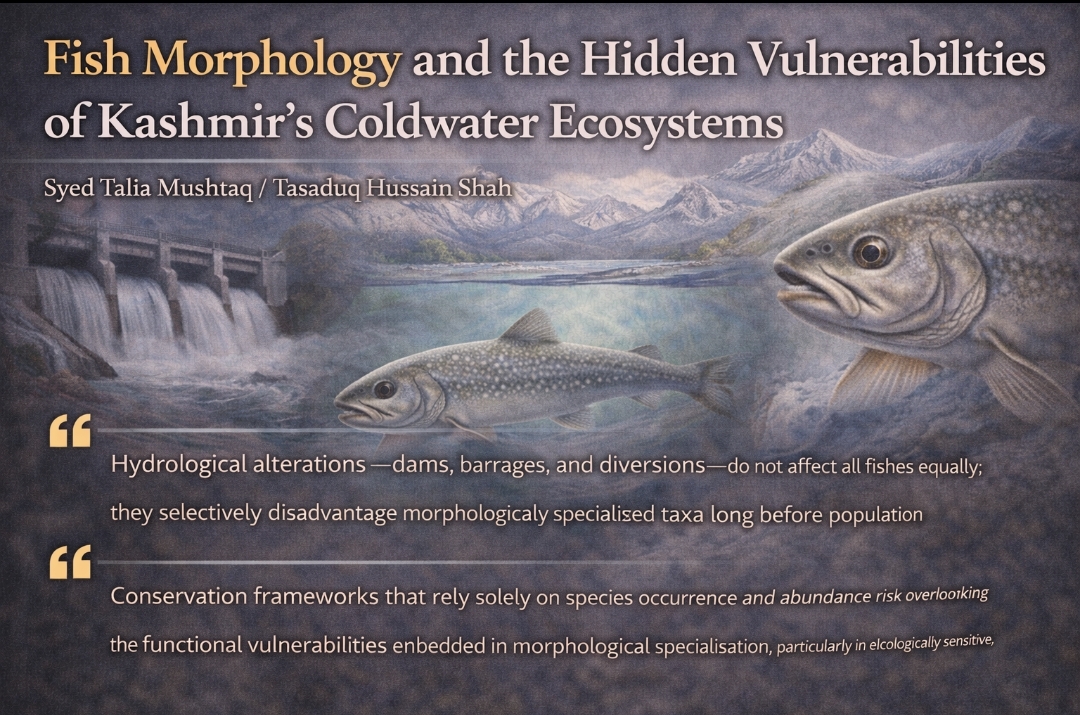
Fish Morphology and the Hidden Vulnerabilities of Kashmir’s Coldwater Ecosystems

The article examines the absence of morphological considerations in Indian freshwater fish conservation policy, with particular reference to high-altitude ecosystems.

Syed Talia Mushtaq / Tasaduq Hussain Shah

“Hydrological alterations—dams, barrages, and diversions—do not affect all fishes equally; they selectively disadvantage morphologically specialised taxa long before population collapse becomes visible.”

High-altitude freshwater ecosystems of India, while exhibiting low temperatures, steep environmental gradients, short growing seasons, and limited trophic resources support a high diversity of coldwater fish fauna comprising both endemic and introduced species. These systems, concentrated mostly in the Himalayan and Trans-Himalayan regions, are known for their ecological sensitivity and high levels of endemism. However, conservation policy and management frameworks for freshwater fishes in India, especially in these ecosystems, continue to rely primarily on species occurrence and abundance. A critical dimension of morphological specialisation and its practical significance remains largely absent when it comes to policy considerations.

In high-altitude environments, morphology is closely linked to survival. Traits such as orientation of the mouth and lips, configuration of jaws, pharyngeal structures, body form, presence of specialised organs and placement of fins reflect feeding strategy, habitat association, and energetic constraints. In cold, oligotrophic waters, where food availability is seasonally limited, these traits determine how efficiently fishes utilize available resources. Functional trait ecology has repeatedly demonstrated that form–function relationships govern niche occupation and ecological performance across aquatic systems. Despite this fact, conservation assessments in Indian freshwater systems rarely incorporate morphological or functional attributes when evaluating vulnerability. This gap is especially pronounced in the coldwater Himalayan regions. In practice, Indian freshwater fish conservation assessments and management guidelines continue to prioritise species occurrence, catch trends, and threat categorisation, with little or no consideration of morphological or functional traits that influence ecological sensitivity especially in these biodiversity hotspots.

Current policy instruments and threat assessments remain largely species-centric. While such approaches are necessary, they indirectly assume functional equivalence across populations and habitats. This assumption is problematic in upland systems, where many fishes occupy narrow trophic niches or exhibit strong benthic or substrate-associated feeding specialisation. Species that appear stable in terms of presence or catch may nevertheless be highly sensitive to environmental change due to limited functional plasticity. Similar concerns have been raised globally, where reliance on species lists alone has been shown to underestimate ecological degradation and functional loss.

Hydrological modification further adds to this oversight. Construction of dams, barrages, and water diversions are increasingly common in high-altitude river systems, altering flow regimes, sediment dynamics, and benthic prey availability. Such changes interact directly with feeding morphology and habitat use, disproportionately affecting fishes adapted to specific flow conditions or substrates. Functional trait approaches in lotic ecosystems have demonstrated that hydrological alteration selectively disadvantages specialist taxa long before population collapse becomes evident Yet environmental impact assessments and management plans in India continue to focus primarily on changes in species composition or overall abundance.

Climate change adds an additional layer of complexity. Rising temperatures, altered snowmelt patterns, and reduced seasonal predictability influence both prey communities and metabolic demand in cold upland waters. Morphologically specialised fishes may have limited capacity to adjust to such changes compared to generalist species, leading to an overestimation of resilience when assessments rely solely on distributional data. This concern is particularly relevant for cold-water and endemic fishes already constrained by narrow ecological tolerances.

The exclusion of morphology from conservation policy also limits early detection of ecological stress. Shifts in functional traits, body condition, or feeding structures can precede measurable declines in abundance, offering valuable early warning signals. Trait-based indicators are increasingly used in terrestrial and freshwater ecology to assess ecosystem integrity and functional erosion, yet remain underutilised in Indian freshwater conservation, particularly in remote high-altitude regions where long-term monitoring data are limited.

This gap reflects not only a lack of scientific understanding, but also a disconnect between research and policy translation. Morphological diversity and functional specialisation of Indian upland fishes have been documented for decades, yet these insights rarely inform conservation prioritisation, environmental impact assessments, or management guidelines. Even recent policy discussions on freshwater biodiversity and invasive species management continue to emphasize merely the presence of species rather than their functional vulnerability. Addressing this disconnect does not require replacing existing species-based frameworks. Rather, it calls for complementing them with trait-informed approaches that integrate basic morphological and functional classifications into vulnerability assessments and monitoring programmes thus improving ecological realism while remaining feasible within existing management structures.

As pressures on high-altitude freshwater ecosystems intensify, conservation policy must evolve accordingly. Recognising morphology as a determinant of vulnerability is not a theoretical refinement, but a practical necessity. Without this shift, freshwater conservation risks protecting species names while overlooking the functional attributes that sustain ecosystem stability in some of India’s most fragile aquatic environments.

Authors are scholars of the Division of FRM, Faculty of Fisheries, Sher-e-Kashmir University of Agricultural Sciences and Technology-Kashmir, Jammu and Kashmir, India. They can be contacted at syedtalia2020@gmail.com

Comments are closed.