

Firdous Ahmad Malik
Kashmir, with its mountains, rivers, and orchards, is not only known for its natural beauty but also for the simple, creative ways in which its people once found joy. Long before televisions, mobile phones, and video games, Kashmiri childhood was filled with homemade games, crafted out of whatever was available in the surroundings. One of the most cherished and widely remembered among these was Faith Cheed — literally meaning “bird under the bucket.” It was not only a pastime but also a symbol of innocence, mischief, and the playful community spirit of village life.
The Game and Its Simplicity
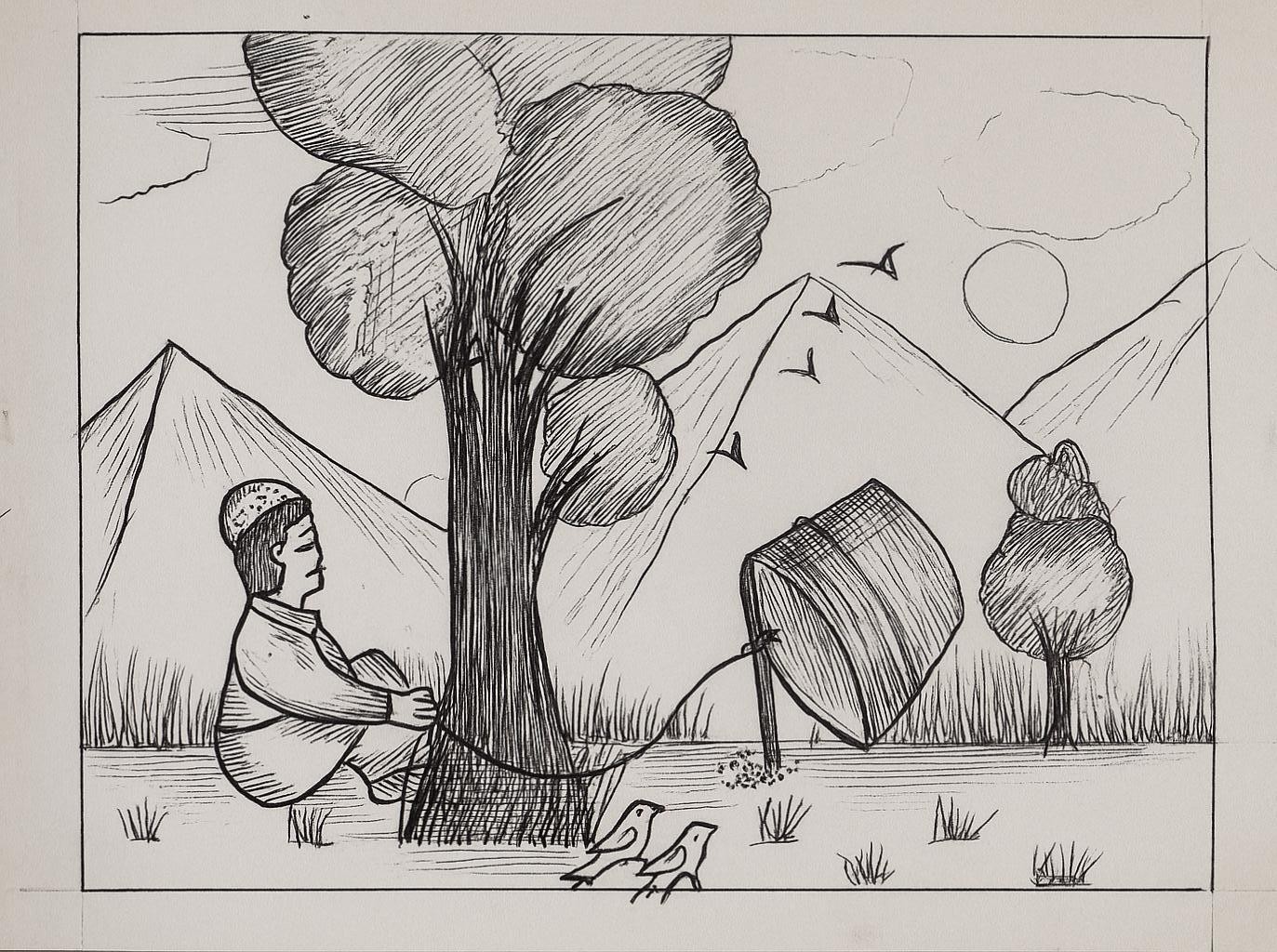
The essence of Faith Cheed lay in its simplicity. All that was required was a bucket, a large earthen pot (kraal), or sometimes even a woven wicker basket. The trap was set by placing the pot upside down, propped up with a stick. A string was tied to the stick and held from a distance. Beneath the pot, children scattered maize kernels (shol), tiny treasures to lure hungry sparrows (tchi’ri) and mynas. Once everything was arranged, the children hid behind a wall, a haystack, or sometimes even a pile of firewood, waiting with bated breath.
The game did not demand money, skill, or equipment. It thrived in the resourcefulness of Kashmiri children who turned everyday household items into tools of joy. For them, a rusty tin bucket was not a neglected object but the gateway to an afternoon of laughter.
Suspense in the Winter Air
The peak season of Faith Cheed was winter, particularly during chillai kalan, the harshest forty days of cold when schools were closed and outdoor activities were limited. Children, restless from long hours indoors, would run to the courtyards and lanes, carrying with them the energy of pent-up play.
In the stillness of the snowy afternoon, the suspense of the game was electric. Children crouched in silence, their eyes peeping over the mud wall, watching the sparrows flutter on the bare branches of willow and poplar trees. The birds, cautious yet tempted by the bright yellow maize, hopped closer and closer. Hearts beat faster, hands trembled slightly on the string. The silence was often broken by nervous giggles or a whispered, “Yi chu guzas, yi chu guzas!” (It is coming, it is coming!).
When at last a sparrow or two darted under the pot to peck at the grains, the waiting child pulled the string. With a quick thak, the pot dropped. The sparrows flapped in confusion, their wings brushing against the iron or clay. Then came the eruption — shrieks of joy, clapping, and wild laughter as children ran to see what they had caught.
The Joy of Success and Failure
The delight of Faith Cheed was not only in success. Failures, too, brought enormous laughter. If someone pulled the string too early, the birds escaped, and the others burst into teasing. If someone pulled too late, they groaned dramatically, holding their heads as if mourning a great loss. The teasing was endless. “Yi chu na shikari, yi chu fool!” they laughed at the unlucky one who spoiled the chance.
On good days, two or three sparrows were caught at once, and the entire group erupted into victorious shouts. The children would dance around, pretending to be great hunters, their imaginations turning a simple game into a grand adventure. On unlucky days, the sparrows were too clever, refusing to step under the bucket at all. Then the children waited in vain, their noses red from the cold, only to return home empty-handed. Yet even these failures turned into stories to share and laugh about later.
Togetherness and Laughter
Faith Cheed was never a solitary game. It was always played in groups, sometimes with a dozen children from neighboring houses. One would hold the string, others kept watch, and still others cheered from the sidelines. Girls often joined too, sometimes helping, sometimes simply laughing at the boys’ exaggerated excitement.
The game created a sense of togetherness. It required teamwork, patience, and a shared sense of suspense. The joy was multiplied because it was experienced collectively. A successful catch was celebrated like a festival; a failed attempt became a comedy performed for everyone’s amusement. The lanes of villages echoed with these playful cries, carrying the sound of childhood innocence across rooftops and orchards.
The Birds and Their Freedom
Although birds were trapped, most of the time they were released shortly afterward. The real joy was in the catching, not in the keeping. Children loved to hold the sparrows for a brief moment, feeling the rapid flutter of their hearts, marveling at their fragile wings. Then, with a laugh, they opened their palms or lifted the bucket, watching the birds soar into the pale winter sky.
This act of release was often followed by clapping and shouts of “Yi chu wapas guvas!” (It has gone back!). The game was not about cruelty but about the thrill of the chase, the suspense of the trap, and the innocent wonder of being close to a living creature.
Part of a Larger Childhood World
Faith Cheed was one game among many that colored Kashmiri childhood. Alongside it were games like dang chol (stick play), kaand tuul (rope swing), and tull-bul (stone skipping on water). Together, they formed a mosaic of village entertainment where imagination, nature, and friendship were the only ingredients needed.
What made Faith Cheed special was its mixture of patience and sudden excitement. Unlike running or chasing games, it required sitting quietly, controlling one’s laughter, waiting for the right moment. Then, in a flash, all that patience exploded into joy. It was a perfect blend of suspense and celebration, unique in its character.
Nostalgia and Change
Today, the practice of Faith Cheed has almost disappeared. Children now spend their afternoons with mobile phones, televisions, or video games. The sight of a group of boys hiding behind a wall, eyes fixed on a bucket, waiting to catch a sparrow, is rare. Times have changed, lifestyles have shifted, and the innocence of such simple pastimes has faded into memory.
Yet, for those who grew up in Kashmiri villages, the mention of Faith Cheed instantly lights up their eyes. They remember the laughter, the teasing, the breathless suspense, and the triumphant shouts. They remember the feel of snow under their shoes, the warmth of kangris waiting at home, and the taste of hot noon chai after an afternoon of play. They remember not only the sparrows but the friendships, the togetherness, and the carefree spirit of childhood.
A Symbol of Innocence
Faith Cheed may seem like a small and forgotten game, but it represents a larger truth about Kashmiri childhood. It shows how joy does not require wealth or technology, but only creativity, community, and the willingness to find magic in ordinary things. A bucket, a stick, a few maize kernels, and a group of laughing children — that was enough to turn a cold winter afternoon into a festival of happiness.
It also stands as a reminder of innocence. The children who played Faith Cheed did not think of cruelty or harm. Their joy came from suspense, surprise, and laughter. The birds were caught, admired, and then set free, leaving behind memories that lasted far longer than the moment itself.
Conclusion
In the story of Kashmir’s culture, Faith Cheed is a small but precious chapter. It belongs to the world of mud houses, willow trees, snow-covered courtyards, and the echo of children’s laughter across quiet villages. It is remembered not for the birds that were caught but for the joy that was shared, the friendships that were built, and the innocence that defined childhood.
Though times have changed and such games have almost vanished, the memory of Faith Cheed continues to flutter like a sparrow in the hearts of those who once played it. It is a reminder that happiness can be simple, fleeting, and yet unforgettable — like the moment when a bird steps under a bucket and a group of Kashmiri children explode into laughter.
The writer is a columnist and research scholar of Political Science at Mansarovar Global University, Bhopal, M.P. He can be reached at: artistmalik12@gmail.com

Comments are closed.