Bandipora, Jan 07: Around four o’clock in the afternoon, Ali Mohammad stepped out of his home, as he had done countless times before. It was part of his daily routine. He walked a short distance to a nearby shop run by a shopkeeper named Khazar Kakh. There was nothing unusual about the visit. He bought a loaf of bread and a candle—ordinary items for an ordinary evening. As he was about to leave, he mentioned casually that he had fainted the previous day. It was said without drama, without worry, almost in passing. Ali Mohammad was not a man who made much of his troubles.
That simple remark, however, was misunderstood by some. Word spread that he had died. In reality, he was still alive. Breath still moved within him. Life had not yet left his body. But destiny, it seems, had only granted him a short extension.
Around five in the evening, news began to circulate again—this time with grim accuracy. Ali Mohammad had suffered another bout of fainting. He was rushed to the hospital in haste and hope. But fate intervened on the way. Before he could reach medical care, his soul quietly departed from its earthly frame. Without noise, without spectacle, a life that had always moved in silence came to its end.
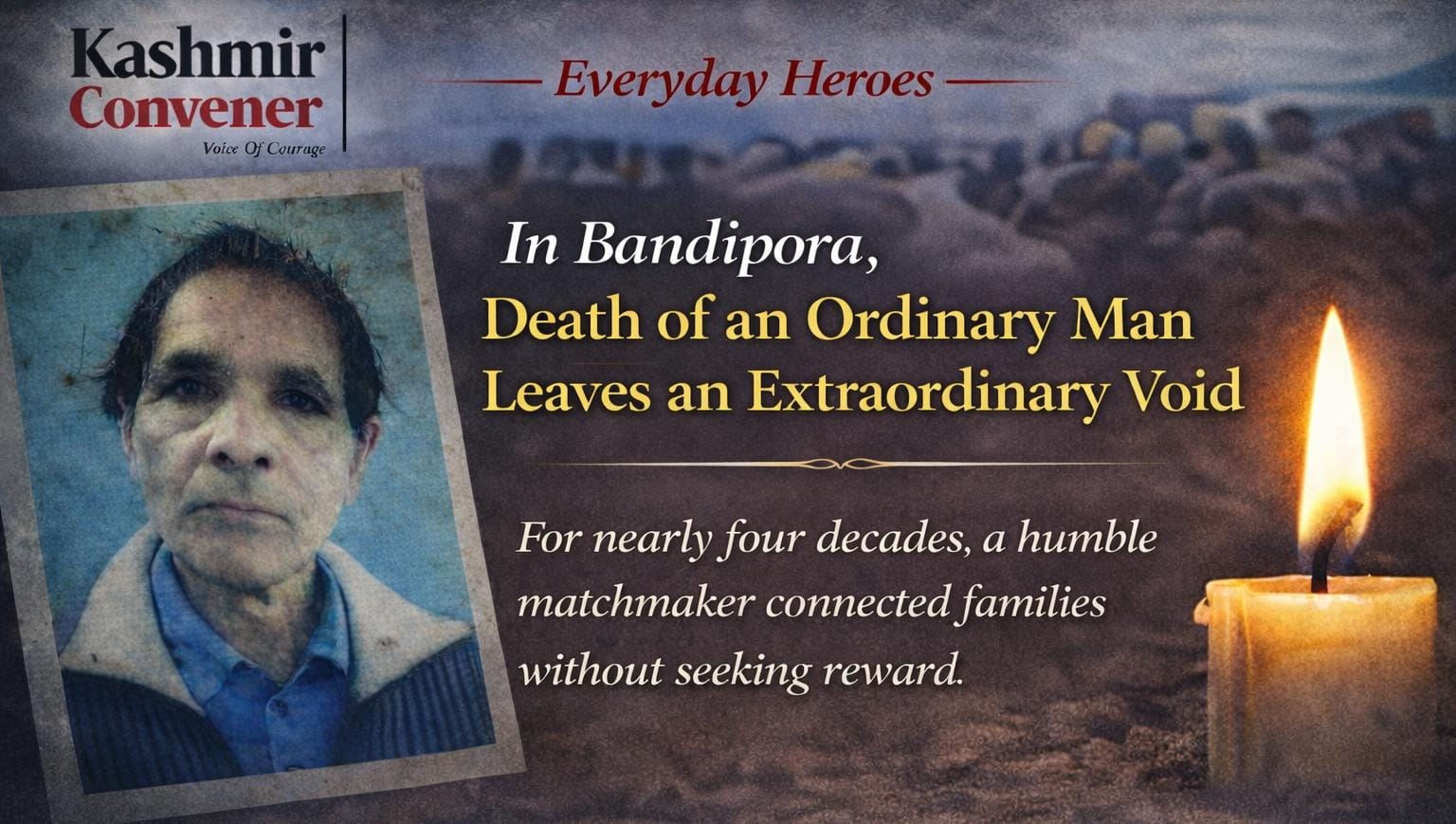
Ali Mohammad’s death may appear, at first glance, to be the passing of an ordinary man. Yet for the people of Bandipora, and especially those who truly knew him, his departure has created a quiet but deep emptiness. He was one of those rare individuals who never seek attention, yet whose absence is felt long after they are gone.
He was a poor man from Kaloosa, known across Bandipora as a matchmaker. From dawn to dusk, he would walk door to door, meeting families, listening patiently, memorising details of unmarried boys and girls, and trying—often against social odds—to bring together compatible lives. He carried no register, no formal records, only names and circumstances carefully stored in his mind. And remarkably, he was successful. Many marriages across the district owe their beginning to his quiet efforts.
For nearly forty years, Ali Mohammad played a vital role in the social fabric of the district. He devoted much of his life to arranging marriages, performing a service that holds immense cultural and moral significance.
At a time when marriage has increasingly been reduced to a commercial transaction—crippled by dowries, inflated expectations, and relentless social pressure—Ali Mohammad stood quietly apart. He refused to turn a sacred bond into a bargain. He never demanded money. He never imposed conditions. He never encouraged wasteful customs or material displays. Whatever parents offered of their own will, he accepted with humility and contentment. Often, it was modest. Sometimes, it was nothing at all. At times, it was only a few clothes or simple eatables—things he would later pass on to the children of his divorced sister, whom he raised as his own. Unmarried, with few needs and a life shaped by care rather than possession, Ali Mohammad measured wealth not in what he received, but in what he quietly gave.
Life, however, was not kind to him. On days when there was no matchmaking work, he would join construction labourers or take up whatever job he could find, just to survive. Behind the smiles he carried, behind the stories of successful matches that people happily repeated, he lived a life of constant struggle. He worked relentlessly, yet barely managed to make ends meet.
What defined Ali Mohammad most was his simplicity and honesty. His dealings were transparent. His intentions were pure. Whether a family was wealthy or poor, influential or unknown, he treated everyone with the same respect. He spoke little, but his words carried sincerity. He made few promises, but once he did, he worked tirelessly to fulfill them. There was no showmanship in him, no exaggeration, no self-promotion. His work spoke for itself.
By conventional standards, Ali Mohammad lived an unremarkable life often taunted for his job. He was born into poverty. He was physically frail. He had no formal education, nor any religious training from institutions. Much of his fifty to sixty years were spent in hardship and deprivation. Yet there was no bitterness in him. No complaint escaped his lips. Even when he spoke of his struggles, his tone was such that people often took it as a joke, or failed to take him seriously. Perhaps he shared more than we realised. Perhaps we simply did not listen closely enough.
He was not a politician. He was not a businessman. He never sought a post, a title, or public recognition. He did not master any celebrated art. He had no presence on social media. He lived far from the spotlight of modern fame. And yet, his influence is deeply rooted in the lives of people across Bandipora. His legacy lives on in countless homes, in families that exist today because he once acted as a humble bridge between two households.
Perhaps one of the most striking aspects of Ali Mohammad’s life was his personal sacrifice. He himself never married. He lived a solitary life. Yet despite being denied the comfort of a family of his own, he took full responsibility for his divorced sister and her only daughter. He raised them with care, love, and unwavering commitment. He stood by them quietly, without complaint, fulfilling his duty not because society demanded it, but because his conscience did.
This alone reveals the true measure of his character. Greatness is not found in status or visibility. It lies in responsibility, compassion, and silent service. Ali Mohammad embodied all three.
He was a resident of Ganie Mohalla in Kaloosa, Bandipora. His burial took place at the local graveyard at nine o’clock on Tuesday night. There were no grand announcements. No large gatherings of dignitaries. Yet among those who stood by his grave were hearts heavy with realization. Only in his absence did many fully understand the value of the man they had long taken for granted.
Ali Mohammad was like a bridge. He stood in the middle, connecting lives, easing paths, bringing people together. A bridge does not announce its importance. It does not ask for praise. Yet when it collapses, the loss is immediately felt. Today, that bridge is gone.
And somewhere, the candle he bought that evening remains unlit. It waits in silence, much like the life that ended quietly, without asking for attention.
His life leaves behind a simple but urgent reminder: we should be kind to everyone. We never truly know the battles they are fighting behind their smiles.
May Allah Almighty grant Ali Mohammad a high place in His infinite mercy. May He forgive his shortcomings and reward his selfless service. May patience be granted to those he left behind..



Comments are closed.