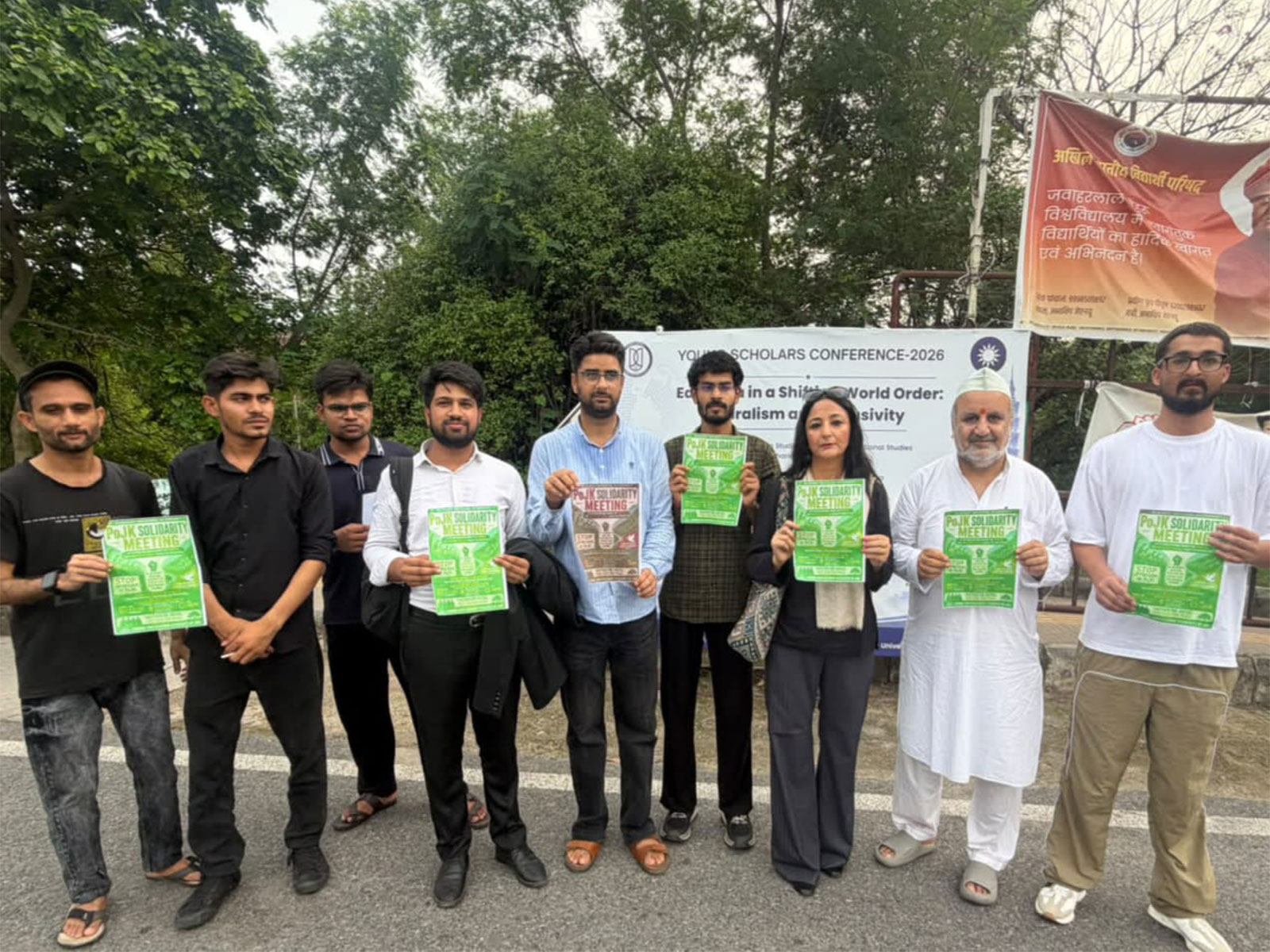
New Delhi July 31: Students, academics, and activists from the Kashmir community staged a silent protest, held a solidarity meeting at the Jawaharlal Nehru University campus here on Friday, condemning the alleged human rights violations in Pakistan-occupied Jammu and Kashmir and appealing to the international community to intervene.
The gathering, organised under the banner of Jammu and Kashmir Students of JNU, brought together a cross-section of voices to express solidarity with the people of PoJK and demand an end to what speakers termed “brutalities” against civilians in the region.
Social activist Ravinder Pandita, who addressed the meeting, strongly condemned the reported violence and alleged that the situation in PoJK was a direct consequence of Pakistan’s actions dating back to 1947.
Speaking to Kashmir Convener he said, “Look, this revolution started on 22nd October 1947 when the Pak forces came. The oppressors didn’t come out till now. Because of them, we saw how 100,000 people died in the Pak proxy war. The life of Kashmiris, the life of the state, is not less,” Pandita said.
He demanded an immediate end to military operations in the region and called for the protection of civilian lives. “We believe this operation should be ended immediately. The human rights violations, the killings — there is no end to this. No matter how it is going on, the Kashmiris have understood,” he added.
Pandita also emphasised the need to change the nomenclature of the region from PoK to PoJK, citing the Parliamentary resolution passed on the matter. He raised concerns over the closure of 49 religious shrines across the Line of Control and the denial of free movement to the people.
“Why are our religious sites there? The 49 sites have been closed. Why should our UN resolution, Chapter 6 of 1948, not be opened? Our freedom of movement is in that. We can go to Muzaffarabad, we can go anywhere — this is our state. We are not allowed to go there. These are human rights violations,” he said.
Earlier, a silent protest was held on the JNU campus with activists holding placards demanding an end to atrocities against fellow state subjects in PoJK. The protests come amid reports of escalating tensions in the region, with civilians protesting against high electricity tariffs and demanding the abolition of reserved seats in the PoJK Legislative Assembly.
Rizwan Ahmed, a law student at Jamia Millia Islamia, criticised Pakistan’s actions and emphasised the need to safeguard fundamental human rights. He called for peaceful and lawful measures to address the concerns of the people living in the region.
Umar Farooq, a PhD Research Scholar at JNU, spoke about the deep historical, cultural, and social connections shared by the people across the region. He reflected on the enduring human suffering associated with Partition and emphasised the need to preserve shared heritage while promoting peace, dialogue, and reconciliation.
Hamid Hashmi, another JNU Research Scholar, stated that the people living in PoJK were “our own people,” bound by shared history, culture, and familial ties. He highlighted the hardships and reported human rights concerns faced by civilians and called upon all democratic institutions, civil society organisations, and the international community to work towards ensuring justice, dignity, and the protection of fundamental human rights.
The meeting later needed with a resolution appealing to international human rights agencies to take appropriate notice of the situation, examine the reported violations, and work towards ensuring accountability and the protection of civilians.
Speakers stressed that civilians should not bear the consequences of political conflicts and that the rights and welfare of all affected communities deserve attention.


Comments are closed.