

Convener News Desk
New Delhi, Jan 20: Union Minister of State (Independent Charge) for Science and Technology, Dr Jitendra Singh, on Tuesday strongly advocated the adoption of steel slag–based road construction and repair technology for hilly and difficult terrains, saying its potential in Himalayan States and Union Territories remains underutilised and needs urgent scaling up through focused outreach and training.
Addressing a function to mark the signing of an agreement between the Technology Development Board (TDB) and Visakhapatnam-based Ramuka Global Eco Work Private Limited for commercial production of a CSIR-developed pothole repair mix, ‘ECOFIX’, the Minister announced that a series of workshops on steel slag road technology will begin from Jammu and Kashmir next week.
Dr Singh said a two-day workshop will be held in J&K to familiarise engineers and officials from road construction agencies with the application and benefits of steel slag–based solutions, followed by similar programmes in other hill States and UTs. He noted that regions with short working seasons, heavy rainfall and frequent road damage stand to benefit the most from such technologies, yet awareness at the field level remains uneven.
Tracing the evolution of the technology, the Minister said trials had started nearly two years ago with pilot projects in Surat and parts of the Northeast, including Arunachal Pradesh. Since then, steel slag–based road repair solutions have been used in states such as Karnataka, Uttar Pradesh, Assam, Gujarat, Jharkhand and Andhra Pradesh. However, he observed that even senior engineers in some states were still unaware of its availability, highlighting the need for more proactive dissemination by government agencies and industry partners.
The agreement signed on Tuesday enables the commercial rollout of ‘ECOFIX’, a ready-to-use pothole repair mix developed by the CSIR–Central Road Research Institute (CRRI) and supported by TDB. The product converts processed iron and steel slag into a durable construction material and can be applied even in wet or waterlogged conditions, allowing for faster repairs and reduced traffic disruption.
Officials said the technology has undergone extensive laboratory validation and field testing under Indian climatic and traffic conditions, demonstrating better durability and lower lifecycle costs compared to conventional methods. The use of steel slag also supports circular economy objectives by reducing dependence on natural aggregates and addressing the challenge of industrial waste disposal.
Emphasising the need for tangible public impact from publicly funded research, Dr Singh said innovations like ECOFIX show how science can move from laboratories to everyday life by addressing routine yet critical issues such as potholes, which affect road safety, vehicle damage and commuter stress. He also pointed to the evolving nature of public–private partnerships, noting that the private partner’s investment in this project matches government support, reflecting a more balanced collaboration model.
Under the agreement, TDB and the industry partner plan to set up an iron and steel slag processing facility with an annual capacity of nearly two lakh tonnes. Commercial production is expected to begin by the end of 2027. The proposed facility, to be located near major steel plants, is expected to ensure steady raw material supply while generating direct and indirect employment.
Concluding his address, the Minister said wider adoption of steel slag technology could help states build more resilient and climate-resilient road infrastructure, particularly in regions prone to heavy rainfall and extreme weather. He called upon state governments and the media to help spread awareness so that such technologies reach areas where they are needed most, especially across the Himalayan belt.
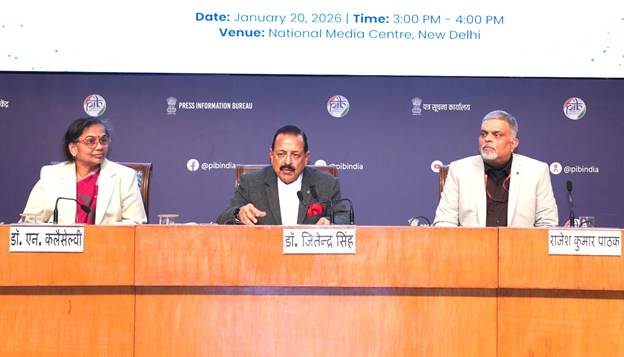
The agreement signing ceremony was attended by CSIR Director General Dr Kalaiselvi, TDB Secretary Rajesh Kumar Pathak, CSIR–CRRI Director Dr C H Ravi Sekhar, senior officials from the Department of Science and Technology, CSIR and TDB, and representatives of Ramuka Global Eco Work Private Limited. (PIB)

Comments are closed.