

Dr. Reyaz Ahmad
“A degree may professionalize ambition, but only character can civilize it. The real measure of education is not the certificate on the wall, but the conduct in daily life.”
Education has always been presented as a civilizational force. It is described as the engine that lifts individuals beyond limitation and the instrument that transforms societies. It is often portrayed as the path to human potential and the foundation of progress. In many traditions, it is seen not as preparation for life but as life itself — a continuous shaping of thought, conduct and contribution.
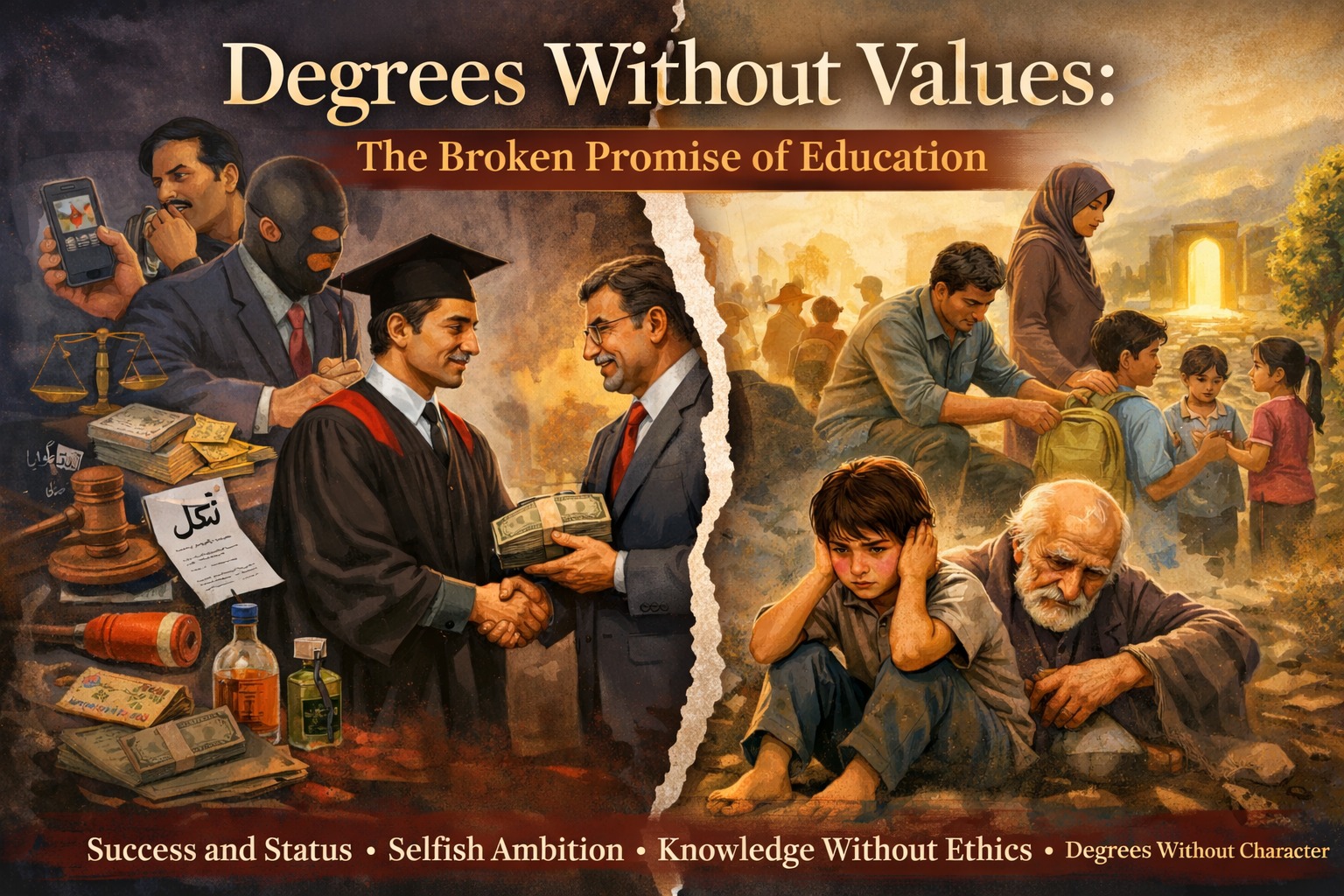
Yet a painful contradiction confronts us. If education is so powerful, why do we frequently witness educated individuals engaging in conduct that harms society? Why do degrees coexist with dishonesty? Why do professional titles sometimes accompany arrogance rather than humility? Why does knowledge become a tool for manipulation instead of service?
The answer is uncomfortable. Education as an ideal has not failed. What has failed is our substitution of education with credentialing. We have replaced transformation with certification.
Society never expected education merely to produce employable individuals. It expected education to produce better human beings. The educated were meant to show refinement in judgment, discipline in emotion and the ability to question themselves. A truly educated manager, for example, should admit an error openly and protect junior colleagues from unjust blame because truth matters more than ego. Education was expected to produce social usefulness. An engineering graduate, ideally, should not only design systems for profit but also use expertise to support local schools, mentor underprivileged students or contribute to community development. Education was meant to cultivate responsibility. An accountant under pressure should refuse to manipulate financial records because integrity is the foundation of freedom. Education was also meant to unite intelligence with character. A student conducting research should cite sources honestly and avoid plagiarism, even when deadlines are tight, because scholarship is a trust.
Society expected capability joined with conscience.
On the ground, however, the picture often appears different. High grades sometimes coexist with low integrity. Assignment markets flourish. Ready-made projects are purchased. Online exam answers circulate in group chats. Professional expertise is sometimes hoarded rather than shared. Specialists decline mentorship because it offers no immediate career benefit. Educated individuals amplify misinformation on social media without verifying sources. Public discourse becomes sharper but not wiser. Legal and technical knowledge is occasionally used to exploit loopholes and intimidate weaker parties rather than protect justice.
This is the central contradiction. Education is celebrated as a moral project, yet practiced as a market project. The focus shifts from growth to ranking, from understanding to scoring, from service to salary. When education becomes primarily a competition for economic survival, values become optional.
Why has this gap widened? The missing bridge between knowledge and character explains much of the problem. Modern systems measure what is easiest to quantify. Marks are measurable. Memory recall is measurable. Speed is measurable. Integrity, courage, empathy and civic responsibility are far harder to measure. Consequently, they receive less institutional attention.
Several forces intensify this drift. Rote learning conditions students to optimize performance rather than understanding. Credential inflation and economic anxiety push students to treat grades as survival tools. Under pressure, ethics can appear negotiable. Institutional hypocrisy deepens cynicism. When schools preach integrity but tolerate favoritism, students learn that power overrides principle. The attention economy of social media rewards outrage and certainty, not reflection. Even educated minds can become performers rather than thinkers. Society’s narrow definition of success — wealth and status over humility and service — reinforces the message that character is secondary.
Responsibility for this contradiction is shared, though not equally distributed. The individual educated person carries moral responsibility because education grants power. Power used irresponsibly cannot be excused by systemic flaws alone. Institutions bear responsibility when they reward grades over growth and tolerate misconduct to protect reputation. Policymakers share blame when systems reduce education to an assembly line and recruitment processes prioritize paper credentials without testing ethical maturity. Families contribute when they emphasize marks over manners and salary over service. Media and employers add to the distortion when aggression and spectacle are rewarded more than integrity and competence.
Those with greater power carry greater blame. Leaders, institutions and influencers shape norms. Their choices ripple outward.
Viewed through an Islamic ethical lens, the problem becomes even clearer. Knowledge is not ornamental. It is accountability. Seeking knowledge is a duty, but beneficial knowledge is the higher ideal. Beneficial knowledge uplifts society, protects justice and reduces harm. A person trained in finance is expected not merely to earn income but to ensure transparent dealings and prevent exploitation. The Qur’anic distinction between those who know and those who do not implies a moral hierarchy of responsibility. Knowledge increases accountability, not privilege.
Repairing this broken promise requires systemic and cultural reform. Integrity must be non-negotiable. Academic misconduct must be addressed transparently and consistently. Assessment must expand beyond memory recall to include communication, ethical reasoning and problem-solving in real contexts. Teachers must be supported as moral mentors, not merely content deliverers. Civic engagement should become embedded within curricula so that students encounter real social responsibility. Hiring and scholarship systems should reward humility, teamwork and ethical judgment alongside academic achievement. Digital literacy education must train students to verify claims, detect bias and resist manipulation. Learning must align with beneficial knowledge that improves lives rather than merely embellishes résumés.
The deeper restoration, however, is philosophical. Education must return to its original promise. It must aim not only at producing skilled professionals but trustworthy human beings. It must humanize power. It must shape character as carefully as it shapes competence.
Blame may be shared across individuals, institutions and systems. Responsibility, however, remains personal. Every educated individual stands at a moral crossroads daily. Each decision either narrows or repairs the gap between degree and dignity.
Education should not simply professionalize ambition. It should civilize it. The true measure of learning is not the certificate on the wall but the character in action. Intelligence without character is incomplete. When intelligence joins character, education fulfills its promise.

Comments are closed.