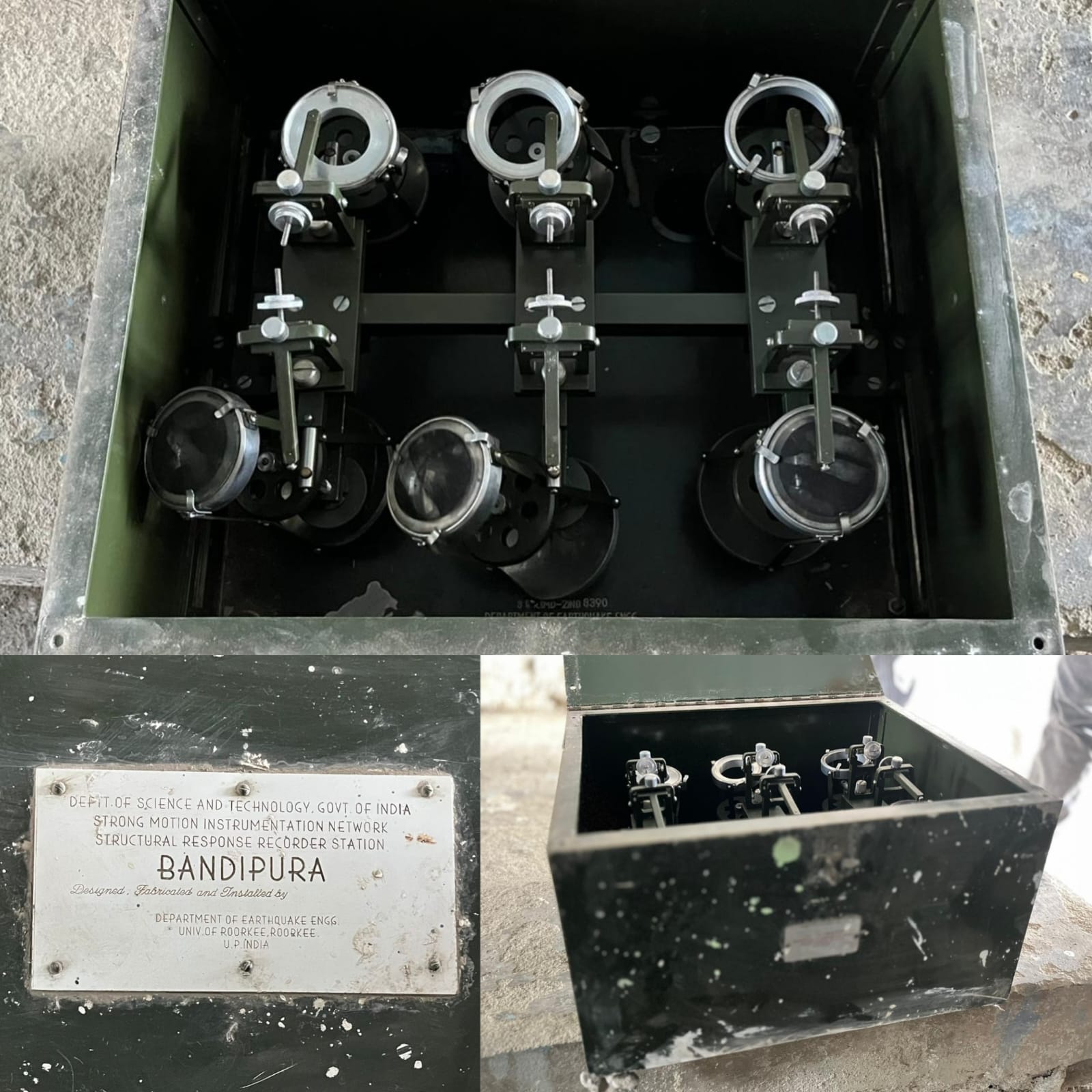
Bandipora, May 07: One of the oldest higher secondary institutions in Jammu and Kashmir, Nadim Memorial Higher Secondary School (NMHSS), Bandipora, houses a decades-old seismic monitoring installation established in collaboration with the then University of Roorkee, now IIT Roorkee, as part of the national Strong Motion Instrumentation Network. The device, mounted inside a weathered metal plaque, bears quiet testimony to the region’s early scientific legacy.
According to school officials, a Structural Response Recorder (SRR) station was installed at the campus in the 1960s as part of the Indian National Strong Motion Instrumentation Network in collaboration with the Department of Earthquake Engineering at the then University of Roorkee. The school itself was established in 1957, at a time when Bandipora had not yet attained tehsil status.
Tawheed Parvaiz Bhat, subject specialist teacher of Bio-Technology, said the SRR station was installed to record ground movement during earthquakes and to study how buildings respond to strong seismic activity. Such data, he explained, was crucial for earthquake hazard assessment and engineering design.
“The SRR station was a low-cost analogue strong-motion instrument designed to capture the maximum response of structures during earthquakes,” Parvaiz said. “Unlike high-gain seismographs that often go off-scale during strong shaking, these devices were built to record potentially damaging ground motions”.
The project was initiated and designed by the Department of Earthquake Engineering at what was then the University of Roorkee (now IIT Roorkee), which pioneered earthquake engineering research in India.
Experts said this station would have helped engineers analyse how buildings reacted to earthquakes, allowing for structural improvements and safety recommendations-particularly important given Kashmir’s location in a seismically active Himalayan zone.
While there is currently no official listing of such stations in Jammu and Kashmir by the Department of Earthquake Engineering, the existence of the Bandipora installation is documented in a research paper authored by Himanshu Mittal, Ashok Kumar, and Rebecca Ramhmachhuani of IIT Roorkee.
The paper notes that India’s strong-motion programme began in the mid-1960s, during which the Roorkee Earthquake School Accelerograph (RESA) and Structural Response Recorder (SRR) were developed to monitor seismic activity.
Tawheed added that although many analogue seismic stations across the country were upgraded to digital accelerographs from around 2004, original installations and plaques remain preserved at several historic locations.
Principal Reyaz Ahmad Lone said the seismic device, though non-operational for decades, has been preserved as part of the institution’s archival heritage.
“We consider the installation of this device a reminder of Bandipora’s glorious academic past,” Lone said. “In those days, institutions like NM Higher Secondary School had academic collaborations with some of the most reputed scientific institutions in the country.”
He said the school plans to formally approach DST and IIT Roorkee to revive academic engagement and explore modern collaborations, including possible memorandums of understanding (MoUs), research exposure, and student exchange programmes.
“Though the SRR station is no longer functional, it stands as evidence of Bandipora’s legacy in education, true to its reputation for Alim, Adab and Aab,” he said. “We are hopeful that renewed partnerships will help restore that legacy and benefit students in the modern era.”


Comments are closed.