

Peerzada Mohsin Shafi
“In Jammu and Kashmir, routine infrastructure projects are increasingly projected as personal achievements. This culture of exaggerated credit distorts facts, weakens accountability and gradually erodes public trust in institutions.”
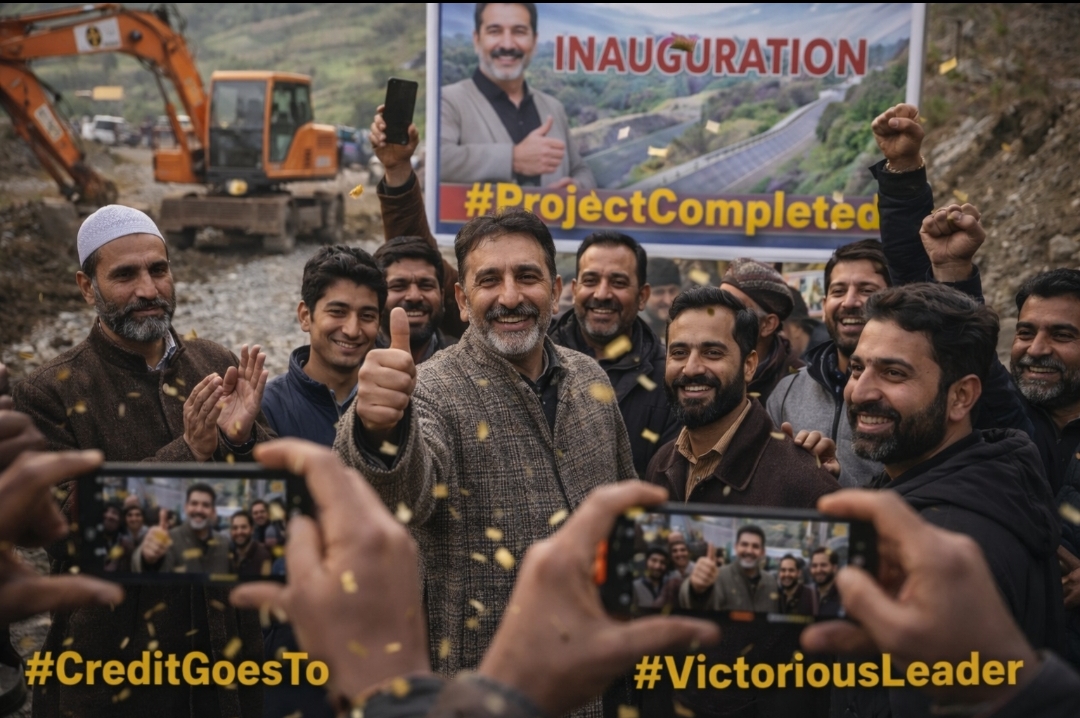
In Jammu and Kashmir a strange and worrying culture has steadily grown where even the smallest hint of infrastructure development becomes a race for personal credit. A tender notice uploaded quietly by a department, a routine correspondence by an official or meeting with the relevant minister is enough to trigger a flood of claims. Everyone suddenly appears to be the architect of progress. Local power brokers, self-declared activists, social media commentators and political workers rush forward to announce that this happened because of them. Development, instead of being understood as a structured institutional process, is turned into a competitive spectacle of self-praise.
This phenomenon becomes louder and more aggressive when political parties or some so called social activists step in. The narrative is carefully crafted that the project was stalled for years and only moved because of one leader’s intervention. Routine administrative actions are presented as extraordinary political achievements. A simple correspondence seeking information is exaggerated as pressure politics. A meeting with a departmental officer is projected as a turning point that changed the destiny of the area.
What is deliberately hidden in this process is how development actually works. Projects are conceived through planning exercises, technical surveys, feasibility reports and budget allocations. Files move through departments, approvals are granted at multiple levels and timelines are fixed long before anyone poses for a photograph. Most works that are now being claimed by individuals were already part of approved plans. But touts rely on public ignorance of these processes. They give super hype to ordinary communications and convince people that nothing moves without their leader’s will. This distortion of facts is not accidental. It is a calculated attempt to convert public works into personal favors.
The danger of this trend is deep and long lasting. When credit is falsely claimed accountability disappears. If a project is delayed tomorrow those who owned it today will quietly distance themselves. If quality is compromised blame will be shifted to departments or conspiracies. Public discourse shifts from questioning performance to defending personalities. Development becomes less about delivery and more about managing perception. Over time this weakens institutions because processes are overshadowed by individuals who have no formal responsibility for execution.
The situation often descends into absurdity. If a department floats a tender for even a small toilet complex hundreds of people rush to claim that it happened because of them. Social media fills with congratulatory posts and exaggerated praise. Routine works that are part of annual plans are celebrated like historic milestones. Very few bother to check facts, understand scope or ask whether the work will actually be completed on time. Celebration begins at the announcement stage and by the time the work stalls or fails public memory has already moved on to the next claim.
Such behaviour is not harmless. It slowly damages public sense and social maturity. When people are trained to celebrate announcements instead of outcomes they stop demanding results. When applause is given freely for starting rather than finishing there is little incentive to complete projects properly. This culture also discourages honest officials and engineers who work quietly within the system. Their years of effort are overshadowed by those who arrive at the last moment to take credit. Over time professionalism gives way to showmanship and governance becomes a performance.
History offers enough warnings about this mindset. Many past civilizations declined not because they lacked resources but because truth was replaced by flattery and propaganda. Courts and administrations where rulers were praised for routine acts slowly lost touch with reality. Systems decayed because honest feedback was drowned in applause. Societies that survived were those that valued institutions, records and accountability over personal glory. The lesson is simple. When exaggeration becomes normal decline follows silently.
In Jammu and Kashmir this culture carries additional risks due to various reasons. Development here must be handled with transparency and responsibility. Turning public projects into partisan trophies deepens divisions. A road or a bridge stop being a shared public good and becomes a symbol of political loyalty. Those outside the narrative feel excluded while those inside feel entitled. This weakens social cohesion and fuels unnecessary rivalry over basic amenities.
Media also bears responsibility in this ecosystem. When press releases and claims are published without verification hype replaces journalism. Headlines repeat narratives without explaining context. The public is rarely told whether a project was already sanctioned, who is funding it or what the timeline is. This creates an environment where exaggeration thrives and truth struggles to survive. A healthy society needs media that educates citizens about processes not media that amplifies personal claims. It must be clarified that seeking development and raising public issues is not wrong. Elected representatives are expected to advocate for their constituencies. But there is a clear difference between genuine advocacy and opportunistic appropriation. Genuine advocacy acknowledges institutions and collective effort. Opportunistic credit grabbing erases them. The former strengthens democracy while the latter weakens it.
Citizens too must introspect. Not every sanction is a victory. Not every tender is transformation. Development is often slow and unglamorous. It is measured in quality, durability and service delivery. A hospital matters only when doctors are present and equipment works. A road matters only when it lasts beyond one season. Premature celebration only creates false expectations and eventual disappointment.
Ultimately the real question should not be who brought what but how well it serves the people. Public works are funded by public money and executed by public institutions. They are not gifts from individuals. A bridge that stands strong for decades matters far more than a banner that lasts a day. When society learns to value substance over spectacle the market for false credit will shrink. Until then the scramble will continue, narratives will clash and truth will remain buried under applause. Recognizing this reality is essential if Jammu and Kashmir is to move forward with dignity, patience and genuine progress.
Peerzada Mohsin Shafi hails from Anantnag and is an infrastructure columnist.

Comments are closed.