KUPWARA, Feb 21: For the young men and women of Tangdhar, ambition has always had to wait for the weather to clear and the ceasefire to hold. Wedged against the Line of Control (LoC) in north Kashmir’s Karnah sector, the town is defined by its borders—geographical, political, and psychological.
This week, a small delegation attempted to redraw the last of those lines.
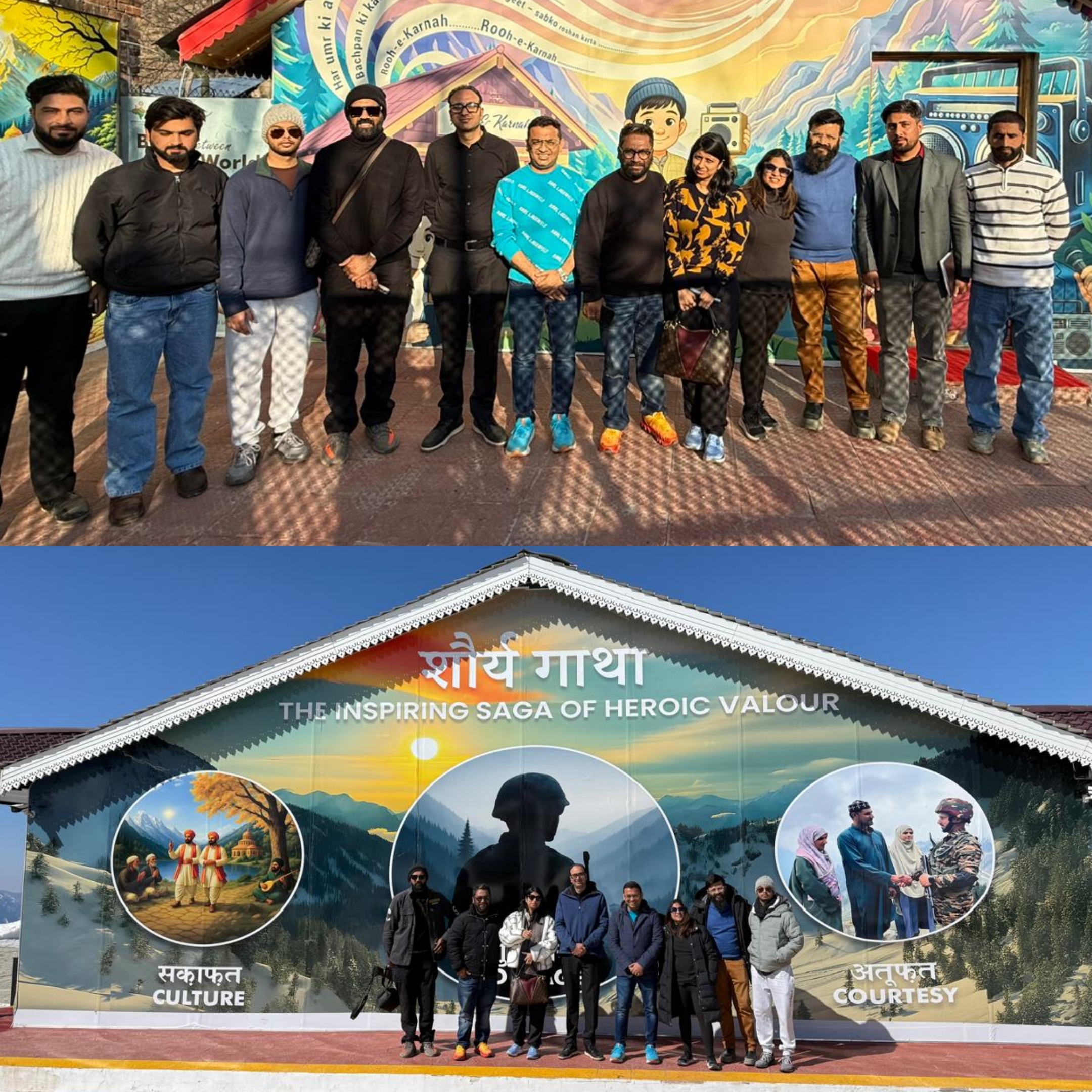
A team from Young Indians (Yi), the youth wing of the Confederation of Indian Industry (CII), traveled to this frontier outpost to scout for what the military calls “hearts and minds” but what the industry calls “human capital.” Facilitated by the Indian Army’s Chinar Corps, the visit represented a rare intersection between the corporate world and a conflict zone.
The setting was a modest government conference hall. On one side sat local entrepreneurs, students from Government Degree College Tangdhar, and district officials—Assistant Commissioner Revenue Mumtaz, BDO Muddasir, and Tehsildar Ameen Bhat. On the other were men in blazers who had flown in from the cities, armed with PowerPoint potential and market linkages.
The agenda was simple, yet for this valley, revolutionary: How does a village overlooking a militarized border build a business?
The answer, the delegates suggested, lies in the very geography that has held it back. The delegation explored models for border tourism, where visitors could walk through history along the LoC. They discussed homestays, where a tourist might wake up to noon chai with a view of the peaks that define the frontier. Cottage industries, they argued, could find a market if the supply chain were de-clogged.
“This isn’t just a meeting; it’s a message,” said a Yi member, speaking to Kashmir Convener. “These kids see the fence every day. We want them to see a future beyond it.”
Yi has committed to a sustained program of mentorship and hand-holding, a promise to walk with the local entrepreneurs beyond the initial handshake.
For the administration, it was a validation of ground-level work. For the army, it was a soft-power win. But for the youth in the room, it was perhaps the first time they saw the mainstream economy as something that could exist on their side of the mountains.
Peerzada Waseem, a local who also met the delegation, told Kashmir Convener, “It was truly a moment of happiness for the people of Tangdhar, especially for the youth, who have been waiting for years for the green light for border tourism, which had been suspended. The dreams we had seen years ago, when border tourism was first promoted, were cut short after Operation Sindoor. The youngsters had just started to see their businesses thrive, as tourism here was boosted and tourists from across the country were coming, giving a push to the local economy. But with this visit, we are hopeful that once again we will host tourists and earn our livelihoods.”
Mohsin Khan, a student at GDC Tangdhar, told Kashmir Convener, “We are used to seeing the Army for security. Today, we are grateful to see them as hosts for development. They brought the country to our doorstep.” He added, “It felt like a bridge was built today. For a long time, we felt disconnected from the rest of the country’s progress. Seeing the Confederation of Indian Industry come all the way here tells us that ‘Viksit Bharat’ includes us too.”
Arshid Ahmad, a local, said, “We have always opened our homes to guests with a cup of salt tea. Now, the Young Indians delegation is telling us that this hospitality can become our livelihood. We are ready to learn how to turn our traditions into a profession.”
Notably, the road to Tangdhar is long, often blocked by snow or shut by shelling. But this week, a few travelers made it through, carrying not supplies, but possibilities.



Comments are closed.