

Firdous Ahmad Najar
“What was once an act of necessity—keeping animals for food and work—has today become an act of vanity and misplaced affection. Creatures meant for open skies and free movement are confined for human amusement, their liberty traded for display.”
In every age, human beings have shared this planet with animals. They graze in our fields, rest in our forests, and walk alongside us in cities and villages. Together, they form part of the delicate web of life that keeps our world balanced and beautiful. Without animals, nature would lose its rhythm, and life would fall into imbalance and decay.
Animals are indeed a blessing from the Almighty: each created with a purpose, each playing its part in maintaining the harmony of creation.
Over time, humans have learned to domesticate certain animals for their livelihood and sustenance. Cattle, sheep, goats, and poultry have served humankind for centuries; providing milk, meat, wool, and leather. In caring for these animals, we care for ourselves, for they sustain our survival and economy.
Islam and every moral tradition encourage us to treat such animals with kindness, provide them shelter and nourishment, and protect them from cruelty. This humane relationship is not only a moral obligation but also a practical necessity for life on earth.
Yet, in recent years, society has drifted away from this natural order. An alarming trend is spreading, people are beginning to domesticate animals that were never meant to be confined. Stray dogs, cats, parrots, rabbits, even monkeys; creatures that find joy and purpose in freedom are being turned into house pets. Their natural instincts are suppressed for human amusement, and their lives of liberty are traded for captivity. What was once an act of necessity, keeping domestic animals for food and work, has now become an act of vanity and misplaced affection.
This shift reflects a deeper moral confusion. People who claim to love animals often ignore that these very animals belong to the open world, not to our drawing rooms. By keeping them in cages or apartments, we interfere with their natural cycle of life, denying them the freedom Allah intended for them.
True compassion means to let living beings live as they were created to live: freely, safely, and without human interference. Unfortunately, our version of love today often causes more harm than good.
More troubling is the growing trend of extravagance in caring for these animals. It has become fashionable, especially among the wealthy, to spend lavishly on imported dogs and exotic pets, some costing several lakhs of rupees. They are pampered with air-conditioned rooms, designer beds, imported food, and costly accessories.
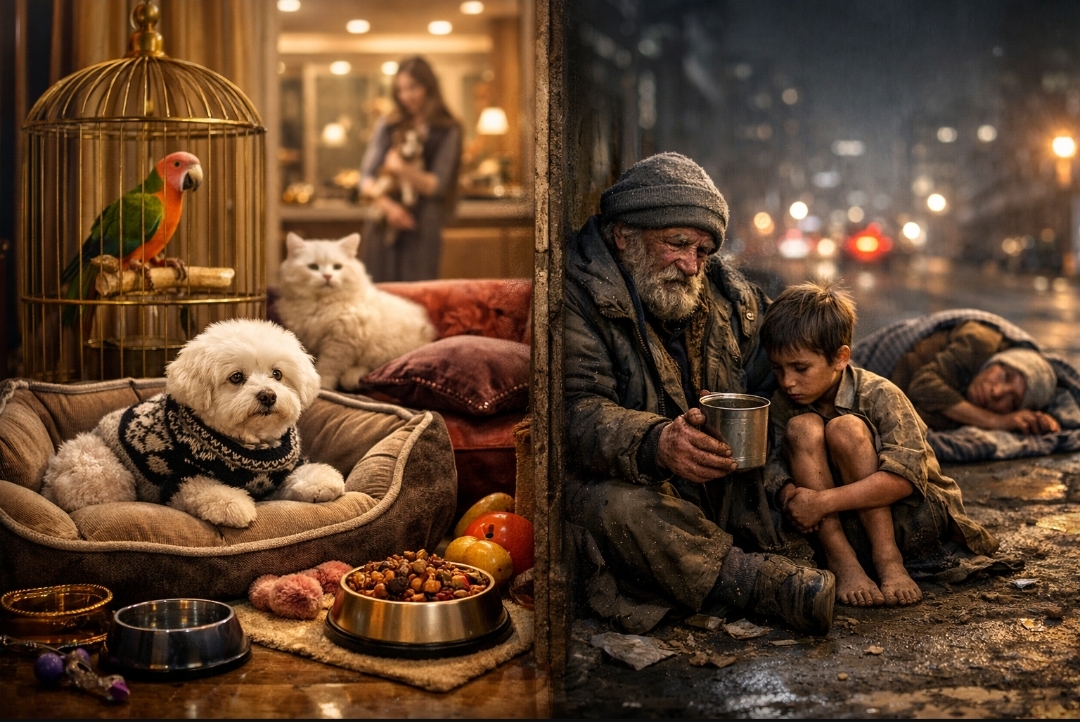
The more expensive the animal, the greater the sense of pride its owner feels. In many urban homes, pets sleep on velvet cushions while poor human beings sleep hungry on the same Street.This contrast between comfort and suffering has become the mark of our moral decline.
In the same society where animals are fed with luxury, thousands of people are deprived of basic needs. Old parents are left uncared for, orphan children beg for bread, and sick individuals struggle to afford medicine. A widow shivers at night under the open sky while a pet sleeps comfortably inside a heated shelter. We rush to buy food for our pets but turn our faces away when a hungry man extends his hand for help. It is here that the question of ethics arises; what has happened to our sense of proportion, to our duty as humans?
Human suffering today often goes unnoticed. Poverty, illness, and loneliness surround us, yet we turn a blind eye while spending heavily on pets. We have built animal shelters with modern facilities, but we still lack homes for orphans and the elderly. We have turned mercy into a matter of fashion. In doing so, we have lost the ability to distinguish between what is noble and what is merely sentimental.
India’s animal protection laws: the Prevention of Cruelty to Animals Act, 1960 and the Wildlife (Protection) Act, 1972, rightly prohibit cruelty and exploitation. They remind us to respect all living beings. But they do not encourage us to keep animals in unnatural environments or to treat them as status symbols. Our duty is to ensure that animals live without fear, hunger, or pain; not to turn them into displays of wealth. The time and money we spend on unnecessary luxuries for animals could instead bring comfort to people who are truly suffering.
Islam also teaches compassion but within the boundaries of wisdom and balance. The Prophet Muhammad (peace be upon him) once told of a woman forgiven for giving water to a thirsty dog, showing that mercy to animals is a virtue. But he also warned against keeping certain animals, especially dogs, inside homes, saying that angels do not enter such places. This guidance is not about hatred; it is about preserving purity and respecting divine order. Compassion should never violate the limits set by faith.
At the same time, Islam gives the highest priority to helping fellow human beings. The Qur’an clearly condemns those who ignore the poor and the orphan:
“Have you seen the one who denies the Judgment? That is the one who repulses the orphan and does not encourage the feeding of the poor.”
(Surah Al-Ma’un, 107:1–3)
This verse shows that true faith is reflected in serving humanity. Similarly, the Prophet (peace be upon him) said:
“Whoever relieves a believer’s distress in this world, Allah will relieve his distress in the Hereafter.”
(Sahih Muslim, Hadith 2699)
These teachings remind us that the greatest act of mercy is to ease human suffering. When we spend our wealth to feed the hungry, heal the sick, or comfort the lonely, we fulfil our duty to Almighty Allah and humanity alike. Spending the same wealth on extravagance, while people around us go hungry, is a betrayal of that duty.
Unfortunately, modern compassion seems to have lost its true direction. We are quick to offer food and comfort to animals, yet we hesitate to provide medicine to a poor patient. We readily take in stray animals but often neglect our fellow human beings.
Our hearts are touched by the sight of a stray dog, but remain unmoved by a hungry family. Such behaviour shows that we have mistaken emotion for righteousness. True compassion is not about display; it is quiet, sincere, and directed toward those who need it the most.
The Russian writer Leo Tolstoy once said, “If you feel the pain, you are alive. But if you feel the pain of others, you are human.”
These words capture the essence of humanity. To be human is to feel and act for others, especially those who suffer in silence. The great poet Allama Iqbal expressed the same truth when he wrote:
“Dard dil ke waste paida kiya insaan ko,
Varna ita‘at ke liye kuch kam na the karobiyan.”
“Man was created to feel the pain of others; for worship alone, angels were enough.”
Both Tolstoy and Iqbal remind us that compassion is not meant to decorate our image but to define our humanity. When we spend lavishly on animals but ignore the hungry and the poor, we fail in the purpose for which Allah created us. Mercy must be guided by justice; otherwise, it turns into vanity.
Caring for animals is good and necessary, but it must not overshadow our responsibility toward people. A society is not judged by how well it treats its pets, but by how it treats its poor. Compassion should begin with those around us: our neighbours, relatives, and the helpless members of our community. To feed a hungry man, comfort an orphan, or help a sick person is far more valuable than spending on unnecessary luxuries for animals.
A balanced heart shows kindness to all creation but keeps its priorities right. It provides food to the hungry animal and the starving man alike, but it never forgets that human life holds the highest value.
When we relieve a person’s pain, we earn not only gratitude but divine pleasure. The Prophet (peace be upon him) said, “The best of people are those who are most beneficial to others.” These words summarize the true meaning of compassion: to benefit, not merely to feel.
Today, we must ask ourselves: have we become too emotional about animals and too indifferent toward humans? Do we use our compassion to please Allah or to please ourselves? The Almighty has given us hearts to feel and hands to help. Let us use them where they are needed most, among the poor, the hungry, and the suffering.
We must strive to build a world where no animal faces cruelty and no human sleeps hungry. Islam calls for adl: balance and fairness, giving every being its due without neglecting what matters most. Real compassion shines when it is guided by wisdom and directed toward genuine need.
Caring for animals is good, but turning it into fashion and luxury has made us forget real compassion. Many people spend huge amounts on pets and foreign breeds while ignoring the hunger and pain of fellow humans. Animals meant to live freely are confined to homes, disturbing their natural life.
This trend, which we call animal care, is actually a stupefying hangover of fashionism and social status, where show-off replaces sincerity. The wealth that could bring comfort to the poor, medicine to the sick, or food to the hungry is often wasted on unnecessary care and luxury for animals. Real care means keeping balance: showing kindness to animals but giving priority to human suffering.
Let these animals live as God created them, and let us use our wealth to ease human suffering. Only then will our care reflect true humanity and earn the pleasure of the Almighty.
The writer is a teacher from Arin Bandipora and can be reached at njfirdous090@gmail.com

Comments are closed.