

S Ahmad
The Pradhan Mantri Vidyalaxmi Scheme is a flagship initiative of the Education Ministry that seeks to make quality higher education accessible to deserving students facing financial constraints. The scheme provides collateral-free and guarantor-free education loans to such students for studying in top ranked higher education institutions in the country. It further supports beneficiaries through interest subvention based on family income, reducing financial constraints to educational attainment. In doing so, the scheme contributes to India’s progress towards SDG 4, which seeks to ensure inclusive and equitable quality education and promote lifelong learning opportunities for all by 2030.
Few investments yield returns as enduring as education. It expands individual opportunity, strengthens social mobility, fuels economic growth and builds the human capital on which nations compete. Yet, for millions of Indian students, the journey from merit to opportunity is interrupted not by a lack of talent but by a lack of money. Every year, countless students secure admission to prestigious institutions only to discover that the cost of higher education remains beyond their family’s reach.
This contradiction has become increasingly visible as India pursues the goals of becoming a developed nation by 2047. Universities have expanded, enrolment has risen, and aspirations have grown. The Gross Enrolment Ratio in higher education has climbed from 23.7 per cent in 2014-15 to 30 per cent in 2023-24, reflecting significant progress in widening access. Yet behind these encouraging numbers lies another reality: access is still unequal. The country’s finest institutions continue to remain financially inaccessible for many deserving students.
The Pradhan Mantri Vidyalaxmi Scheme attempts to bridge this gap. Approved in November 2024, the scheme represents one of India’s most ambitious efforts to remove financial barriers to higher education. Unlike conventional education loan programmes, it combines collateral-free lending, government-backed credit guarantees, targeted interest subvention and an entirely digital application process. More importantly, it shifts the conversation from financing education to protecting educational opportunity.
Merit Should Not Depend on Wealth
The central philosophy behind the scheme is simple yet transformative: admission secured through merit should not be denied because of financial limitations.
For decades, education loans have remained available in principle but inaccessible in practice. Banks often demanded collateral, guarantors or substantial financial documentation. Families from lower and middle-income backgrounds frequently hesitated to borrow because repayment risks appeared overwhelming. Students from rural areas or economically weaker sections were especially disadvantaged.
PM Vidyalaxmi attempts to remove these structural barriers.
Students admitted through merit to designated Quality Higher Educational Institutions (QHEIs) can now obtain collateral-free and guarantor-free loans. Government support through a 75 per cent credit guarantee on loans up to ₹7.5 lakh significantly reduces the lending risk for banks while expanding access for borrowers.
The policy sends an important message: educational opportunity should depend upon academic merit rather than inherited financial privilege.
Aligning with National Education Policy
The scheme is also a practical implementation of the National Education Policy (NEP) 2020, which emphasises equitable access to quality higher education.
NEP recognised that financial constraints remain one of the largest reasons students discontinue education or compromise on institutional choice. Expanding educational infrastructure alone cannot solve this challenge unless financing mechanisms are equally inclusive.
PM Vidyalaxmi therefore functions not merely as a banking initiative but as an educational reform. By integrating loan facilitation, digital governance and targeted subsidies, it strengthens India’s commitment towards Sustainable Development Goal 4, which seeks inclusive and equitable quality education for all by 2030.
Beyond IITs and IIMs
Public discussion often associates the scheme with elite institutions like IITs and IIMs. While these undoubtedly remain important beneficiaries, the programme’s coverage is considerably broader.
Currently, 1,425 Quality Higher Educational Institutions are included under the scheme, encompassing Central institutions, top-ranked State universities and highly ranked private institutions identified through the National Institutional Ranking Framework (NIRF).
The coverage includes engineering, medicine, law, management, science, humanities, commerce and numerous other disciplines. It extends to both undergraduate and postgraduate programmes, recognising that India’s future workforce requires excellence across sectors rather than within a handful of professions.
This wider institutional coverage broadens educational choice without restricting opportunity.
A Digital Architecture
One of the scheme’s most notable innovations lies in its digital architecture.
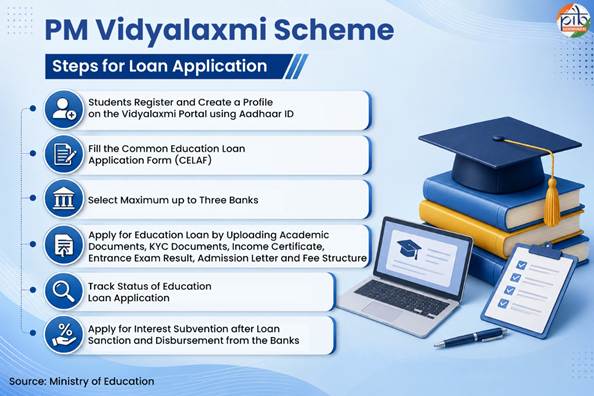
Instead of requiring students to navigate multiple bank branches and lengthy paperwork, PM Vidyalaxmi operates through a unified online portal where applicants can:
-
submit common loan applications;
-
choose participating banks;
-
monitor application status;
-
apply for interest subvention;
-
raise grievances digitally.
Such integration significantly reduces procedural complexity.
The use of Aadhaar authentication, digital processing and online tracking also enhances transparency while minimising opportunities for administrative delays.
Equally significant is the introduction of the Digital Rupee (CBDC) Wallet, through which interest subsidies are transferred directly before being credited to loan accounts. This reflects the government’s broader push towards digital public infrastructure in welfare delivery.
Interest Relief Matters
Education loans often become intimidating not because of principal amounts alone but because of accumulated interest during the study period.
PM Vidyalaxmi addresses this through targeted interest subvention.
Students from families earning up to ₹8 lakh annually receive a 3 per cent interest subsidy during the moratorium period on loans up to ₹10 lakh.
Those with family incomes below ₹4.5 lakh continue receiving full interest support under the existing Central Sector Interest Subsidy Scheme.
This layered structure reflects an important policy recognition: the financial challenges faced by India’s middle-income households are often underestimated.
Families earning between ₹4 lakh and ₹8 lakh annually frequently fall outside conventional welfare programmes while simultaneously lacking sufficient disposable income to finance expensive higher education.
By extending support to this segment, the scheme broadens educational inclusion beyond traditional poverty-based eligibility.
Lower Borrowing Costs
The scheme also introduces safeguards regarding lending costs.
Interest rates are capped at each bank’s Externally Benchmarked Lending Rate (EBLR) plus only 0.5 per cent, ensuring borrowers receive loans at rates below conventional education lending.
Repayment periods extend up to fifteen years after completion of the moratorium period, giving graduates greater financial flexibility during the early years of employment.
Combined with collateral-free lending and interest support, these provisions substantially reduce financial anxiety for students and families.
Early Indicators
The programme’s initial response suggests considerable demand.
During FY 2025-26:
-
over 6.45 lakh education loan applications were submitted through the portal across schemes;
-
1,10,667 applications were received specifically under PM Vidyalaxmi;
-
70,852 loans were sanctioned;
-
67,728 loans had already been disbursed.
Comments are closed.