


S Ahmad
A “Safe Harbour Margin” (under the Income Tax Act) refers to a specified profit margin declared by a taxpayer for certain international transactions, without detailed checking, if it meets prescribed conditions and provisions.
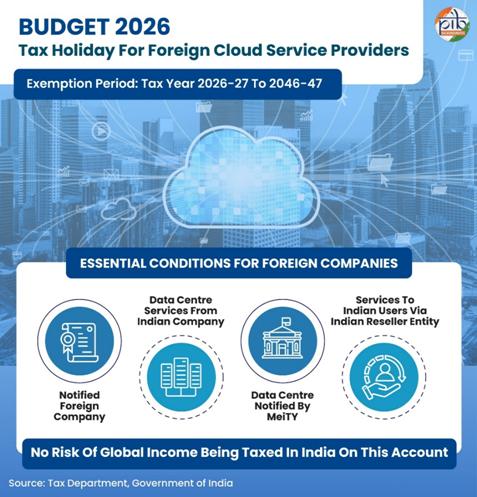
The Union Budget 2026–27 introduces a major policy initiative to strengthen India’s position as a global hub for digital infrastructure. Recognizing the central role of cloud computing, AI data centres and advanced electronics in economic growth, the Government has announced a tax holiday till 2047 for eligible foreign cloud service providers operating through India-based data centre infrastructure.

Data centres and cloud infrastructure require high upfront capital investment, long gestation periods, and sustained policy certainty. AI-oriented data centres, in particular, involve significant expenditure on computing hardware, energy systems, cooling infrastructure, and skilled manpower.
With global demand for AI compute capacity rising rapidly, countries are competing to attract large-scale data centre investments. The tax holiday till 2047 is intended to provide long-term visibility and certainty, enabling India to attract global cloud service providers while anchoring critical digital infrastructure within the country.
Globally, data centres have emerged as a major driver of investment and economic activity. According to the United Nations Conference on Trade and Development (UNCTAD), data centres accounted for more than one fifth of global greenfield project values in 2025, with announced investments exceeding USD 270 billion. Rapid growth in AI compute demand and data-intensive digital services is intensifying international competition to attract such infrastructure.
In this context, India’s long-term tax framework aims to provide investment certainty, anchor high-value digital infrastructure within the country, and strengthen India’s role in global digital value chains in line with the vision of Viksit Bharat by 2047.
The Union Budget 2026–27 does more than allocate revenues and expenditures; it signals a structural shift in India’s economic strategy. At a time when artificial intelligence, cloud computing and digital infrastructure are reshaping the global economic order, the government has introduced a long-term policy framework aimed at positioning India as a global hub for cloud and AI infrastructure.
The announcement of a tax holiday extending until 2047 for eligible foreign cloud service providers operating through India-based data centres is not merely a fiscal incentive — it is a strategic intervention designed to anchor the digital backbone of the future within India’s borders.
To understand why this move is significant, one must first appreciate how central data centres have become to modern economic life. In earlier industrial eras, economic power was measured in terms of manufacturing output, access to ports, highways, oil reserves or heavy industry. Today, computing power plays a similarly foundational role. Every digital service — from online banking and digital payments to e-commerce, video streaming and AI-driven applications — depends on data centres. These facilities house thousands of interconnected servers that store, process and transmit information across the globe.
Artificial intelligence has dramatically increased the demand for such infrastructure. Training AI models requires vast computational capacity, and running AI systems in real time demands scalable cloud platforms supported by reliable energy systems and high-speed connectivity. As AI becomes embedded across sectors such as healthcare, finance, manufacturing, education and governance, the need for advanced data centre infrastructure is rising sharply. According to the United Nations Conference on Trade and Development (UNCTAD), data centres accounted for more than one-fifth of global greenfield investment project values in 2025, with announced investments exceeding USD 270 billion. This figure reflects not a passing trend but a structural transformation in global capital flows.
In this environment, countries are actively competing to attract hyperscale cloud providers and AI infrastructure investments. These projects involve billions of dollars in upfront capital expenditure and operate over long time horizons. Investors require policy certainty, regulatory clarity and long-term visibility before committing such resources. Short-term incentives are rarely sufficient. What global cloud companies seek is assurance that the policy environment will remain stable for decades.
It is in this context that India’s tax holiday until 2047 must be understood. The government has proposed that foreign cloud service providers using India-based data centres for their global cloud operations will be eligible for exemption from Indian taxation on specified income, subject to clearly defined conditions. The framework is designed to provide long-term predictability while maintaining safeguards to protect domestic tax interests.
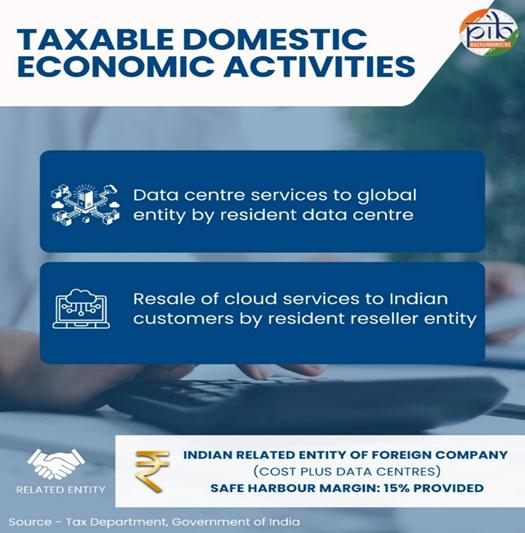
Put simply, if a foreign cloud company routes its international operations through data centres located in India, the income derived from those global services will not be taxed in India during the specified period. However, the structure ensures that domestic transactions remain fully within the Indian tax net. Services provided to Indian customers must be delivered through an Indian reseller entity, meaning that profits arising from domestic business will continue to be taxed under existing provisions. Likewise, income earned by Indian companies operating data centres will remain taxable. This distinction is critical. The objective is to attract global infrastructure operations without eroding domestic revenue bases.
Where the Indian data centre is a related entity of the foreign cloud provider, a safe harbour margin of fifteen percent on cost has been proposed. In simple terms, a safe harbour margin refers to a minimum profit percentage that must be declared on certain international transactions. If the company declares profits at or above this prescribed margin, tax authorities will generally not subject the transaction to detailed scrutiny. This reduces uncertainty, litigation and compliance burden while ensuring that a reasonable share of profits is taxed within India.
The duration of the tax holiday — extending until 2047 — is particularly significant. Data centre investments typically require long gestation periods, often exceeding ten to fifteen years. By offering a stable framework aligned with the broader national vision of Viksit Bharat at 100 years of independence, the government is signalling that digital infrastructure development is not a short-term policy experiment but a central pillar of long-term economic planning. Such policy continuity can meaningfully influence global investment decisions.
Importantly, this measure does not stand alone. It is embedded within a broader ecosystem strategy outlined in the Budget. The launch of India Semiconductor Mission 2.0 recognises that advanced computing infrastructure ultimately depends on semiconductor capabilities. With a provision of ₹1,000 crore for the coming fiscal year, the mission seeks to expand semiconductor equipment manufacturing, materials production, design ecosystems and talent development. This initiative addresses the foundational layer of digital infrastructure — the chips that power servers and AI systems.
Similarly, the substantial increase in allocation for the Electronics Components Manufacturing Scheme, from approximately ₹22,000 crore to ₹40,000 crore, reflects an effort to strengthen domestic production of critical hardware components. With strong industry participation and over a hundred applications received, the scheme signals growing investor interest in India’s electronics manufacturing landscape.
Parallel reforms in the IT services sector further enhance the ecosystem. India’s IT exports exceed USD 220 billion annually, making it one of the country’s largest service export sectors. To provide tax certainty and reduce disputes, the Budget proposes grouping various IT-related services under a unified category, prescribing a common safe harbour margin of 15.5 percent, raising eligibility thresholds and streamlining approvals through automated processes. It also proposes fast-tracking the Unilateral Advance Pricing Agreement mechanism. A Unilateral Advance Pricing Agreement is an arrangement between a taxpayer and the Central Board of Direct Taxes under which the pricing of specified international transactions is determined in advance for a fixed period. Such agreements reduce litigation and provide long-term clarity to businesses engaged in cross-border operations.
India’s domestic cloud ecosystem is already expanding rapidly. Under the Digital India initiative, the national cloud platform GI Cloud, known as MeghRaj, has been developed to serve government requirements through secure and scalable infrastructure operated by the National Informatics Centre. Industry estimates suggest that India’s data centre capacity has reached around 1,280 megawatts and could expand four to five times by 2030. Investments worth nearly USD 70 billion are underway, with additional projects worth about USD 90 billion announced. This expansion reflects the growing demand for AI-enabled applications, digital payments, e-governance services, streaming platforms and data localisation requirements.
Globally, the policy momentum around AI infrastructure is accelerating. In the United States, executive measures have been introduced to expedite permitting and support large-scale data centre development, including projects requiring more than 100 megawatts of power. In China, major AI and cloud companies are expanding data centre capacity alongside investments in chips and hardware supply chains. Digital infrastructure is increasingly viewed not just as a commercial asset but as a strategic capability tied to economic security and technological leadership.
Against this backdrop, India’s long-term tax framework provides a signal of stability and seriousness. It communicates that India is prepared to compete for hyperscale infrastructure on equal footing with major global economies. At the same time, sustained success will depend on complementary reforms, including reliable power supply, renewable energy integration, efficient land and regulatory clearances, and strong data protection frameworks. Data centres are energy-intensive facilities, and their growth must align with sustainability goals and infrastructure readiness.
The tax holiday announced in Budget 2026–27 thus represents more than a fiscal concession. It is a structural economic strategy aimed at anchoring the digital infrastructure of the future within India. By aligning tax certainty with semiconductor development, electronics manufacturing expansion and IT sector reform, the government has outlined a coordinated approach to strengthening the entire digital value chain.
The coming decade will determine whether India evolves from being one of the world’s largest digital markets into one of its principal digital infrastructure hubs. Budget 2026–27 suggests that India intends to pursue that transformation with long-term policy commitment and strategic clarity.
The tax holiday announced in Budget 2026–27 provides long-term policy certainty till 2047 for global cloud and AI infrastructure investments in India. While offering investment visibility in a capital-intensive sector, the framework retains safeguards through clearly defined eligibility conditions and continued taxation of domestic operations.
Aligned with semiconductor, electronics manufacturing and IT sector reforms, the measure reflects a coordinated strategy to strengthen India’s digital ecosystem. In a period of intensifying global competition for AI infrastructure, the policy positions India as a credible and long-term destination for cloud and data centre investment.

Comments are closed.