

S. Ahmad
From the frozen Himalayan passes where oxygen thins to a whisper, to roaring river valleys and silent deserts, India’s borders are not guarded by soldiers alone. They are secured by roads, bridges, tunnels, and airstrips carved into unforgiving terrain. At the heart of this silent but decisive effort stands the Border Roads Organisation (BRO), an institution that for over six decades has translated geography into strategy and isolation into integration.
Established on 7 May 1960, the BRO was born with a deceptively simple mandate: to build and maintain infrastructure in India’s most remote and strategically sensitive regions. Guided by its enduring motto, “Shramena Sarvam Sadhyam”—through hard work, all things are possible—the organisation has evolved far beyond a construction agency. Today, it is a cornerstone of India’s national security architecture and a powerful instrument of socio-economic transformation along the nation’s frontiers.
Since its inception, the BRO has built over 64,100 kilometres of roads, 1,179 bridges, seven strategic tunnels, and 22 airfields across border areas and inaccessible regions. These numbers, impressive as they are, only hint at the complexity of working in terrains defined by avalanches, earthquakes, flash floods, glacial lakes, and extreme altitudes. Each kilometre completed is a triumph over nature and a reinforcement of sovereignty.
In recent years, the scale and pace of BRO’s work have accelerated significantly. During FY 2024–25, the organisation recorded its highest-ever expenditure of ₹16,690 crore, with an even more ambitious target of ₹17,900 crore set for FY 2025–26. Between 2024 and 2025 alone, 356 infrastructure projects were dedicated to the nation, reflecting a decisive national focus on border preparedness. Recognising this critical role, the Union Budget enhanced BRO’s allocation from ₹6,500 crore in 2024–25 to ₹7,146 crore in 2025–26.
Structurally, the BRO represents a unique fusion of military discipline and civilian engineering expertise. Functioning fully under the Ministry of Defence since 2015–16, it draws strength from the General Reserve Engineer Force (GREF), Indian Army engineers, civilian specialists, and thousands of Casual Paid Labourers. From modest beginnings with just two projects—Vartak in the East and Beacon in the North—the organisation now operates 18 field projects across 11 States and 3 Union Territories, spanning the Northwest, the Northeast, eastern India, and Bhutan.
Nowhere is BRO’s strategic relevance more visible than along the Line of Actual Control. In Arunachal Pradesh, projects such as Vartak, Arunank, Brahmank, and Udayak are stitching together remote villages and forward posts through critical assets like the Sela Tunnel, Nechiphu Tunnel, Siyom Bridge, and Sisseri Bridge, ensuring reliable access to Tawang and adjoining areas. These links are not merely logistical conveniences; they are force multipliers that enhance operational readiness while bringing healthcare, education, and markets closer to border communities.
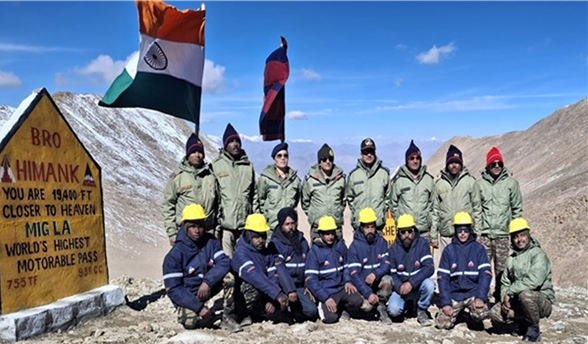
In Ladakh, BRO projects including Himank, Beacon, Vijayak, Deepak, and Yojak maintain lifelines across some of the world’s highest motorable terrain. The Srinagar–Leh Highway, Darbuk–Shyok–Daulat Beg Oldie Road, Atal Tunnel, and the ongoing Shinku La Tunnel ensure all-weather connectivity to Kargil, Leh, and the Karakoram sector. Project Vijayak alone has developed over 1,000 kilometres of roads and more than 80 major bridges, enabling swift movement even during extreme winters. The rapid reopening of Zoji La Pass on 1 April 2025, after a record winter closure of just 32 days, stands as a testament to BRO’s unmatched operational capability.
The organisation’s footprint across the Northeast—through projects like Swastik in Sikkim, Pushpak in Mizoram, Sewak in Nagaland and Manipur, and Setuk in Assam and Meghalaya—has strengthened regional connectivity while supporting national initiatives such as Act East and the Vibrant Villages Programme. In Sikkim, Project Swastik has developed over 1,000 kilometres of roads and built 80 major bridges, restoring damaged infrastructure even after floods and glacial lake outburst events.
BRO’s role extends to India’s western borders as well. In Jammu and Kashmir, Project Sampark’s construction of the 422.9-metre Devak Bridge has strengthened troop mobility and regional connectivity. In Rajasthan, Project Chetak enhances strategic movement across desert sectors. Meanwhile, Project Shivalik ensures uninterrupted access to the Char Dham Yatra routes in Uttarakhand, and Project Hirak extends connectivity into Left-Wing Extremism-affected areas of Chhattisgarh, demonstrating the organisation’s dual security-development mandate.
Beyond roads and bridges, BRO has delivered engineering landmarks of global significance. The Atal Tunnel under Rohtang Pass, at 9.02 kilometres and over 10,000 feet above sea level, has revolutionised Leh–Manali connectivity. The Sela Tunnel at 13,000 feet and the Shyok Tunnel on the DS-DBO axis ensure uninterrupted access in some of the harshest environments on earth.
BRO’s contribution to air power is equally strategic. The reconstruction of Bagdogra and Barrackpore airfields in West Bengal in 2023, at a cost exceeding ₹500 crore, has enhanced Indian Air Force readiness while supporting dual-use civilian connectivity in the eastern sector.
Yet, perhaps the most defining aspect of BRO’s identity lies in its role during disasters. Whether responding to the 2004 tsunami, earthquakes in Kashmir, flash floods in Ladakh, or cloudbursts in Uttarakhand, BRO’s Road Opening Parties and bridge units are often the first to restore access. From clearing snow at Zoji La, Rohtang, and Sela, to erecting Class-70 Bailey bridges within days, the organisation has repeatedly turned engineering into humanitarian action. The 200-foot Bailey bridge at Reini, built in just 26 days after the Rishiganga floods, aptly named the Bridge of Compassion, captures this ethos.
Internationally, BRO has been a quiet but effective instrument of India’s neighbourhood diplomacy. Project DANTAK in Bhutan, launched in 1961, has shaped the country’s modern connectivity, building roads, bridges, airports, and hydropower infrastructure. In Myanmar, the India-Myanmar Friendship Road strengthened regional integration. In Afghanistan, the Delaram–Zaranj Highway provided strategic access to Iran and Chabahar Port. In Tajikistan, BRO’s work at Farkhor and Ayni airbases expanded India’s strategic reach, reinforcing trust and cooperation.
Looking ahead, BRO’s vision is equally ambitious. Plans are underway for 470 roads spanning 27,300 kilometres, including the transformative Trans-Kashmir Connectivity Project, stretching from Poonch to Sonamarg with tunnels at Sadhna, Z Gali, P Gali, and Razdhan Pass. Once completed, this network will dramatically enhance inter-sector mobility, operational preparedness, and long-term regional integration.
For more than six decades, the Border Roads Organisation has demonstrated that national security does not begin at the border post, but at the first road leading to it. By connecting remote valleys to the heartland, enabling swift military response, and transforming the lives of border communities, BRO has built far more than infrastructure. It has built confidence, resilience, and unity.
In the toughest terrains, where maps end and resolve begins, the BRO continues to live by its timeless creed—finding a way, or making one.
The article is based on the inputs and background information provided by the Press Information Bureau (PIB) Author is Writer, Policy Commentator. He can be mailed at kcprmijk@gmail.com

Comments are closed.