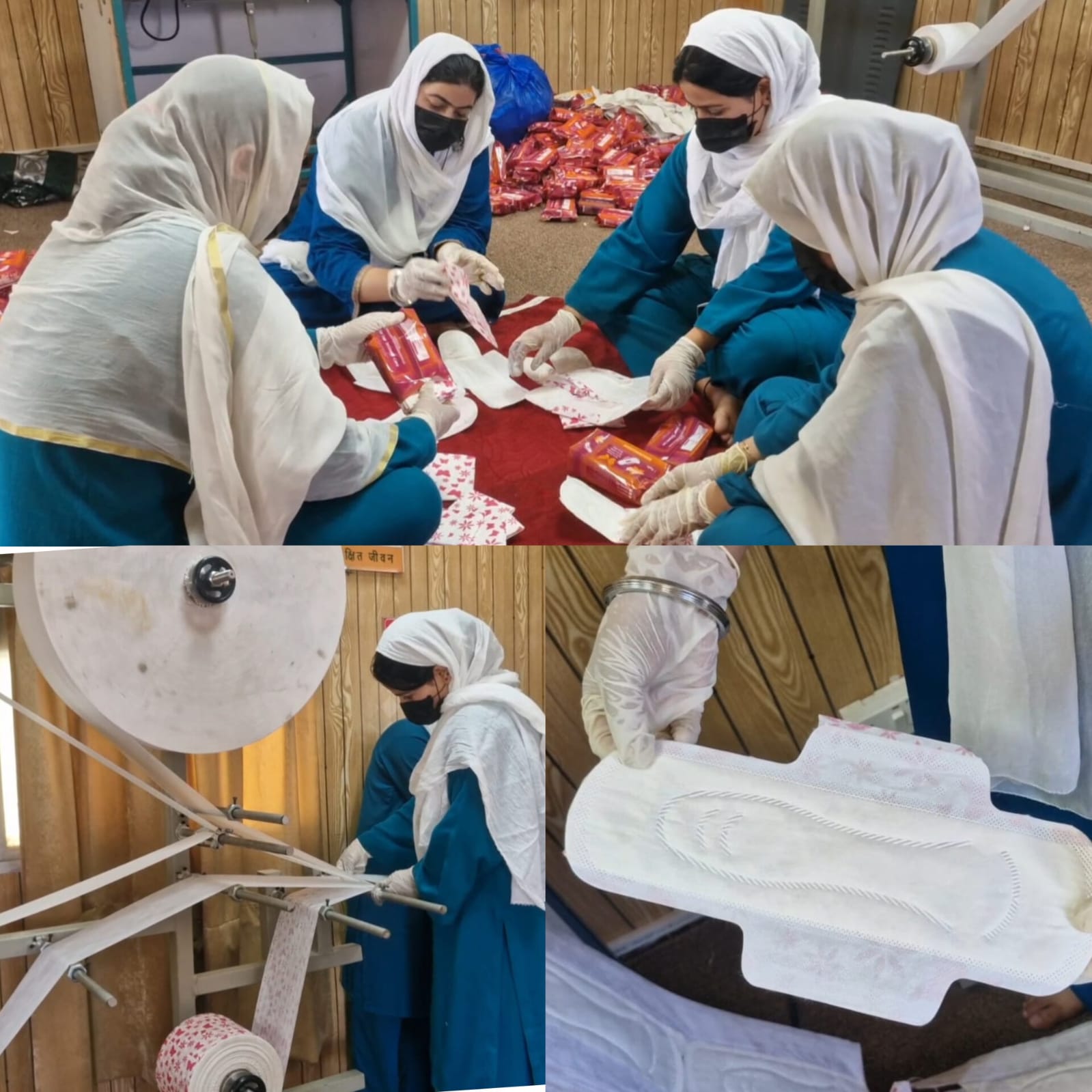
Bandipora, Aug 10: In a significant step towards women’s empowerment, menstrual hygiene awareness and livelihood generation, a group of young women from Bandipora has established a sanitary pad manufacturing unit near Army Goodwill School (AGS) Hajin with the support of the Indian Army’s Rashtriya Rifles unit.
The initiative seeks to promote menstrual hygiene by making quality sanitary products accessible to women and girls while creating livelihood opportunities for local women and encouraging them to become economically self-reliant.
Local girls and residents appreciated the initiative and expressed gratitude to the Indian Army for supporting the project. They said the Army has continued to support community-oriented initiatives aimed at youth empowerment, women’s welfare and local development.
Speaking to Kashmir Convener, Razia Farooq said she has been associated with sanitary pad manufacturing since 2022 and initially started the work from her home in Shahgund.
She said the initiative faced several challenges in its initial phase, but encouragement from the local community motivated the women involved to continue their efforts.
With support from the Indian Army, including the provision of necessary machinery and equipment, the unit has now been established near AGS Hajin, giving the women an opportunity to expand their work and develop a more sustainable livelihood.
Razia urged girls and young women who remain at home to come forward, acquire new skills and explore opportunities for self-employment.
“Women should come forward and take initiatives of their own, develop their skills and create opportunities not only for themselves but also for others,” she said, encouraging young women to start small ventures and work towards economic independence.
The initiative represents a promising example of how community participation and institutional support can come together to address menstrual hygiene concerns while creating avenues for women’s economic empowerment.
Beyond the production of sanitary pads, the project carries a wider message of dignity, awareness and self-reliance, particularly for women and girls in rural areas. It also highlights the potential of locally driven initiatives to create sustainable livelihood opportunities while addressing an important public health and social issue.


Comments are closed.