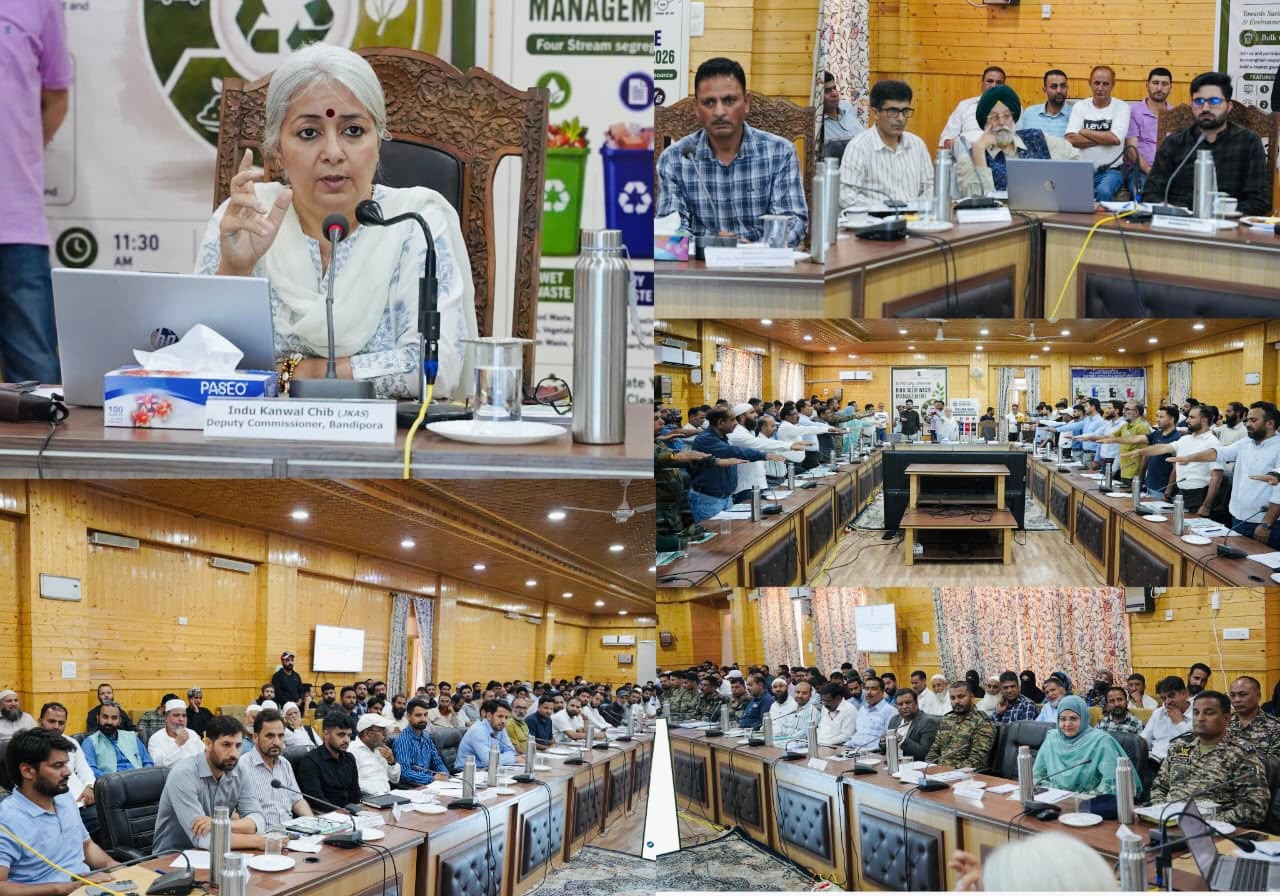
Bandipora, June 30: In a first-of-its-kind initiative aimed at strengthening scientific solid waste management, the District Administration Bandipora on Tuesday organised the district’s first-ever Bulk Waste Generators Convention, with Deputy Commissioner Indu Kanwal Chib chairing the event at the Conference Hall of the Mini Secretariat.
The convention brought together representatives from government departments, security forces, police, educational and healthcare institutions, hotels, restaurants, commercial and tourism establishments, religious institutions, public sector undertakings, the Municipal Council Bandipora, Municipal Committees Hajin and Sumbal, and other identified bulk waste generators to deliberate on scientific solid waste management.
Addressing the gathering, the Deputy Commissioner said scientific management of bulk solid waste is essential for protecting public health, preserving the environment and ensuring sustainable development.
She stressed the need for collective responsibility and coordinated action among government departments, urban local bodies, institutions, commercial establishments and all bulk waste generators.
She urged stakeholders to ensure segregation of waste at source, adopt sustainable waste management practices and comply with the Solid Waste Management Rules, stating that active participation by bulk waste generators would strengthen the district’s waste management system and contribute towards making Bandipora cleaner and greener.
The convention featured technical presentations by experts from various fields. Dr. Sameer Sharma, Founder of SWAHA Resource Management Company, spoke on the responsibilities of bulk waste generators, while environmental activist Raja Muzaffar highlighted the importance of environmental responsibility. Dr. Mudasir Ahmad Shah, an IITian and international expert on waste conversion technologies, presented the rural waste management ecosystem of Bandipora.
Dr. Sabeena Sultan, Scientist-C at the Pollution Control Committee, delivered a presentation on scientific and sustainable municipal solid waste management, while Zawar Kazim, Solid Waste Management Expert from the Directorate of Urban Local Bodies, Kashmir, discussed scientific waste management practices.
Prabjot Sodhi, Senior Programme Director (Circular Economy) at the Centre for Environment Education (CEE), spoke on sustainable circularity in plastics, emphasising circular economy principles, sustainable resource management, behavioural change and institutional collaboration for effective plastic waste management.
During his presentation, Sodhi also commended the Deputy Commissioner for transforming the Deputy Commissioner’s Office Complex into a green and sustainable workplace, describing it as a model of responsible governance and environmental stewardship.
Participants were sensitised on source segregation, recycling, composting, resource recovery, and scientific processing and disposal of waste. Interactive sessions focused on institutional mechanisms, compliance with the Solid Waste Management Rules and the promotion of sustainable waste management practices.
The Deputy Commissioner thanked all experts, stakeholders and citizens for their active participation and valuable contributions, expressing confidence that such collective efforts would help build a cleaner, greener and more sustainable Bandipora.
The convention concluded with participants pledging their support for scientific solid waste management and environmental conservation.
Among those present were Additional District Development Commissioner Nazir Ahmad Mir, Chief Planning Officer Mohammad Maqbool Lone, Assistant Commissioner Development, Assistant Commissioner Panchayat, Medical Superintendent District Hospital Bandipora, Chief Executive Officer of Municipal Council Bandipora, Executive Officers of Municipal Committees Hajin and Sumbal, Block Development Officers and other officers, besides representatives of the security forces, police and educational, healthcare, hospitality, commercial, religious and public sector institutions identified as bulk waste generators.


Comments are closed.