

Mohammad Noumaan Mir
“Despite its breathtaking beauty, cultural ethos of Ilm, Adab and Aab, and immense natural potential, Bandipora continues to struggle in healthcare, education, and basic infrastructure, raising serious questions about uneven development and governance.”
Situated on the banks of the majestic Wullar Lake, Bandipora, known for its incredible beauty, gateway to the breathtaking Gurez Valley, and cultural ethos of Ilm, Adab and Aab. Despite these features, Bandipora’s development raises serious concerns. Whether in healthcare, education sector or infrastructure, Bandipora struggles to keep pace with development. Though the district is full of potential, the uneven management seems to hold it back. From the so-called doctor-less hospitals to the crowded Gulshan Chowk, the management appears to lag behind everywhere. On the snowy days of Chill-e-Kalan, the authorities adopt a wait-and-watch approach, often taking numerous requests from social workers and the public to clear the snowy roads, creating widespread public inconvenience.
The District Hospital, a white elephant, boasts massive infrastructure but suffers from a severe shortage of doctors and equipment during emergencies. From the viral photos of dogs and cows resting at the main entrance of the hospital to everyday conflicts arising from doctors being absent during night shifts, the management seems exhausted from continuing to issue duty rosters that are rarely followed. The newly posted DC, Ms. Indu Kawal Chib, has introduced some strictness, but the patients continue to struggle with proper treatment and equipment at the District Hospital, Bandipora.
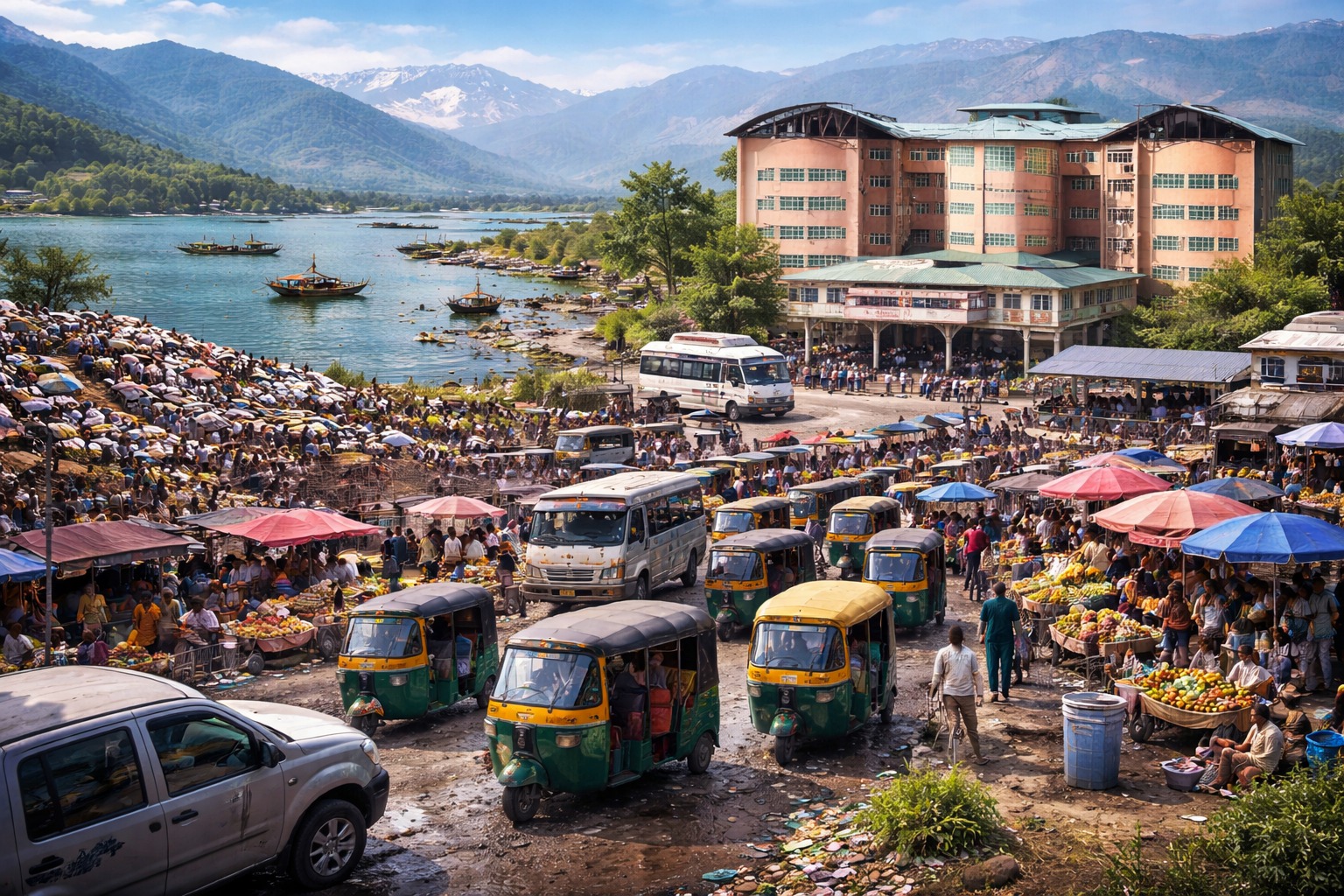
Gulshan Chowk, the main junction of the district, is mainly occupied by autos, buses, and nowadays e-rickshaws. Though a separate stand was provided by the administration, still the auto-drivers tend to operate from the main chowk only. Plan, just a few meters away from Gulshan Chowk, also feels full of autos, with drivers drifting their vehicles into every empty street or lane. The remaining space at Gulshan Chowk meant for pedestrians is occupied by hawkers and fish sellers. The municipal council workers tried to shift them away but failed to do so and were often seen destroying the carts of the hawkers instead of warning or fining them. On a positive note, the Bandipora Parking Project, which was accomplished recently, is expected to bring some relief to the chowk and the public once inaugurated, as it is expected to prevent the chowk from choking with traffic. To prevent traffic jams, the management installed road barriers in the main market a few years ago. However, hawkers and shopkeepers occupying the road with carts and display items made movement difficult; as a result, the barriers were removed.
In Khadim Market, the business lane of the town and the largest marketplace, mobility becomes a curse during peak hours as shopkeepers hang their products beyond their shops for display; due to this practice, nearly 60% of the road gets blocked, leaving everything in chaos.
Next to the gate of my house are two electricity poles: one old concrete pole with hollow roots and only a few iron rods supporting it, which is on the verge of collapsing and poses a serious risk to life and property nearby. Though a new pole was installed ages ago, the old one has not been demolished. Leaving it aside, during the harsh winters in Bandipora, heavy rainfall or strong winds can bring massive power cuts or on-field faults that take the concerned authorities a long time to rectify, leaving the citizens shivering in the cold.
The majestic Wullar Lake, once regarded among Asia’s largest freshwater lakes, now feels like a dumping site. Its dimensions stretch roughly around 16 km in length and 189–200 square kilometres in area. However, a study reveals that its open water area has shrunk by about one quarter between 2008 and 2019. Siltation and changes in agricultural practices are some of the reasons, but massive waste and plastic dumping and urban expansion are the main causes. Lakes, rivers, water bodies and forests are the bounties of nature, and having a lake like Wullar is a blessing. Yet its shrinkage is not something for which we can blame the management alone; it is something we, the residents of Bandipora, are equally responsible for, as we still need to learn to value such blessings.
The Municipal Council Bandipora has been trying to make people aware of waste segregation. Waste segregation is something through which we can contribute to the conservation of nature from our homes. The municipal council’s social media handles are full of videos from different institutions, with students and employees spreading awareness about the importance of waste segregation. The municipal vehicles that come to collect trash every morning in the town have separate compartments for dry and wet waste, so if we really wish to conserve natural bounties, we need to segregate waste from our homes today.
Another major issue in our district is the growing number of stray dogs on roads and streets, raising serious public safety concerns and making it difficult for parents to send their children out for daily movement.
In conclusion, the government has overall made significant progress over the past few decades, but there are still some concerning issues that need to be addressed. To transform Bandipora into a district of excellence, a few practical steps could be considered. At the District Hospital, necessary equipment should be made available, proper duty shifts should be assigned to all staff members, and strict action should be taken against those who violate their responsibilities. Electricity concerns should be addressed by appointing more dedicated field staff. Autos should be restricted from settling on streets and at the main chowk, and strict rules should be enforced to prevent unauthorised parking. Proper traffic management should be implemented to tackle congestion. Public awareness should be promoted about waste segregation, and Wullar Lake should be cleaned regularly.

Comments are closed.