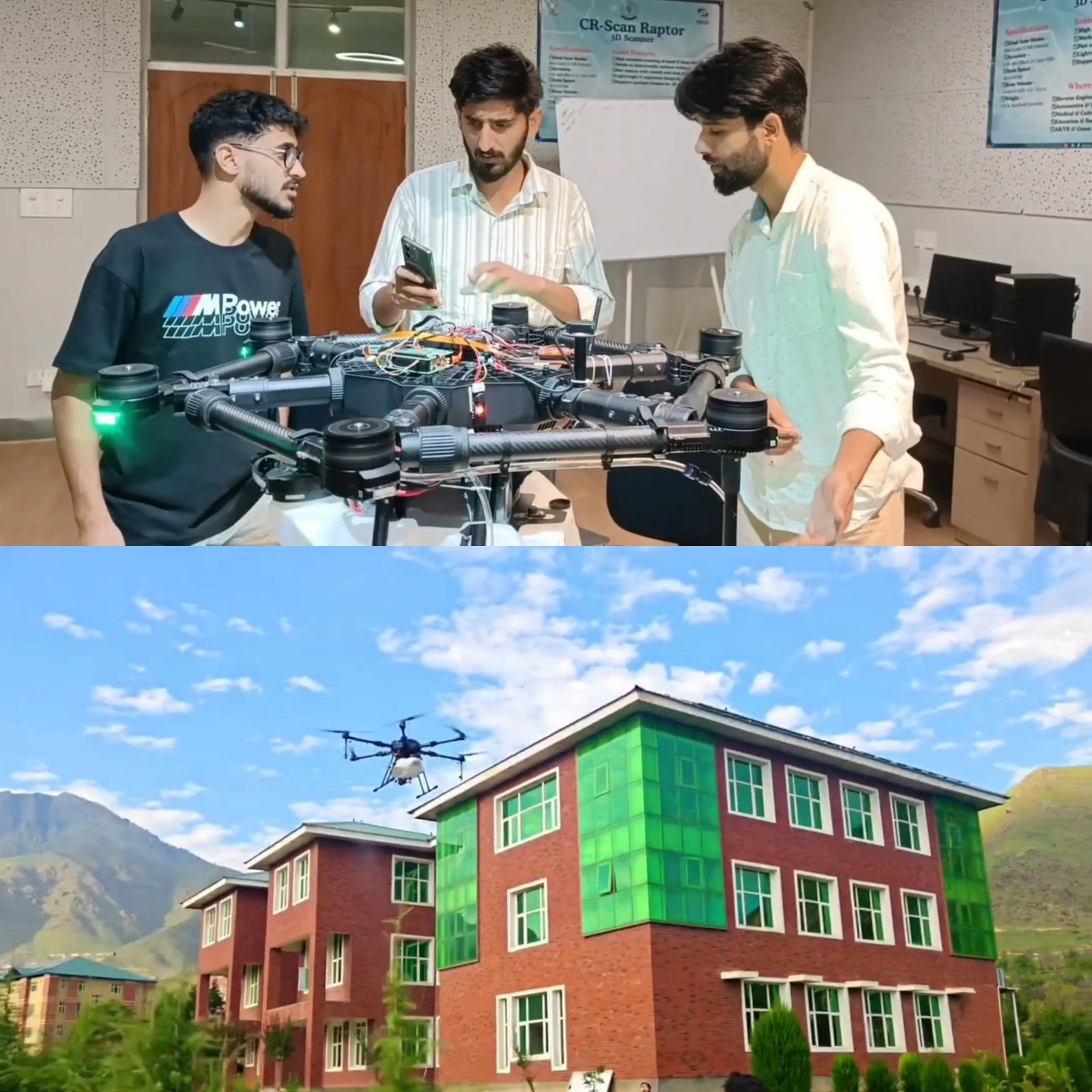
Awantipora, October 21: Three young innovators from Awantipora in south Kashmir’s Pulwama district have developed an Artificial Intelligence (AI)-powered drone designed to make pesticide spraying in agriculture and horticulture safer, more precise and efficient.
The drone is aimed at helping farmers, particularly apple orchard owners, reduce direct exposure to pesticides, minimise chemical wastage and improve crop-protection practices through targeted spraying.
The technology has been developed by Nouman Ijaz Bhat, Syed Arsalan Qazmi and Naveed Ahmad Dar, who have joined hands to apply modern technology to challenges faced by Kashmir’s agricultural and horticultural sectors.
Designed primarily for high-density apple orchards, the drone uses AI-based imaging to identify areas affected by plant diseases and spray pesticides only where treatment is required. The approach is intended to reduce unnecessary chemical use, save time and improve the efficiency of spraying operations.
Speaking to Kashmir Convener, Nouman Ijaz, a recent B.Tech graduate in Computer Science and Engineering from the Islamic University of Science and Technology (IUST), Awantipora, said the idea emerged from concerns over the health risks associated with conventional pesticide spraying.
He said the team began working on the project in January 2026 under the guidance of Dr Sajad Lone and later received seed funding from IUST through Parveez Sir, which helped them continue developing the agricultural spraying drone.
“We started working on this project in January 2026 under the guidance of Dr Sajad Lone, who guided us throughout the development process. Later, we received seed funding from IUST through Parveez Sir, which helped us continue our work on the agricultural spraying drone,” he said.
Nouman said the drone had been specifically designed for high-density apple orchards and incorporated AI technology to identify plant diseases and target pesticide application.
“The drone uses an AI model connected to a camera that scans high-density apple trees and identifies areas affected by disease. Instead of spraying the entire orchard, it sprays pesticides only on the affected plants or areas where treatment is needed,” he explained.
He said the technology offered two major advantages: reducing farmers’ direct exposure to harmful pesticides and limiting excessive chemical use and wastage.
“Under traditional spraying methods, farmers have to come into direct contact with pesticides, which can cause serious health problems. Moreover, a large quantity of chemicals is wasted during conventional spraying. In some cases, around 1,000 litres of spray may be required. With our drone, we aim to minimise this wastage by spraying only the quantity needed by the affected trees,” he said.
According to Nouman, the drone has been developed at an approximate cost of Rs 2 lakh, while its proposed selling price is Rs 3.5 lakh.
The drone is equipped with a 16,000 mAh battery, a 10-litre pesticide tank and a motor capable of emptying the tank in approximately two minutes, he said.
Nouman said the team’s primary objective was to make agricultural spraying safer and more efficient by reducing direct human contact with pesticides and ensuring that chemicals were applied only where necessary.
Another member of the team, Syed Arsalan, said the drone was also intended to address the health risks associated with pesticide exposure and the growing shortage of agricultural labour in Kashmir.
Speaking to Kashmir Convener, Arsalan said the drone operated through an application integrated with GPS technology, allowing operators to determine its location and identify the areas where spraying was required.
“Through the application, we can set the drone’s flight path, specify its take-off and landing points, and mark the locations where pesticides need to be sprayed. Once these details are entered into the application, the drone takes off, follows the designated route and sprays pesticides at the marked locations,” he said.
Arsalan said the technology could reduce direct human contact with pesticides and other potentially harmful chemicals, making spraying operations safer for farmers and orchard workers.
He also pointed to the shortage of agricultural labour in Kashmir, saying the drone could help reduce dependence on manual labour and improve the efficiency of orchard management.
“The drone will not only help minimise human exposure to harmful pesticides but will also address the shortage of labour in the agricultural sector. Along with improving the efficiency of spraying, it will help farmers carry out the process in a safer and more precise manner,” he added.
The innovation comes at a time when the adoption of modern technology is gaining momentum in agriculture, particularly in Kashmir, where horticulture plays a vital role in the region’s economy and provides livelihoods to thousands of families.
AI-powered drone technology could open new avenues for precision farming in the Valley by helping orchardists save time, optimise pesticide use and improve operational efficiency. Its potential benefits, however, will depend on its performance, safety and reliability under actual field conditions.
The initiative also highlights the role of local youth in developing technology-based solutions to practical challenges. By combining AI, imaging and GPS-guided operations, the three innovators are seeking to modernise conventional spraying practices and make crop protection more efficient for Kashmir’s farmers.


Comments are closed.