

Malik Mushtaq
“Alienation from mathematics is not just an academic weakness—it is a social risk that quietly limits opportunity, reasoning, and informed citizenship.”
In an era shaped by data, digital governance, and scientific innovation, alienation from mathematics poses a serious but often ignored threat to society. Mathematics is not merely a classroom subject; it is the intellectual backbone of modern civilization.
In India—and particularly in regions like Jammu & Kashmir—strengthening mathematical literacy is not just an educational concern but a social and developmental necessity.
India has a rich mathematical heritage that dates back thousands of years. From the concept of zero and the decimal system to early work in algebra, trigonometry, and astronomy, Indian mathematicians such as Aryabhata, Brahmagupta, Bhaskara, and later scholars made contributions that continue to influence global science.
Kashmir, too, has historically been a center of learning, where logic, astronomy, and mathematics flourished as part of a broader intellectual tradition. Alienation from mathematics today represents a painful disconnect from this legacy.
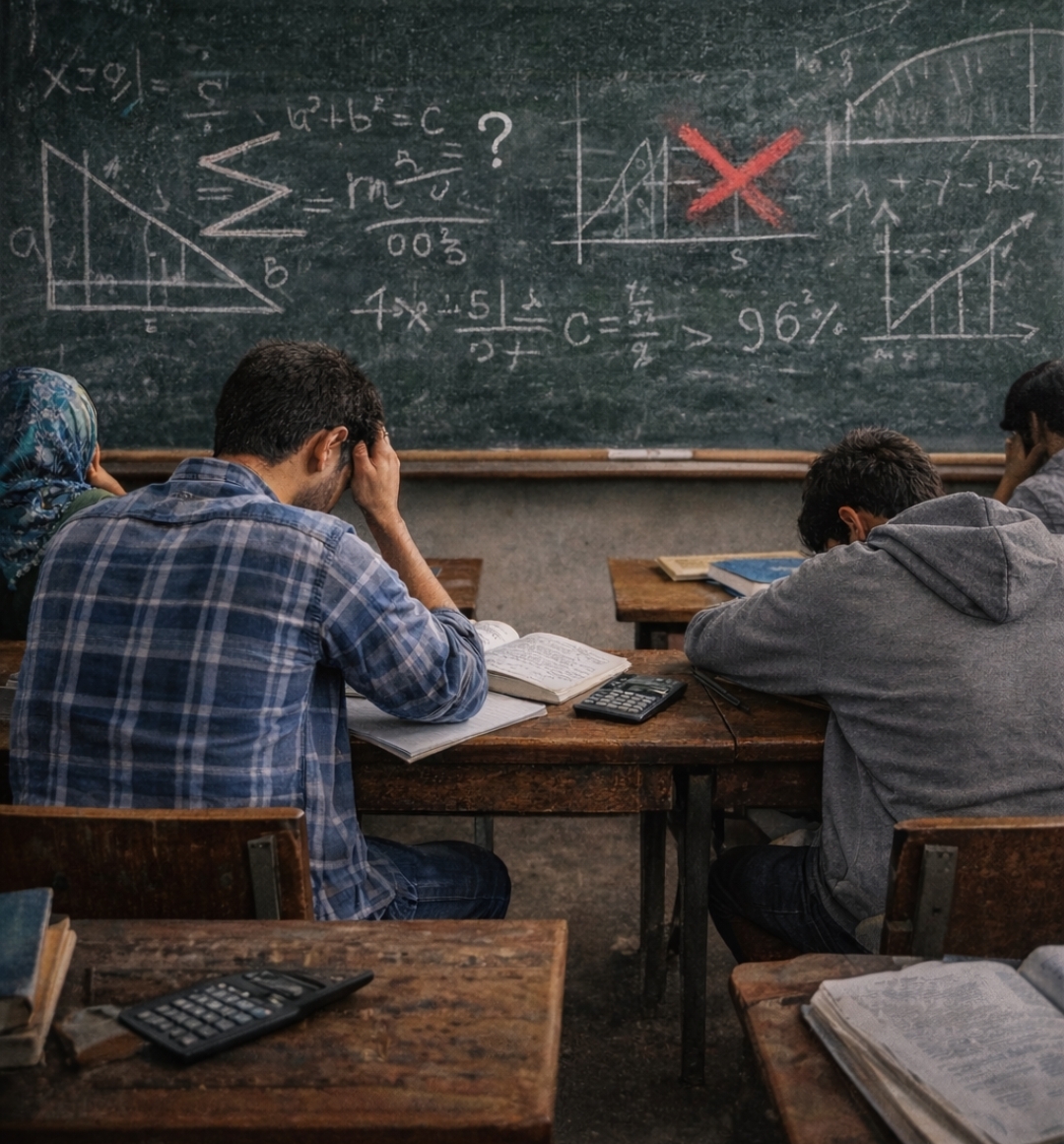
Despite this heritage, mathematics is increasingly viewed with fear and reluctance among students. This trend is visible across India, including Jammu & Kashmir, where many learners consider mathematics difficult, abstract, or irrelevant. Examination pressure, rote-based teaching, and lack of real-life application often turn mathematics into a source of anxiety rather than understanding. Statements like “math is not for everyone” or “arts students don’t need math” reinforce this divide and limit young minds.
The consequences of this alienation are far-reaching. In everyday life, mathematical understanding is essential for managing finances, understanding bank loans, interpreting government schemes, and evaluating employment opportunities.
For a region like Jammu & Kashmir—where youth aspirations, entrepreneurship, infrastructure development, and sustainable tourism are key to progress—numerical literacy is indispensable. Whether it is estimating project costs, understanding market trends, or analyzing data for development planning, mathematics plays a silent but decisive role.
At the national level, India’s push towards Digital India, Start-up India, financial inclusion, and data-driven governance depends heavily on mathematical competence. Citizens are increasingly expected to understand percentages, statistics, digital transactions, and data-based information. Without basic numeracy and logical reasoning, people become vulnerable to misinformation, financial exploitation, and poor decision-making—especially in rural and economically sensitive regions.
Mathematics is also central to science, technology, and employment. Fields such as engineering, medicine, information technology, artificial intelligence, climate science, and economics are all rooted in mathematical thinking. For the youth of Jammu & Kashmir, who are striving to compete at national and global levels, alienation from mathematics can close doors to emerging career opportunities. In a competitive job market, lack of mathematical skills often translates into limited choices and dependence.
Beyond careers and economics, mathematics nurtures critical thinking and rational judgment—qualities essential for a healthy democracy. In a country like India, where public discourse increasingly relies on data, graphs, surveys, and statistics, citizens must be able to interpret numbers intelligently. Mathematical illiteracy weakens public debate and reduces people to passive consumers of information rather than informed participants.
Addressing this challenge requires reimagining how mathematics is taught and perceived. The National Education Policy (NEP) 2020 rightly emphasizes numeracy, critical thinking, and experiential learning. In Jammu & Kashmir, contextualizing mathematics—linking it with local examples such as agriculture, trade, weather patterns, handicrafts, and infrastructure—can make learning meaningful and relatable. Teachers, parents, and institutions must work together to remove fear, encourage curiosity, and celebrate understanding over memorization.
Mathematics should be presented as a human and creative endeavor, not a mechanical exercise. When students see its relevance to real life and local development, alienation naturally gives way to engagement. Reviving interest in mathematics is not about producing mathematicians alone; it is about nurturing informed citizens capable of reasoning, planning, and contributing to society.
In conclusion, alienation from mathematics is indeed dangerous—especially for a developing nation like India and a region striving for stability and progress like Jammu & Kashmir. Mathematics is the silent force behind development, democracy, and dignity. Reconnecting society with mathematical thinking is not merely an educational reform; it is an investment in a more rational, resilient, and empowered future.

Comments are closed.