

S Ahmad
“India’s fisheries story is no longer just about nets and boats — it is about institutions, innovation and inclusion working together to power rural transformation.”
For decades, India’s fisheries sector existed in the margins of public policy discourse—visible in coastal villages and inland ponds, yet rarely recognised as a strategic driver of economic growth. Today, that perception has changed dramatically. Fisheries are no longer treated merely as a subsistence occupation or a traditional livelihood activity. They have emerged as a high-growth, technology-driven, export-oriented sector integral to India’s broader vision of agricultural diversification, rural prosperity, and blue economy expansion.
The transformation is not accidental. It is the result of sustained policy reform, institutional strengthening, digital integration, and unprecedented budgetary prioritisation over the past decade.
India now stands as the world’s second-largest fish-producing nation, contributing nearly 8 percent to global production. More significantly, fisheries account for approximately 7.43 percent of Agricultural Gross Value Added (GVA)—the highest among agriculture and allied sectors. The sector supports the livelihoods of nearly three crore people, including fishers, aquaculture farmers, processors, traders, exporters, and allied workers across coastal and inland regions.
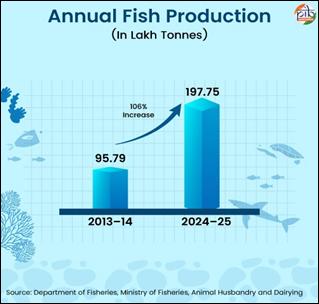
What makes this growth particularly noteworthy is its pace. Fish production has more than doubled—from 95.79 lakh tonnes in FY 2013–14 to 197.75 lakh tonnes in FY 2024–25—an increase of 106 percent. In parallel, seafood exports have expanded to ₹62,408 crore in FY 2024–25, with frozen shrimp leading the export basket and markets such as the United States and China driving demand.
These figures signal not just quantitative expansion but structural evolution.
Budgetary Commitment: A Sector Elevated to Strategic Priority
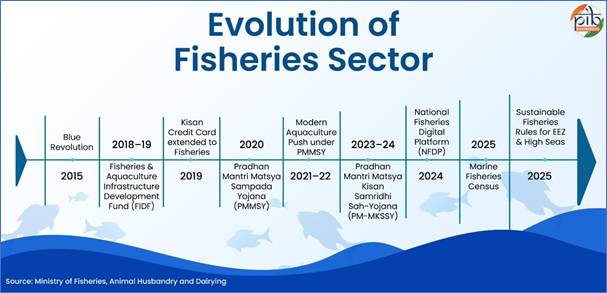
The Union Budget 2026–27 reflects the government’s recognition of fisheries as a strategic growth sector. With a record allocation of ₹2,761.80 crore—the highest ever annual outlay for fisheries—the message is clear: the blue economy is no longer peripheral to national development.
Of this, ₹2,530 crore has been earmarked for targeted schemes focused on infrastructure development, credit facilitation, insurance coverage, livelihood support, and technological modernisation. The flagship Pradhan Mantri Matsya Sampada Yojana (PMMSY) continues to anchor the sector with an allocation of ₹2,500 crore for 2026–27.
This financial prioritisation represents more than budgetary generosity. It signifies a shift from sporadic interventions to mission-mode governance—where fisheries development is approached holistically, integrating production, post-harvest management, digital systems, sustainability frameworks, and social security.
From Blue Revolution to Structural Reform
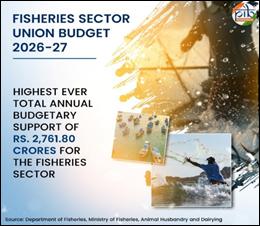
The modern trajectory of India’s fisheries transformation began with the Blue Revolution in 2015, which repositioned the sector within the national agricultural reform narrative. It emphasised productivity enhancement, infrastructure strengthening, and improved value chains.
Recognising that infrastructure gaps were constraining growth, the Fisheries and Aquaculture Infrastructure Development Fund (FIDF) was introduced in 2018–19. Fishing harbours, landing centres, cold storage units, processing facilities, and transport networks began receiving structured financial backing.
Financial inclusion followed. In 2019, the Kisan Credit Card (KCC) scheme was extended to fishers and aquaculture farmers, acknowledging that access to affordable institutional credit was critical for working capital, feed procurement, and input investments.
The launch of PMMSY in 2020 marked a turning point. Designed as an umbrella scheme, it aimed not only to boost production but to formalise and modernise the entire fisheries value chain. Subsequent initiatives—including the Pradhan Mantri Matsya Kisan Samridhi Sah-Yojana (PM-MKSSY) and the National Fisheries Digital Platform (NFDP)—deepened this transformation.
By 2025, the notification of Sustainable Fisheries Rules for the Exclusive Economic Zone (EEZ) and High Seas added a regulatory dimension aligned with international norms, reinforcing India’s commitment to responsible marine resource management.
PMMSY: Building the Value Chain from Pond to Port
Under PMMSY, development has moved beyond isolated subsidies toward comprehensive value-chain strengthening.
As of March 2026, approved interventions include:
-
23,285 hectares of pond area development
-
52,058 reservoir cages
-
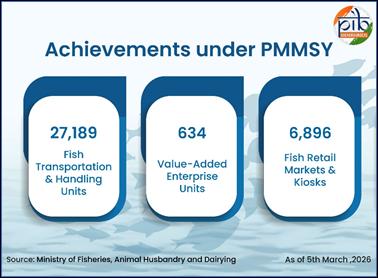
27,189 fish transport and handling units
-
634 value-addition enterprises such as ice plants and cold storages
-
6,896 retail markets and kiosks
This network of assets addresses one of the sector’s historical weaknesses: post-harvest losses. By improving cold-chain infrastructure and retail access, fish quality is preserved, farmer incomes rise, and consumer safety improves.
Importantly, these investments extend beyond coastal states to inland regions, recognising the untapped potential of reservoirs, ponds, and tanks across the country.
Technology and Sustainability: The Rise of Modern Aquaculture
Perhaps the most transformative shift is technological adoption.
Traditional aquaculture methods, though productive, often faced constraints related to water usage, disease management, and environmental stress. Modern systems such as Recirculatory Aquaculture Systems (RAS) and Bio-floc technology are addressing these limitations.
RAS systems filter and recycle water, enabling high-density fish farming with minimal water consumption. Bio-floc technology uses beneficial microbial communities to convert waste into feed nutrients, reducing input costs and environmental discharge.
So far, 12,081 RAS units worth ₹902.97 crore and 4,205 Bio-floc units worth ₹523.30 crore have been approved. These technologies are particularly attractive to young entrepreneurs who view fisheries not merely as a traditional livelihood but as an agri-startup opportunity.
By reducing water use, improving feed efficiency, and enhancing disease control, such systems align productivity with sustainability—ensuring growth does not compromise ecological balance.
Financial Inclusion and Risk Mitigation
Fisheries, by nature, carry inherent risks—weather disruptions, market volatility, disease outbreaks, and seasonal fishing bans.
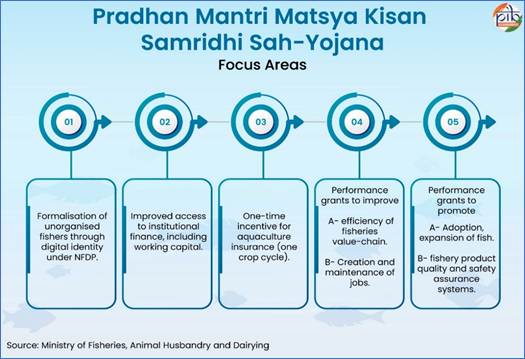
The PM-MKSSY scheme, operational from 2023–24 to 2026–27 with an outlay of ₹6,000 crore, addresses these vulnerabilities by promoting formalisation, insurance coverage, and quality assurance.
Approximately 4.39 lakh fishers have been brought under the KCC framework. Insurance coverage now extends to 3.3 million beneficiaries. Lean-period assistance supports an average of 7.44 lakh fisher families annually.
The enhancement of the KCC lending limit from ₹2 lakh to ₹5 lakh reflects a deeper understanding of capital requirements in modern aquaculture.
Meanwhile, FIDF has approved 225 projects worth ₹6,685.78 crore, creating safe landing facilities for over 8,100 vessels and benefiting more than 3.3 lakh stakeholders. The employment impact—nearly 2.5 lakh jobs—is substantial, particularly in coastal districts where alternative opportunities are limited.
Institutional Strength: Fisheries Farmer Producer Organisations
Formalisation has also progressed through the formation of 2,195 Fisheries Farmer Producer Organizations (FFPOs), backed by ₹544 crore in investment.
These organisations enhance bargaining power, enable bulk procurement of inputs, facilitate market access, and improve price realisation. By aggregating small producers, FFPOs reduce exploitation by intermediaries and encourage collective entrepreneurship.
In a sector traditionally fragmented and informal, this institutional consolidation marks a structural shift.
Digital Governance: The NFDP Revolution
Digitalisation has become the backbone of governance reform.
Launched in September 2024, the National Fisheries Digital Platform integrates credit, insurance, traceability, and incentive systems under a single digital interface. By March 2026, more than 30.60 lakh stakeholders had registered, with 12 banks integrated into the system.
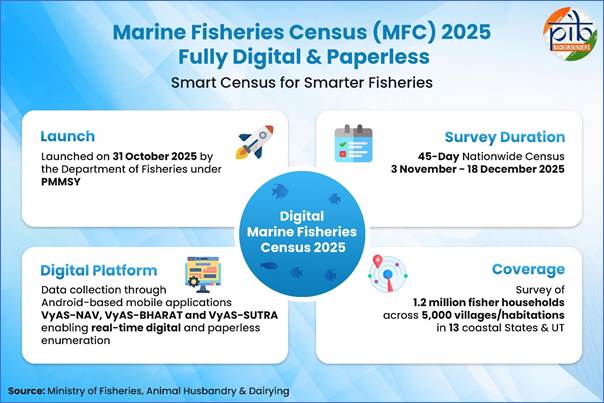
The Marine Fisheries Census 2025 further strengthened data-driven policymaking. Using geo-referenced mobile applications such as VyAS–NAV, VyAS–BHARAT, and VyAS–SUTRA, the census mapped fisher households in real time, capturing socio-economic indicators and scheme participation status.
For the first time, fisheries planning is anchored in verified digital data rather than fragmented estimates.
Unlocking Inland Reservoir Potential
India possesses 31.5 lakh hectares of reservoirs—many underutilised.
Under Mission Amrit Sarovar, 68,827 water bodies have been developed, with 1,222 integrated into fisheries activities. Plans to integrate 500 additional reservoirs promise to strengthen inland aquaculture.
Reservoir-based fisheries are particularly important for landlocked states, expanding income opportunities beyond coastal zones.
Marine Governance and Global Competitiveness
India’s coastline of 11,099 km and its 24 lakh square kilometre EEZ support more than 50 lakh members of the fishing community.
The Sustainable Harnessing Rules for the EEZ and High Seas (2025) bring regulatory clarity, aligning domestic practices with international maritime obligations. By granting duty-free status to certain catches landed abroad—while maintaining traceability safeguards—the government aims to enhance export competitiveness without compromising compliance.
The Marine Products Export Development Authority (MPEDA) continues to play a central role in ensuring quality certification and ecological responsibility in exports.
Employment, Inclusion and Rural Transformation
Beyond macroeconomic statistics, the sector’s real success lies in its human impact.
Since 2014–15, fisheries schemes have generated approximately 74.66 lakh direct and indirect employment opportunities. For coastal villages and inland districts, fisheries often represent the most viable non-farm employment option.
Women’s participation, particularly in processing, value addition, and marketing, is expanding. Youth engagement through technology-driven aquaculture is growing. The sector is gradually shedding its image as a subsistence activity and emerging as a structured enterprise ecosystem.
Aligning Growth with Sustainability
As global discourse increasingly focuses on climate resilience and sustainable resource use, India’s fisheries reforms align with Sustainable Development Goal 14—Life Below Water.
Responsible harvesting rules, digital traceability, infrastructure modernisation, and insurance coverage collectively build resilience against climate shocks and overexploitation.
Balancing ecological sustainability with economic growth remains an ongoing challenge. Yet the policy architecture now recognises that long-term prosperity depends on marine conservation and responsible aquaculture practices.
Conclusion: Toward a Mature Blue Economy
India’s fisheries transformation represents a rare convergence of economic ambition and social inclusion.
The record allocation in the Union Budget 2026–27 signals sustained political commitment. PMMSY and PM-MKSSY are formalising the value chain. NFDP is embedding transparency. Sustainable EEZ regulations are reinforcing ecological accountability.
What was once a fragmented livelihood sector is evolving into a modern, technology-enabled, globally competitive industry.
For millions of fishers and fish farmers, this shift means improved incomes, stronger social protection, access to credit, and greater dignity of work.
The journey is far from complete. Climate change, market volatility, and sustainability pressures remain real challenges. But the foundations of a resilient blue economy have been firmly laid.
India’s fisheries story is no longer just about nets and boats—it is about institutions, innovation, and inclusion working together to chart a sustainable course toward economic growth and community prosperity.

Comments are closed.